
Can Text Messages Be Used in Court? Admissibility, Explained
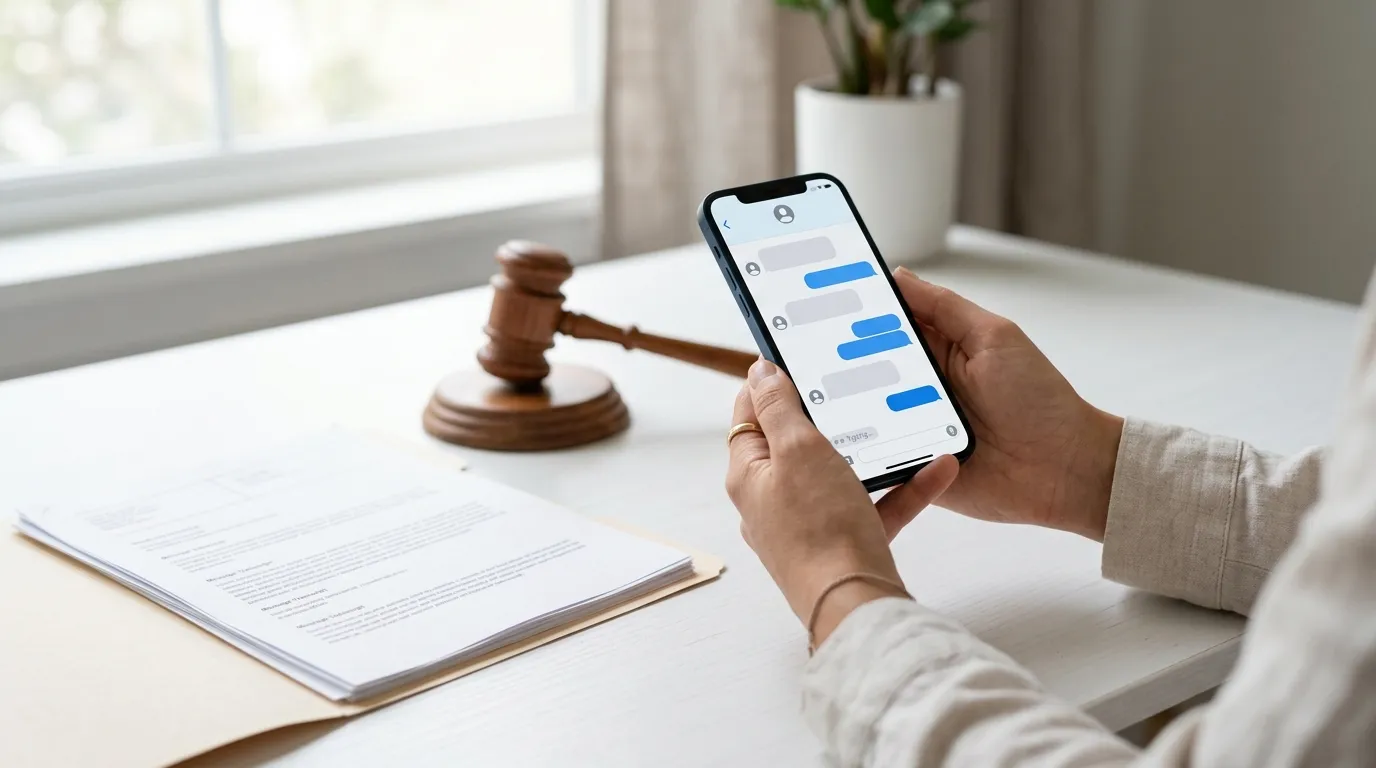
Yes — text messages are used in US courtrooms every day. They show up in custody hearings, divorce trials, small claims over money owed, and protective-order and harassment cases, and judges are thoroughly used to seeing them.
The real question is whether yours will be accepted. That comes down to two things: authentication (proving the messages are genuine and came from who you say) and presentation (handing the court a record it can trust and follow).
The trend is visible from both sides of the courtroom. In TextPort's national survey of 1,081 U.S. adults, fielded June 12–16, 2026, 38% said texts or DMs had been used in a legal, workplace, or other formal proceeding they were personally involved in. Among people who saved messages for a custody or co-parenting dispute, that figure was 74%. A separate survey by the American Academy of Matrimonial Lawyers found that 97% of leading divorce attorneys had seen an increase in smartphone evidence, with text messages the most common type. The lawyer survey tracks a professional trend; TextPort's newer consumer survey shows how often people encounter message evidence themselves.
There is also an expectation gap. In the TextPort survey, 65% believed a screenshot would be accepted as evidence in court or another formal proceeding. Acceptance still depends on authentication, context, and local rules, so belief is not a guarantee of admissibility. This guide walks through those requirements, how to present messages clearly, and the situations where texts matter most.
Are text messages admissible in court?
"Admissible" means a judge will allow the evidence to be considered. Text messages, like any evidence, generally have to clear four hurdles:
- Relevance. The messages have to relate directly to something at issue in the case. A judge won't spend time on an exchange that doesn't tend to prove or disprove a fact that matters.
- Authentication. You have to show the messages are what you claim: a real conversation between the people you say, not something fabricated or altered. This is the hurdle text evidence stumbles on most often, and the next section is entirely about clearing it.
- Hearsay. An out-of-court statement offered to prove the truth of what it says is generally barred, unless an exception applies. As you'll see, the other side's own texts usually aren't hearsay at all.
- Best-evidence rule. When the content of a writing is what's at issue, the court generally wants the "original." For digital messages, a duplicate, meaning an accurate export or printout, is typically treated as good as the original.
One caveat: evidence rules are set state by state, so exact rule numbers and wording vary. But nearly every state has modeled its rules on the Federal Rules of Evidence, so this framework applies in most US courts. Your county courthouse may still have a local twist — checking your specific court, or asking an attorney, genuinely pays off.
How to authenticate text messages
Authentication is where text evidence most often succeeds or fails. The core idea is simple: someone has to convince the judge the messages are genuine. In most cases that someone is you — a witness with personal knowledge of the conversation, testifying that these are the real messages, sent and received on your phone, involving the people you name.
Testimony alone isn't always enough, because a contact name doesn't prove who was on the other end. Courts fill that gap with circumstantial evidence — "confirming circumstances." Under FRE 901(b)(4), a judge can authenticate messages from their appearance, contents, substance, and surrounding context. What tends to satisfy a court:
- The phone number the messages came from, tied to the person you say sent them.
- How the sender identified themselves: signing off with their name, referencing their own life, or answering to it.
- The sender's writing style, nicknames, or turns of phrase.
- Content only that person would know: details about your shared history, plans, or private facts.
- The back-and-forth itself: replies that make sense only as answers to what you sent, in a conversation that clearly continued over time.
Courts have been explicit that a name on the screen isn't proof by itself. In Massachusetts, for example, Commonwealth v. Purdy and the Massachusetts Guide to Evidence §901(b)(11) reflect the principle that a party generally needs "confirming circumstances" beyond a display name before electronic messages come in.
The concern is straightforward: phones get shared, numbers get spoofed, accounts get borrowed. That a message appears to come from someone doesn't establish that they wrote it. Some version of that standard applies across US courts — which is why a little preparation up front saves you from an authentication fight in the middle of your hearing.
The practical upshot — to make authentication easy on yourself, your copies of the messages should show:
- The sender's actual phone number, not just a contact name you assigned in your phone. A judge has no way to know "Mike (Ex)" is really Mike.
- A date and time on every single message — not just at the top of a page — so the timeline is beyond dispute.
- Both sides of the exchange: your messages and theirs, so the conversation reads naturally.
- No gaps that look like cherry-picking: a continuous thread is far harder to challenge than a handful of clipped highlights.
TexasLawHelp publishes a plain-language sample authentication script that shows how a self-represented person can walk the court through these exact points. It's a useful template even if you're not in Texas.
Do text messages count as hearsay?
For text evidence, the hearsay answer is usually reassuring. Hearsay is an out-of-court statement offered to prove that what it says is true, and it's generally barred unless an exception applies. The key point: under FRE 801(d)(2), a statement made by an opposing party and offered against them is defined as not hearsay in the first place. So in most courts, the other side's own texts offered against them come in without a hearsay problem at all.
Your own texts are harder. Offered to prove their truth, they can run into the hearsay rule. But courts frequently admit them for a different purpose — to show context, notice or knowledge, or the effect the message had on the reader — rather than for the truth of what they say. Whether a specific message clears the bar depends on why you're offering it, which is a good question to put to an attorney.
Screenshots vs. a formatted transcript
A common worry is whether you need the physical phone in court. Usually not: under the best-evidence rule (FRE 1002 and 1003), duplicates are generally admissible to the same extent as originals, so an accurate export or printout is enough. That said, bring the phone to the hearing anyway. If a judge or opposing counsel wants to compare your printout against what's actually on the screen, having it there settles the question on the spot.
Screenshots are admissible, but they're fragile. Cropping to fit a message on screen often removes the timestamp. A contact name proves nothing about identity. And a loose pile of images practically invites the objection that you left out the parts that didn't help you. What attorneys ask for instead is a paginated, chronological record with the sender and a date and time on every message. That is the format a judge can flip through without wondering what's missing.
This is where an export tool earns its place. TextPort pulls your conversation straight out of iMessage — right on your iPhone, no computer needed — and turns it into a timestamped, text-searchable PDF where every message carries its sender and date/time. It also handles WhatsApp, Instagram, and other chat apps, which matters when the conversation happened somewhere other than plain SMS.
Keep the original conversation on your phone as well; it's your source if an export is ever questioned. The step-by-step for the courtroom version lives on the court-export guide.
Can you get text messages that aren't on your phone?
There's a persistent myth that you can subpoena the carrier and get someone's actual messages. Usually you can't. Carriers like Verizon, AT&T, and T-Mobile retain metadata — which number texted which, and when — but they generally don't store the content of messages, and whatever content exists is held only very briefly, if at all. A subpoena to the carrier can confirm that two numbers exchanged messages on a given date; it rarely produces the words themselves.
So where do the messages actually come from? Three real routes:
- A discovery request to the other party. In litigation, you can formally request that the other side produce the messages on their own device. This is the main mechanism for getting texts you don't have.
- Their backups. Messages preserved in an iCloud or device backup can surface even after they're deleted from the live conversation.
- Your own backups. Your phone, iCloud, or a local backup may hold copies you thought were gone.
A serious warning goes with all of this: once litigation is reasonably on the horizon, deleting texts is dangerous. Destroying evidence you had a duty to preserve — known as spoliation — can lead to sanctions and instructions that let the judge assume the deleted messages were bad for you. Expect the other side's copy of the conversation to surface anyway. Preserve everything; delete nothing.
How courts expect you to present text messages
Getting texts admitted is only half the job. Courts also have practical expectations for how you hand them over. Specifics vary, but self-help guidance from courts around the country is remarkably consistent on the basics:
- Print them, don't hand the judge your phone. Many courts explicitly want the evidence transferred off the device and onto paper or a filed exhibit. Illinois Legal Aid, for instance, walks through transferring evidence off the phone rather than passing around a device mid-hearing.
- Bring enough copies. Plan on multiple sets: one for the judge, one for the other party, and one for yourself. California's self-help guidance on preparing for a court date points to bringing three copies; Alaska's courts suggest four, with exhibit stickers attached.
- Label and exchange your exhibits. Mark each exhibit and share it with the other side by your court's deadline. Surprise evidence is often excluded.
- Keep timestamps and phone numbers visible on every page. Washington's family-law and protection-order guidance reinforces that the who and the when need to be readable throughout, not just at the top.
- Don't dump the whole thread, but keep the context. Curate down to what's relevant while preserving the surrounding exchange, so nothing looks cherry-picked. Utah even asks for a summary form when a text collection runs over ten pages.
If you're e-filing, exhibits generally must be text-searchable PDFs without password protection. That's the rule under systems used in states like Texas and California, and it's a good default to follow everywhere.
Many courts now accept — and sometimes require — exhibits through digital evidence portals with their own upload deadlines days before the hearing. Maricopa County family court, for example, uses a portal with a lead time of roughly seven days, and Los Angeles small claims runs closer to ten. Check your court's website as soon as you know you have a hearing; a great exhibit filed after the portal closes may not get in.
Presentation rules are hyper-local. The same PDF that sails through in one county may need a summary sheet, an exhibit sticker, or a portal upload in the next — so read your own court's instructions early.
Common situations
Text messages carry different weight depending on the kind of case. Here's how they tend to play out where people most often ask about them.
Child custody and family court
Family court sees more text evidence than almost any other venue, because so much co-parenting now happens by message. Texts document missed or refused exchanges, hostile or threatening language, admissions about a child's schedule or well-being, and the overall tone of how two parents deal with each other. Since custody turns on the child's best interests, a clean record of who actually cooperates — and who doesn't — can shift a ruling.
Capture and export the complete threads with the other parent, with numbers and timestamps intact, rather than the two or three lines that sting the most.
Divorce (including adultery and asset arguments)
In divorce, texts routinely prove adultery and surface hidden assets or a spouse's own damaging statements about money and conduct. Remember that discovery cuts both ways: your messages are as producible as your spouse's, so assume everything you sent could show up. Messages your spouse sent generally come in against them as their own statements.
Preserve full, dated conversations and let your attorney choose which exchanges help. A single line pulled out of a fight rarely lands the way you hope.
Small claims and money owed
Small claims runs on informal deals, and texts often are the contract. A message agreeing to repay a loan, confirming a price, or acknowledging a balance can carry a case where nothing was ever signed. What persuades the judge is the sequence: the request, the agreement, and the follow-through, in order and dated. Export the whole exchange that shows the deal being made, keep the other person's number visible, and bring copies. The small-claims evidence guide covers the format judges expect.
Protective and restraining orders
In protective-order cases, the messages themselves are frequently the central evidence: threats, harassment, unwanted contact, or violations of an existing order. Courts here care about a clear timeline and about content that shows a pattern, not a single incident. Volume and consistency matter. Capture every message in sequence, including the ones that establish escalation over time, and preserve the originals. The harassment-documentation guide walks through building that record.
Workplace and HR disputes
Texts also drive employment and HR matters — proving harassment, retaliation, a promised term, or who said what and when. Internal complaints and outside claims both lean on a documented trail, and messages between coworkers or with a manager can establish exactly that. Keep work-related exchanges intact and dated. Export the full conversation rather than a forwarded excerpt, which strips the metadata that makes it credible. The general legal-evidence guide covers preservation.
When to get professional help
For everyday civil matters like custody, small claims, harassment, landlord disputes, and employment, a clean, self-exported PDF is what people actually file, and courts routinely accept it. You generally don't need a forensic firm to use text messages in court.
The calculus changes when authenticity itself is genuinely in dispute — claims that the messages were fabricated, that someone was impersonated, or that a message was altered. In that situation a forensic extraction, which pulls messages directly from the device with a documented chain of custody, can be worth the cost. High-stakes matters and anything that turns on whether the messages are real deserve a conversation with a lawyer before you rely on a DIY export.
One thing to be clear about: TextPort is not a law firm, court reporter, or forensic service. Nothing in this article is legal advice, and no export, from any tool, is guaranteed to be admissible. Rules vary by state and by court, and admissibility is always the judge's call. Check your specific court's requirements or ask an attorney before you file.
The bottom line
Can text messages be used in court? Yes, they're admitted in courtrooms across the country every day. Whether your messages get in comes down to authenticating them and presenting them the way courts expect. If you do three things, you'll be in good shape:
- Export a complete, timestamped record. A paginated, chronological PDF with the sender and a date and time on every message: the whole thread, not clipped highlights.
- Label and copy it per your court's rules. Mark your exhibits, make enough copies (or upload to the digital portal), and keep numbers and timestamps visible throughout.
- File and serve by the deadline. Exchange exhibits with the other side and meet any portal cutoff, which may fall days before the hearing.
For the hands-on mechanics of producing that record from an iPhone, see the companion guide on how to print text messages for court.
Frequently asked questions
-
Yes, and family court is one of the most common places text messages show up. Judges routinely see them used to document missed exchanges, hostile or threatening communication, admissions about the child's care, and patterns of cooperation or the lack of it. Because custody rulings turn on the child's best interests, a clear timeline of how each parent actually communicates carries real weight. Bring the full back-and-forth, not isolated lines, with the other parent's phone number and a date and time on every message. The custody-evidence guide covers what to capture.
-
Yes. Texts routinely surface in divorce cases to prove adultery, hidden assets, or a spouse's own words about finances and conduct. Keep in mind that discovery runs both ways. Your texts are just as discoverable as your spouse's, so assume anything you sent may be produced. Messages the other spouse sent are generally admitted against them as their own statements. Preserve complete threads with timestamps rather than cropped highlights, and let your attorney decide which exchanges actually help your position.
-
Yes, texts are common evidence in small claims and debt disputes. A message where someone agrees to repay a loan, confirms a price, or acknowledges a balance can stand in for a written contract that was never signed. What makes the exchange persuasive is context: the ask, the agreement, and the follow-up, all in order and dated. Export the whole conversation showing the deal being made, keep the other person's phone number visible, and bring copies for the judge and the other party. See small-claims evidence for the format.
-
Generally yes, when they clearly show the sender's name or phone number, the recipient, and a timestamp on every message. Their weakness is fragility: cropping can strip timestamps, a contact name you assigned isn't proof of who actually sent the message, and a stack of loose images invites the argument that you left something out. A paginated, chronological export that stamps sender and date/time on each message is harder to challenge on those grounds, which is why many attorneys prefer it over a folder of screenshots.
-
Authentication means showing the messages are what you say they are. Usually a witness with knowledge (often you) testifies to your number, the other person's number, and how you know it's really them: their writing style, replies that fit the ongoing conversation, and details only they would know. Under FRE 901(b)(4), these "confirming circumstances" let a judge accept the messages even without the sender admitting they wrote them. A display name alone is rarely enough. TexasLawHelp publishes a sample authentication script you can adapt.
-
Partly. Carriers like Verizon, AT&T, and T-Mobile keep metadata (which numbers messaged which, and when) but generally not the content of the messages, and any content is held only very briefly if at all. So a subpoena to the carrier rarely produces the actual words. The real mechanism is discovery: a request served on the other party for the messages on their own device or backups. The messages live on the phones, which is where they usually come from in a dispute.
-
Sometimes. If a deleted message can be recovered from a phone backup, iCloud, or the other party's device, it can still be used. Deletion doesn't erase a message from everywhere it exists. More importantly, once a dispute is on the horizon, do not delete texts. Destroying evidence you should have preserved is called spoliation, and it can carry sanctions, an adverse-inference instruction, or worse. Assume the other side kept a copy of anything you sent.
-
Often not, when it matters most. The other party's own texts, offered against them, are generally treated as party-opponent statements under FRE 801(d)(2) and its state equivalents, which means they're not hearsay at all. Your own texts are harder to get in for their truth, but courts frequently admit them for a non-truth purpose, such as showing notice, context, or the effect on the reader. Whether a specific message clears the hearsay bar depends on why you're offering it, so ask your attorney.

Start exporting your messages
Available for iPhone, Mac, and Windows. No computer required.