MNDES: How to Submit Evidence in Minnesota Courts (2026 Guide)
MNDES, the Minnesota Digital Exhibit System, is the Minnesota Judicial Branch's website for submitting exhibits — documents, photos, and audio or video recordings — that you plan to offer as evidence at an evidentiary hearing or trial. If you just want the door: log in or register at the MNDES portal, or create an account with your legal name and an email address. The official information page lives at mncourts.gov.
If you have a hearing coming up and the evidence you need is sitting on your phone, keep going. This guide covers what MNDES is and is not, whether you have to use it, how to prepare and upload your exhibits (including text messages), how to share them with the other party, and what happens at the hearing.
What MNDES is (and what it is not)
Think of MNDES as the court's secure exhibit locker. You upload the documents, photos, and recordings you intend to offer at a contested evidentiary hearing or trial ahead of time; court staff can view them, and you can display them during the proceeding — nobody is fumbling with files in the courtroom.
Here is what trips people up. MNDES is not the system for court filings. Anything you file with the court — a motion, a petition, or a document with attachments as part of that filing — goes through the separate eFile and eServe (eFS) system, in person, or by mail. An attachment to a filing travels with the filing, not through MNDES.
MNDES is also not a discovery repository. Discovery materials — the information the parties exchange before trial — do not belong in MNDES unless a judicial officer specifically orders otherwise. Filings and discovery are one track; the exhibits you will hold up at the hearing are the MNDES track.
Is MNDES mandatory?
For most Minnesota district court cases, yes. A Minnesota Supreme Court order (No. ADM09-8010), filed August 30, 2024 and effective January 1, 2025, requires parties and attorneys to use MNDES for the submission of all electronic exhibits, including documents, photographs, audio files, and video files, in all district court cases statewide. The system ran as a pilot starting in 2021 before the mandate made it uniform.
There are a few important edges to that rule:
- Good-cause alternative. The presiding judge can permit an alternative submission method for good cause, but only if you make a direct request. It is a discretionary exception, not something you can assume.
- Sexual content exception. The order itself says exhibits that contain, or are alleged to contain, sexual content or nudity (including live hyperlinks to such content) must not be uploaded into MNDES. Those must be submitted by conventional means and brought to the hearing.
- Hennepin County caveat. If your case is in Hennepin County, contact court administration to ask whether you should use MNDES for your exhibits before you rely on it.
One more point of context: an advisory committee has recommended a permanent rule of general practice to govern digital exhibits, but it has not been adopted yet. The requirement currently rests on the Supreme Court order, not a standing rule.
Setting up: account, or no account
Registration is quick. Go to the MNDES portal, click Login/Register, and choose Sign up now (or register directly). The only information you need is your legal first and last name and a valid email address. You enter your email, receive a verification code, set a password, enter your name, and accept the registration terms.
A common snag: after you register, MNDES sends a confirmation email from [email protected]. It should arrive almost immediately, so if you do not see it, check your spam or junk folder. MNDES works in Chrome, Edge, and Safari, on a computer or a phone.
You do not strictly need your own account. Court administration staff can send you a link to submit an exhibit for a hearing without registering — though the judicial officer hearing your case may still order you to create an account.
No computer, printer, or scanner? LawHelpMN suggests using a public library or one of Minnesota's free Legal Kiosks, which have printers and scanners you can use at no cost. The statewide network is there specifically so that not owning a computer does not keep you from meeting the requirement.
Preparing your exhibits before you upload
A little preparation here saves you real trouble later. The single most important rule is one exhibit per file. Upload each exhibit as its own separate file so it appears on its own line in MNDES, and never combine different exhibits into one file.
The one exception cuts the other way: a document that runs several pages is still one exhibit and should be uploaded as one file. So a three-page letter is one exhibit, and three photos are three exhibits — four exhibits total.
Do not zip or compress your files. ZIP files are banned in MNDES, both because they can hide incompatible content and as a cybersecurity measure. Upload each file in its original format instead. You can upload files in different formats in the same session; you just cannot bundle them.
MNDES accepts the common formats you are likely to have, set by a State Court Administrator order effective June 1, 2024:
| Category | Accepted examples |
|---|---|
| Documents | .pdf, .doc, .docx, .rtf, .txt, .odt |
| Images | .jpg, .jpeg, .png, .heic (iPhone photos), .tif, .tiff, .bmp |
| Video | .mp4, .mov, .avi, .mkv, .wmv, .mpg |
| Audio | .mp3, .m4a, .wav, .aac, .flac |
Notably not accepted: .zip archives and executable files. If your file is in a format not on the accepted list and cannot be converted to one, contact court administration about submitting it as a physical exhibit instead.
Two more preparation habits worth building:
- Redact sensitive information. If a Social Security number or a financial account number is not needed for your case, black it out before you upload. Because you cannot edit a file after it is in MNDES, do this on the front end.
- Name and number carefully. Give each exhibit a plain, descriptive name so you can find it at a glance (for example, "picture of rear passenger door"). Add an exhibit number only if your judge's scheduling order tells you to. Otherwise, leave the number blank: MNDES assigns each file a permanent tracking number, and the official exhibit number gets assigned at the hearing.
Preparing text messages specifically
MNDES publishes no official guidance specific to text messages, so everything in this section is practical advice, not a court requirement. The goal is to hand the court a record it can trust and follow.
Screenshots are fine as far as format goes: .png, .jpg, and .heic are all accepted. The weakness is practical. A folder of dozens of loose screenshots is hard to describe in one line, awkward to display, and easy to attack as cherry-picked.
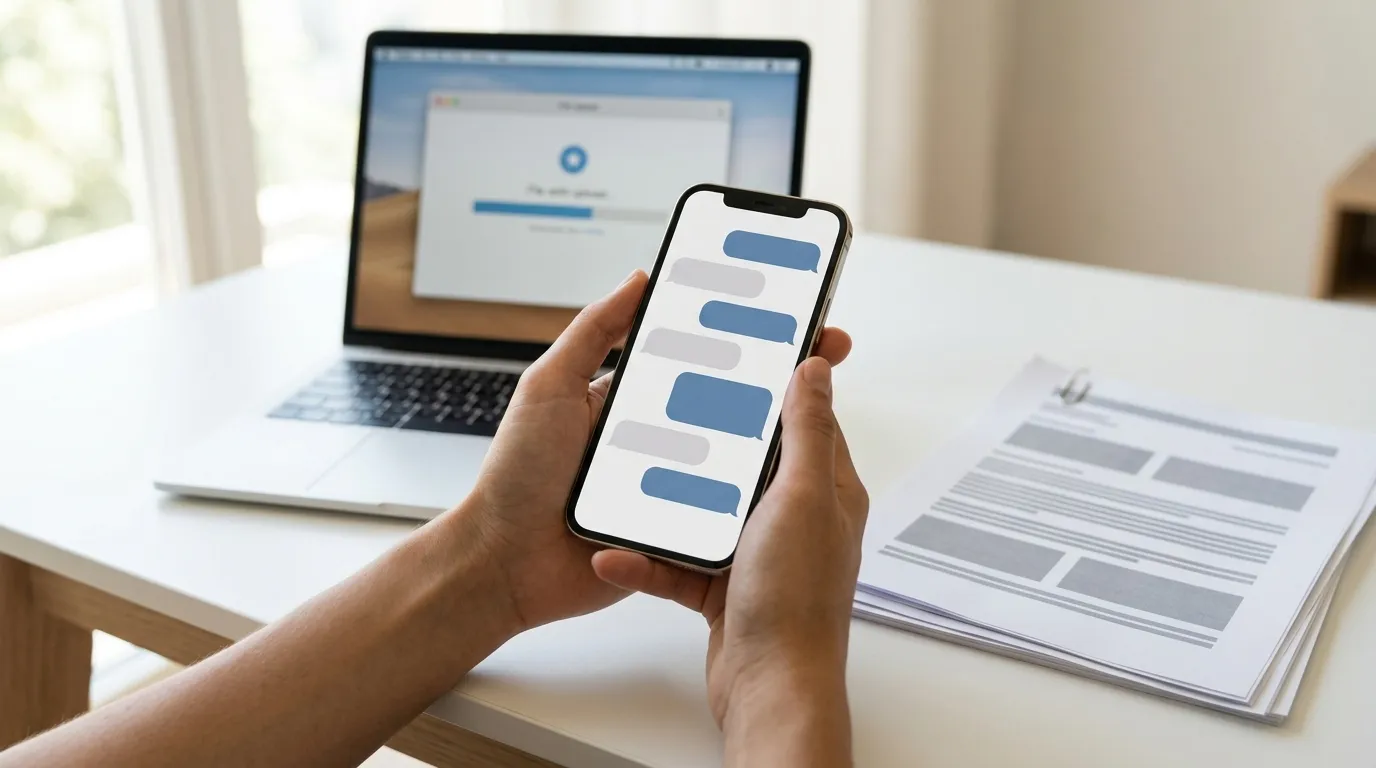
A single chronological PDF of the entire conversation avoids all of that. It reads as one continuous thread, it is simple to name and describe, and it satisfies the one-exhibit-per-file convention the natural way: one conversation is one exhibit is one file. Whatever you upload, make sure the sender and a date and time are visible on each message, and do not clip out the parts that do not help you.
This is where TextPort fits. TextPort pulls the conversation straight out of iMessage, right on your iPhone, and turns it into a timestamped, text-searchable PDF where every message carries its sender and date and time. It also handles WhatsApp, Instagram, and other chat apps. For the authentication side, meaning how you prove the messages are genuine and came from who you say, see the companion guide on whether text messages can be used in court.
Uploading, step by step
Once your files are ready, uploading is straightforward. Exhibits can be uploaded starting the first business day after your case is open.
- Find your case. Log in to the portal and search for your case using the case number. If you do not know it, check the top of any court paperwork you received.
- Add each exhibit as a separate file. Upload one file per exhibit (a multi-page document stays a single file). Repeat for each exhibit.
- Fill in the description. Write a plain, descriptive name so you can identify the exhibit later.
- Enter an exhibit number only if told to. Leave it blank unless your judge's scheduling order gives numbering instructions. Otherwise the system's tracking number is enough for now.
- Choose the exhibit type. Pick Document, Image, Video Recording, or Audio Recording from the drop-down.
- Choose your party affiliation. Select Plaintiff/Petitioner or Defendant/Respondent. If you are unsure, the top of your court paperwork should show which word follows your name.
You cannot edit the content of a file after it is uploaded — to correct an exhibit, upload a new, corrected version instead. If an exhibit is still in pre-hearing status (not yet offered to the court), you can submit a deletion request from the portal, which court staff review.
Finally, the court does not return digital exhibits, so keep your own copies on your device or in physical form.
Deadlines
There is no statewide upload deadline in MNDES. The Supreme Court order requires only that you submit your exhibits before the hearing or trial. Any specific cutoff comes from your judge's scheduling order, and you are responsible for reading and following it. Do not assume a deadline you heard for someone else's case applies to yours.
The practical advice is simple: upload early. Large video files take time to upload and process, spam filters swallow confirmation emails, and scheduling orders can set an earlier date than you expect. Uploading the day your exhibits are ready removes all of that risk.
Sharing exhibits with the other party
Uploading to MNDES does not automatically show your exhibits to the other side. Under the court rules you generally must share them, and that is a separate step you have to take.
The portal has a Shares feature for this. In broad strokes: click Shares in the navigation bar, choose Share By Me, create a new share, select the exhibits from your case, add the recipient as a contact (with their preference for a text or email link), and send it. The share link defaults to expiring one year from the date you create it, which you can adjust. An Exhibit Share can only contain exhibits from a single case, so sort by case number when you select.
If there is a no-contact order in your case, stop before you share directly. If an order for protection, a harassment restraining order, a domestic abuse no-contact order, or any similar order exists between you and the other party, follow the instructions in your hearing notice or court order about how to submit and share exhibits. If none are given, contact court administration to ask about a local process, and strongly consider talking to a lawyer so that sharing your exhibits does not accidentally violate the order.
What happens at the hearing
Uploading is preparation, not admission. Putting an exhibit in MNDES does not get it into evidence. At the hearing or trial you must still offer each exhibit, meaning you ask the judicial officer to admit it, and the court then decides whether it is admissible under the Rules of Evidence. Those rules apply to digital exhibits in MNDES exactly as they would to paper exhibits, so relevance, authentication, and hearsay all still matter.
What MNDES does for you at the hearing is let court staff view your exhibits and let you display them while you present your case. It streamlines the mechanics; it does not lower the evidentiary bar.
One note on privacy. Exhibits sitting in pre-hearing status, uploaded but not yet offered, are not publicly accessible without a court order. Once an exhibit is offered into evidence in a public case, it generally becomes publicly accessible unless a court orders otherwise. Keep that in mind when you decide what to upload and how thoroughly to redact.
Getting help
You do not have to figure this out alone. A few resources:
- MNDES Support Team. Call (651) 413-8160 if you are calling from area code 612, 651, 763, or 952, or (833) 707-2791 for all other callers. Hours are Monday through Friday, 8:30 a.m. to 4:15 p.m., excluding court holidays. You can also use the contact form on the mncourts.gov MNDES page.
- Statewide Self-Help Center. Call (651) 435-6535 for help with court forms, court process, and preparing for your day in court.
- LawHelpMN. The plain-language fact sheet Need to Upload Your Evidence for a Court Case? walks through MNDES step by step.
- Official guides. Quick reference guides and an exhibits overview live on the mncourts.gov exhibits page.
The bottom line
If you remember three things, you will be in good shape. First, prepare one clean file per exhibit: one conversation, one document, or one photo per file, in an accepted format, with sensitive information redacted. Second, upload early, so a large file or a scheduling-order deadline never catches you off guard. Third, share properly, using the Shares feature under the court rules, and following your hearing notice and court administration if a no-contact order is in play.
These procedures are current as of mid-2026. The official MNDES instructions and your judge's scheduling order control, so check them for anything specific to your case. Nothing here is legal advice. TextPort is not a law firm, court reporter, or forensic service, and no export from any tool is guaranteed to be admitted; admissibility is always the judge's call. Check your specific court's requirements or ask an attorney before you rely on any of this.
Frequently asked questions
-
MNDES stands for the Minnesota Digital Exhibit System. It is the Minnesota Judicial Branch's website for submitting exhibits (documents, photos, and audio or video recordings) that you intend to offer as evidence at an evidentiary hearing or trial in a district court case. You upload your exhibits before the hearing so court staff can view them and so you can display them in the courtroom. MNDES is not used for court filings, which go through the separate eFile and eServe system. You can log in or register at the MNDES portal.
-
Yes, for most district court cases. A Minnesota Supreme Court order (No. ADM09-8010), effective January 1, 2025, requires parties and attorneys statewide to submit all electronic exhibits through MNDES, unless the presiding judge allows another method for good cause on request. Exhibits containing sexual content or nudity must not be uploaded and are submitted by conventional means. If your case is in Hennepin County, contact court administration to confirm whether you should use MNDES. A permanent rule of general practice has been recommended but is not yet adopted, so the mandate currently rests on that order.
-
Go to the MNDES portal and click Login/Register. If you already have an account, sign in with your email and password. If you do not, choose Sign up now (or register directly) and follow the steps. Registration asks only for your legal first and last name and a valid email address. Watch for a confirmation email from [email protected], and check your spam folder if it does not arrive right away. You can reach the portal from a computer or a phone using Chrome, Edge, or Safari.
-
MNDES accepts common document, image, audio, and video formats set by a State Court Administrator order effective June 1, 2024. The list includes .pdf, .doc, .docx, .jpg, .jpeg, .png, .heic (iPhone photos), .tif, .txt, .rtf, and audio and video types like .mp3, .mp4, .mov, .wav, and .m4a. It does not accept .zip files or executables. The file size limit is 100 GB per file, so most exhibits upload without any size concern. If a file cannot be converted to an accepted type, ask court administration about submitting it as a physical exhibit.
-
MNDES has no official rule specific to text messages, so treat this as practical guidance rather than a court requirement. Screenshots in .png, .jpg, or .heic are accepted formats, but a single chronological PDF of the whole conversation is far easier to describe, label, and display, and it satisfies MNDES's one-exhibit-per-file convention naturally: one conversation is one exhibit is one file. Make sure the sender and a date and time are visible on each message, and do not cherry-pick fragments. See whether text messages can be used in court for the authentication side.
-
There is no statewide upload deadline. The Supreme Court order requires that you submit exhibits before the hearing or trial, and any specific deadline comes from your judge's scheduling order, which you are responsible for following. Exhibits can be uploaded starting the first business day after your case is open. As a practical matter, upload as soon as your exhibits are ready so a technical problem or a large video that takes time to process does not leave you scrambling right before the hearing.
-
No. Uploading an exhibit to MNDES does not get it into evidence. At the hearing or trial you must still offer each exhibit, meaning you ask the judicial officer to admit it, and the court decides whether it is admissible under the Rules of Evidence. Those rules apply to digital exhibits exactly as they do to paper ones. What uploading does is let court staff view your exhibits and let you display them during the hearing. Uploading early and correctly is preparation, not admission.
-
Usually, yes. Uploading to MNDES does not automatically show your exhibits to the other side. Under the court rules you generally must share them, and the portal has a Shares feature that sends a link by text or email. One critical exception: if there is an order for protection, a harassment restraining order, or another no-contact order between you and the other party, do not share directly. Follow the instructions in your hearing notice and contact court administration about how to submit and share exhibits without violating the order. Consider talking to a lawyer.

Start exporting your messages
Available for iPhone, Mac, and Windows. No computer required.