
USCIS Translation Requirements: Certified Translations, Explained
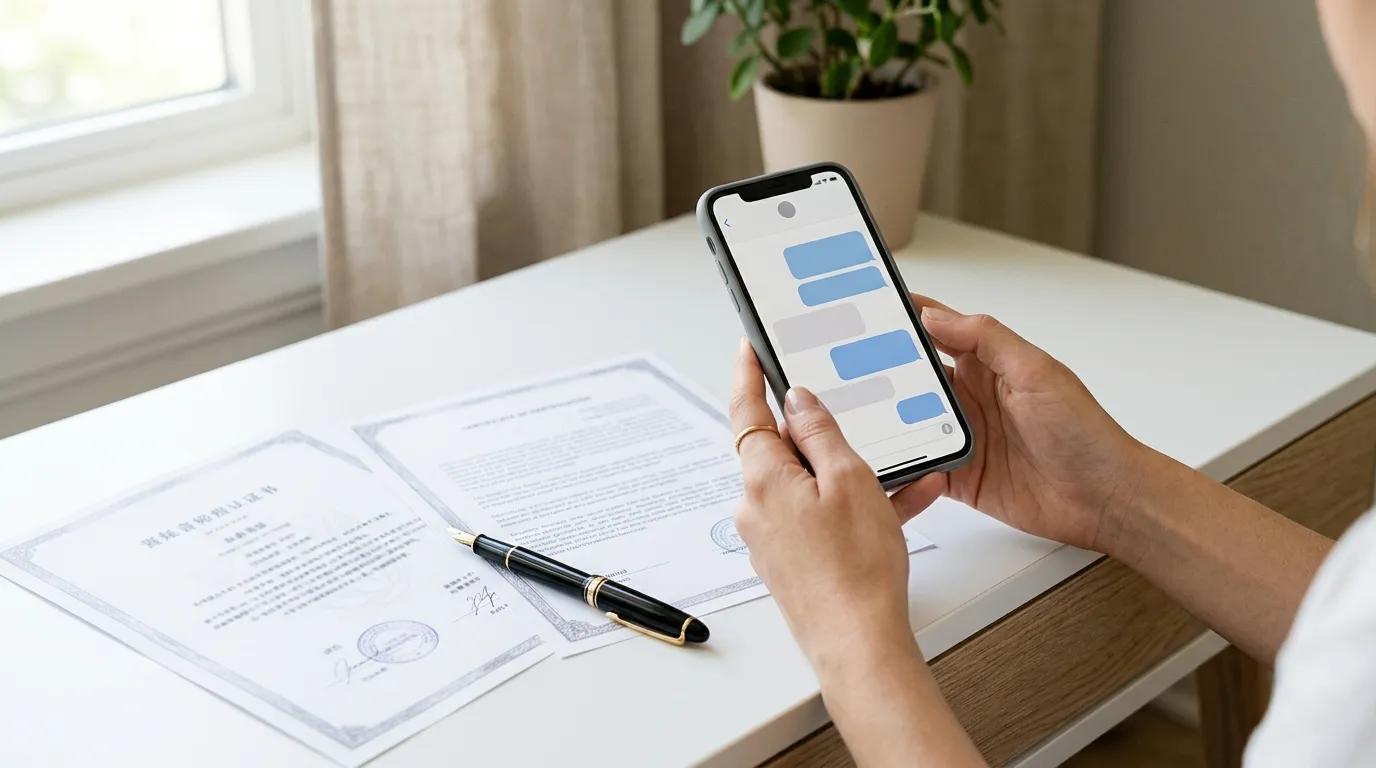
If you are submitting anything to USCIS in a language other than English, one rule governs all of it. It is short, it is specific, and once you understand it, most of the confusion around immigration translations goes away. Here is the rule verbatim, from 8 CFR 103.2(b)(3):
"Any document containing foreign language submitted to USCIS shall be accompanied by a full English language translation which the translator has certified as complete and accurate, and by the translator's certification that he or she is competent to translate from the foreign language into English."
You can read it yourself at eCFR. Everything else in this guide is an application of those two sentences: what a "certified translation" actually is, who can translate, what the certification must say, how to handle chat conversations, and how to file the result on paper or online. This is not legal advice or a substitute for your form's current instructions, but it will get you oriented fast.
Notice what the rule does not say. It does not name a licensing body. It does not require a credential, a stamp, or a fee paid to any agency. It does not distinguish between a birth certificate, a marriage record, a court document, or a text-message thread.
Its scope is deliberately broad — "any document containing foreign language" — and its bar is deliberately simple: a full English translation plus a translator's certification. Most of the mistakes people make with immigration translations come from imagining requirements that are not in that text.
What "certified translation" means at USCIS
The phrase "certified translation" trips a lot of people up, because it sounds like it points to a government credential or a licensed professional. It does not. At USCIS, a certified translation simply means a translation that comes with a signed certification statement from the translator. The "certification" is the statement, not a stamp from any agency.
That statement has to cover the two things the rule names: that the translation is complete and accurate, and that the translator is competent to translate from the foreign language into English. USCIS form instructions, including the I-130 and I-751 instructions, add four practical elements the certification should carry:
- The translator's signature.
- The translator's printed name.
- The signature date.
- The translator's contact information.
Put those together and you have a compliant certified translation: the English text, plus a signed block that makes the two required attestations and identifies who signed and when.
One point comes up constantly: the rule requires a certification and does not mention notarization. A translation does not have to be notarized to satisfy 8 CFR 103.2(b)(3). Notarization verifies a signer's identity, not the accuracy of a translation. You are free to notarize if you want the extra layer, but it is not a requirement.
The translation and the certification do different jobs. The translation is the English rendering of the source document. The certification is a short, signed statement that stands next to it and vouches for it: "complete and accurate" is about the work product (nothing dropped, summarized, or paraphrased away), while "competent to translate" is about the translator's ability in the language pair.
An officer reading your file wants to see both. A translation with no certification is not compliant no matter how good it is, and a certification attached to a partial or paraphrased translation does not cure the gap.
Who can translate documents for USCIS
The rule turns on two things: competence and a signed certification. It does not name credentials, licenses, or accreditation. So the honest answer to "who can translate documents for USCIS" is: any person competent in both languages who is willing to sign the certification.
In practice that includes a bilingual friend, a family member, or a professional translation company. All of them qualify under the same standard, as long as the person genuinely reads both languages well enough to produce a complete and accurate translation and will attest to it in writing.
Self-translation has a nuance. No published USCIS rule bars you from translating your own documents — the regulation asks for a competent translator who certifies the work, and it does not carve out the applicant.
Even so, filing-prep services and professional translators commonly advise against it. The reasoning is about credibility, not the letter of the rule: a translation signed by the person whose case depends on it is easier for an officer to second-guess, and any mistake becomes your mistake on a document you attested to. That advice is theirs, not a USCIS position, but it is consistent and worth weighing.
When should you use a professional? When the document is central to your case, when the language is technical or the handwriting is hard, or when your filing is contested and you want the translation to be beyond reproach. For a routine birth certificate a competent bilingual relative is often fine. For a heavily scrutinized filing, the cost of a professional service usually buys peace of mind.
A model certification block
Because the elements are fixed, you can write a certification that satisfies the rule in a couple of lines. Here is a model, consistent with the rule text and the elements listed in the form instructions. It is not an official USCIS form, and there is no required wording, only required content:
I, [name], certify that I am competent to translate from [language] into English, and that the above is a complete and accurate translation of the attached document.
Signature: ______________________ Printed name: [name] Date: [date] Contact information: [address, phone, or email]
That covers both attestations the regulation requires (competence, and a complete and accurate translation) and the four instruction elements (signature, printed name, date, contact information). Attach it to each translated document, or to a clearly labeled set. Adjust the wording as you like, so long as the two attestations and the four identifying elements are present.
Translating chat conversations
This is where a lot of relationship-based filers get stuck. A non-English WhatsApp, iMessage, or SMS thread is, for the rule's purposes, a document containing a foreign language. The same rule applies: whatever pages you submit need a full certified English translation.
Two consequences follow directly from that.
First, "full English language translation" means all of it. If you submit forty pages of Spanish or Tagalog or Arabic chat, all forty pages have to be translated and certified. This is the single strongest practical reason to sample rather than dump, which is also the standard advice from immigration attorneys.
A complete phone export can run past 300 pages, and translating all of them is expensive, slow, and pointless when a well-chosen sample makes the same point. Choose the exchanges that actually matter, over a span of time, with both names or numbers and dates visible, and translate that. The companion guide on printing WhatsApp chat history for USCIS walks through selecting and exporting that sample.
Second, presentation is a practical problem before it is a translation problem. A raw pile of screenshots is hard for a translator to work from and hard for an officer to follow. Export the conversation as a clean, numbered PDF first, so the translator works line by line from a stable document and the certified translation maps page-for-page to what you filed.
Tools like TextPort exist for exactly this step: it pulls the thread straight out of iMessage (and works with WhatsApp and other chat apps too) and turns it into a timestamped, paginated PDF where every message carries its sender and date — the kind of numbered record a translator (and later an officer) can rely on. For general chat exporting beyond the USCIS context, see how to export WhatsApp chats.
Working from a numbered export also makes the certification cleaner. The translator can certify a defined thing — "a complete and accurate translation of pages 1 through 12 of the attached conversation export" — which is far easier to stand behind than a certification loosely attached to a shuffled stack of images with no page order.
It protects you later, too. If an officer asks about a specific exchange, you can point to a page number in both the original export and its translation, and the two line up. Screenshots with cropped timestamps and no pagination give you none of that.
Filing the translation
Once the certified translation exists, filing it correctly is mechanical. The rules differ between paper and online.
On paper, USCIS wants everything single-sided on standard 8.5 x 11 inch pages, with no binders, photo albums, scrapbooks, or digital media (those get returned unprocessed). Copies must be legible, meaning not blurry, faded, skewed, or cut off. Black-and-white scans are acceptable. Keep the translation with its original document so the pairing is obvious. The current mailing rules live in the USCIS tips for filing by mail.
Online, through myUSCIS, upload the certified translation alongside the original foreign-language document, so the officer sees both together. Files are capped at 12MB each and must be PDF, JPG, or JPEG (some forms also accept TIF or TIFF). Do not encrypt or password-protect your files. Watch the format trap: iPhone screenshots save as PNG or HEIC, and neither is on the accepted online list, so a chat export needs to be a PDF or JPG before it uploads. The current format rules are in the USCIS tips for filing forms online.
Either way, the translation and the original travel together. A polished English translation with no source document behind it, or a foreign-language original with no translation attached, both invite a request for evidence and slow your case down. Keep each translated document paired with its certification and its source, label them clearly, and file the set as a unit.
Where translations come up in relationship cases
Translations surface most often in family and relationship filings, where foreign-language documents and chat histories are common. If you are assembling a K-1 fiance(e) petition, the practical role of communication evidence is covered in the K-1 visa proof of relationship guide. If you are documenting a marriage, whether for an I-130 or an I-751, the bona fide marriage evidence guide explains where translated messages and records fit into a filing.
The bottom line
USCIS translation requirements come down to one rule and a handful of practical elements. To stay on the right side of 8 CFR 103.2(b)(3):
- Submit a full English translation of every foreign-language document you file.
- Attach a certification stating the translation is complete and accurate and that the translator is competent, with the translator's signature, printed name, date, and contact information.
- Remember that notarization is not required, and that you can, but usually should not, translate your own documents.
- For chat threads, export a clean numbered PDF first, then translate a sample rather than the entire history, since every submitted page has to be translated.
- File the translation alongside the original, on 8.5 x 11 paper or as a 12MB PDF or JPG online.
One thing to be clear about: TextPort is not a law firm or an immigration service, and nothing here is legal advice. Translation and evidence rules change, and your specific form's instructions control. Always check the current USCIS instructions for your form, or ask an immigration attorney, before you file. This guide is accurate to the best of our understanding as of mid-2026.
Frequently asked questions
-
One regulation controls it: 8 CFR 103.2(b)(3). Any document containing a foreign language that you submit to USCIS must come with a full English translation, and the translator has to certify two things in writing: that the translation is complete and accurate, and that the translator is competent to translate from that language into English. USCIS form instructions (like the I-130 and I-751) add that the certification should include the translator's signature, printed name, signature date, and contact information. Read the rule at eCFR.
-
Any person competent in both languages who is willing to sign the certification. There is no requirement that the translator hold a license, a government credential, or an official accreditation. The rule at 8 CFR 103.2(b)(3) turns on competence and a signed certification, not on who the translator is. That means a bilingual friend, a relative, or a professional translation service all qualify, as long as the person genuinely reads both languages and certifies the work. For high-stakes or heavily contested filings, many people choose a professional service for credibility.
-
No. The rule at 8 CFR 103.2(b)(3) requires a translator's certification, and it does not mention notarization. The certification is a signed statement from the translator attesting that the translation is complete and accurate and that they are competent to translate the language. A notary does not verify translation accuracy anyway, only identity or a signature. You can have the certification notarized for extra formality, but nothing in the published USCIS requirement asks for it.
-
No published USCIS rule bars you from translating your own documents. The regulation only requires a competent translator who certifies the work, and it does not exclude the applicant. That said, filing-prep services and professional translators commonly advise against self-translation, because a translation signed by the interested party is easier for an officer to question on credibility grounds, and any error becomes your error. If the document matters to your case, having an independent competent translator certify it is the safer, widely recommended path.
-
The rule requires a full English translation of whatever foreign-language document you submit. So the translation has to cover everything on the pages you actually file, not a partial summary of them. It does not require you to translate documents you are not submitting. This is one reason to be selective about what you file: if you submit a 300-page chat export in another language, you have signed up to translate all 300 pages. A short, well-chosen sample means a shorter, cleaner certified translation.
-
It has to state two things from 8 CFR 103.2(b)(3): that the translation is complete and accurate, and that the translator is competent to translate from the foreign language into English. USCIS form instructions add four practical elements: the translator's signature, printed name, signature date, and contact information. A common model reads: "I, [name], certify that I am competent to translate from [language] into English, and that the above is a complete and accurate translation of the attached document," followed by the signature, printed name, date, and contact details. That is a model consistent with the requirements, not an official form.
-
A non-English WhatsApp, iMessage, or SMS thread is a document containing a foreign language, so whatever pages you submit need a full certified translation under 8 CFR 103.2(b)(3). The practical move is to export the conversation to a clean, numbered PDF first, then hand that readable record to your translator and key the translation to it. Because every submitted page must be translated, sample the exchanges that matter rather than dumping the entire history. See printing WhatsApp for USCIS for the export mechanics.
-
When you file through myUSCIS, upload the certified English translation alongside the original foreign-language document. Files max out at 12MB each and must be PDF, JPG, or JPEG (some forms also accept TIF or TIFF). Do not encrypt or password-protect files. One gotcha: iPhone screenshots save as PNG or HEIC, which are not on the accepted online list, so convert a chat export to PDF or JPG before uploading. See the USCIS online-filing tips for the current format rules.
Start exporting your messages
Available for iPhone, Mac, and Windows. No computer required.