
Are Text Messages Legally Binding? When a Text Is a Contract
Often, yes. A deal made by text can be as binding as one made on paper or face to face. Federal law says a contract can't be denied legal effect "solely because it is in electronic form," so a text is judged like any other agreement: a clear offer, a clear yes, something of value on each side, and terms definite enough to enforce. Texts fall short when they're still negotiation, when the deal is one the law requires in a signed writing, such as buying a house, or when only a court can make it official, such as changing child support.
People rely on texts for this constantly. In TextPort's Texting as Evidence 2026 survey, 30% of people who had saved or screenshotted messages as a record did it for a business deal, contract or client.
This is general information, not legal advice. Contract law is mostly state law, so the details depend on where you live.
What makes a text message a contract?
The same things that make anything a contract. Cornell Law School's legal dictionary lists the basics: "Mutual assent (offer and acceptance)," "Consideration (something of value is exchanged)," capacity, and a lawful purpose.
Courts judge agreement by what people said, not what they privately meant. "A meeting of the minds occurs even if one party subjectively did not agree, as long as both parties' outward expressions manifested assent," as the same dictionary puts it. So the question is how a reasonable person would read the thread.
Most everyday deals don't need any writing at all. California's official jury instructions say: "Oral contracts are just as valid as written contracts." For a loan to a friend, a repair job or a used couch, the texts usually aren't what makes the deal legal. They're the proof of it.
That's how it played out in Edinger v. Stillwaters Pool Co. (2025), which began in a Texas justice court, where small claims are heard, over a $2,171.87 pool cleaning bill. The appeals court noted that "Edinger and Calkins communicated both orally and in text messages about their agreement," and said the real question "was not whether there was a valid and enforceable contract between the parties but rather who had breached it."
Here's how courts tend to see some common exchanges:
| The texts | How courts tend to see it |
|---|---|
| "I'll sell you my car for $2,000." / "Deal. I'll pick it up Saturday." | Likely a contract: an offer, a clear yes and a price. |
| "Can you lend me $500? I'll pay you back by June." / "Sure," plus a payment app transfer | Likely a contract, and the transfer is strong proof. |
| "Would you take $1,800?" / "Let me think about it." | Not a contract. It's still negotiation. |
| "Sounds good, I'll send over the paperwork to sign." | It depends. Saying a formal document will follow can mean neither side meant to be bound yet. |
| "OK" or 👍 in reply to specific terms | It depends on context, including how the two of you have done business before. |
| One person texts "Starting next month the rent is $1,200." | Not a change to the deal unless the other side agrees. |
The last row comes from Lac v. Nguyen (2025), where a seller texted a buyer that he had only three months left to buy under a signed contract. A Texas appeals court enforced the original deal and noted that "a party cannot unilaterally modify a contract."
Texts that only show willingness to keep talking don't bind anyone either. In Pelt v. Benjamin (2021), a Tennessee court held that friendly texts about an expired home-sale offer "merely evidence a continued willingness on the part of Mr. Benjamin to deal with the Pelts."
Does "OK" or a thumbs-up count?
It can. What matters is whether, in context, it reads as a yes to specific terms.
"Ok." A California settlement fight shows how much context matters. In 2014, the Court of Appeal held that a man's typed name at the end of an email wasn't a signature for a fast-track procedure that requires signatures (J.B.B. Investment Partners v. Fair). But the case went on, and in 2019 the same court looked at the whole exchange, including his text, "I have accepted by phone and emai[l]," and his emailed "Ok." It agreed the communications "permit only one reasonable conclusion—the parties agreed to a binding settlement" (J.B.B. v. Fair, 2019).
"Sent from my iPhone." In Parish Transport v. Jordan Carriers (2021), a seller emailed "Ok. Let's do it." about a $1.25 million equipment sale, then took a higher offer the next day. Mississippi's Supreme Court held that an email exchange "can be a valid written contract," and that even the automatic "Sent from my iPhone" line could count as a signature if the sender meant to adopt it. That case involved email, but the reasoning is about electronic messages generally.
👍. The one U.S. decision we found is a New York trial court ruling, Lightstone RE v. Zinntex (2022). A man answered a payment plan with a thumbs-up minutes after saying he wouldn't sign anything, and the judge said that "even if such an electronic signature in the form of an emoji can create a valid contract, there still must be a meeting of the minds and an intent to be so bound." The plaintiff won on earlier emails instead. In Canada, a Saskatchewan court did hold that a farmer's 👍 accepted a flax contract in South West Terminal v. Achter Land & Cattle (2023), largely because he had confirmed earlier contracts by texting "looks good," "yup" and "ok" and then delivered. That's Canadian law, and it turned on that history.
The safe habit: if you mean yes, say yes, and restate the terms. If you don't mean to commit yet, say that too.
Which agreements need more than a text?
Every state has a "statute of frauds," a list of agreements that must be in writing and signed by the person you're holding to them. Cornell's dictionary says the most common are contracts "that involve the sale or transfer of land" and "contracts that cannot be completed within one year." Others typically include a promise to pay someone else's debt, agreements made in consideration of marriage, and, under the Uniform Commercial Code, a sale of goods "for the price of $500 or more" (UCC § 2-201). Each state's list differs a little.
Can a text be the signed writing?
Sometimes. Every state except New York has adopted the Uniform Electronic Transactions Act (New York has its own electronic signature law), and the uniform act says: "If a law requires a record to be in writing, an electronic record satisfies the law," and "If a law requires a signature, an electronic signature satisfies the law" (UETA § 7).
Two conditions do the real work:
- Both sides agreed to deal electronically. The act applies "only to transactions between parties each of which has agreed to conduct transactions by electronic means," judged "from the context and surrounding circumstances, including the parties' conduct." Two people who negotiated a deal by text will usually meet that.
- The sender meant to sign. An electronic signature has to be made "with the intent to sign the record" (15 U.S.C. § 7006). The act's official comment says including your name in an email "also may suffice," but "it also may be shown that the requisite intent was not present."
Real estate by text usually fails
Courts are cautious about land. In Loffredo v. Shapiro (2022), would-be buyers pointed to calls, texts and emails about a house, including the seller's text to his son that "looks like we've sold" it. Rhode Island's Supreme Court was "entirely unpersuaded" that the "mélange of telephone calls, text messages, and e-mail communications" was a signed memorandum.
You may read online that a Massachusetts court held a text sold a building. In St. John's Holdings v. Two Electronics (2016), the Land Court did find at an early stage that a broker's text signed "Tim" could satisfy the statute of frauds, according to the Boston Bar Journal. But after trial the buyer lost, because the broker had no authority to bind the seller, and the Appeals Court affirmed without deciding the text question.
Goods over $500 have an escape hatch
The $500 rule for goods doesn't block a deal that's already been carried out. Under UCC § 2-201(3)(c), the writing requirement doesn't apply "with respect to goods for which payment has been made and accepted or which have been received and accepted." If you paid and they took the money, or they delivered and you kept it, the texts help prove the terms.
What a text can't do on its own
Some legal results require a specific form, such as witnesses, a notary or a judge's signature. A text can be evidence of what people intended, but it can't produce the result by itself.
- Wills. Both the federal E-SIGN Act and the uniform act exclude wills, which have their own signing and witness rules. Some states now allow electronic wills under special procedures, but a casual text isn't one.
- Deeds. Washington, for example, says every deed "shall be in writing, signed by the party bound thereby, and acknowledged" (RCW 64.04.020), meaning before a notary or similar officer.
- Custody and child support changes. Parents can agree, but a judge makes it an order. California's court self-help site says of agreements in family cases: "A judge has to sign the agreement before it can be filed" (California Courts). For support, "a judge can only change the support amount as far back as the day you filed papers asking for a change" (California Courts). So "fine, pay me $300 less this month" doesn't change a support order.
- Some legal notices. E-SIGN doesn't cover notices of "default, acceleration, repossession, foreclosure, or eviction" for a person's primary residence, or utility shutoffs (15 U.S.C. § 7003). How those must be delivered is set by state law.
How to make a deal by text hold up
If you're agreeing to something by text that matters:
- Put the terms in one message. Who, what, how much, and when. "I'll pay you $1,500 for the 2014 Civic, cash, pickup Saturday the 12th" beats a scattered back-and-forth.
- Get a clear yes. Ask the other person to reply "Agreed" to the terms. A thumbs-up is more open to argument.
- Say what you mean about paperwork. If you're waiting on a signed contract, say "not final until we sign." If the text is the deal, don't promise paperwork you don't intend.
- Confirm changes the same way. A new price or date needs both people to agree, in writing.
- Keep the money trail. Payment app transfers, receipts and invoices show the deal was real.
- Save the whole conversation. Not just the message that helps you.
If it ends up in court, the judge will look at who sent the messages, what the terms were, whether there was a clear yes or just more negotiation, what each of you did afterwards, and whether either of you said nothing was final until signed. Proving who sent a message is its own step, covered in how to authenticate text messages for court.
Courts want the texts on paper, readable. The Massachusetts courts' Guide to Evidence says printed screenshots "should include relevant information from the image (e.g., sender's name, time, date, and the like)," and that "the mere possibility that digital evidence may have been altered affects the weight of the evidence and is not, without more, a reason to exclude it." For more on small claims, see text messages in small claims court.
Save the deal before it disappears
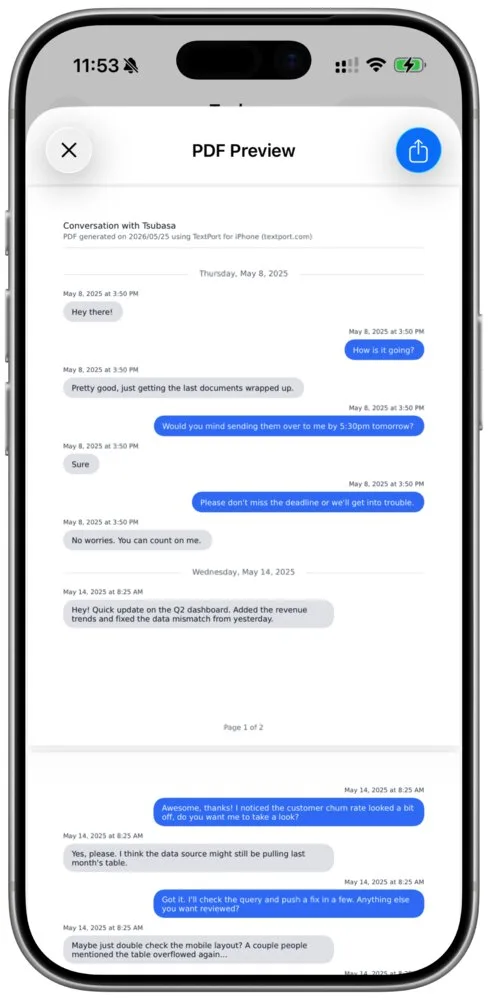
A deal made by text is only as good as your copy of it. Messages get deleted, phones get replaced, and iPhones can be set to delete old conversations automatically. TextPort saves a conversation from your iPhone as a PDF, with the sender's name and the date and time above every message, without a computer.
- iMessage and SMS come in through the TextPort Shortcut (iOS 26.4 or later), word for word, for the dates you pick. WhatsApp comes in from its Export Chat file.
- Marketplace chats, Instagram, Messenger and other apps come in from screenshots or a screen recording, which TextPort reads, so check the result against your phone before you export.
- The PDF can show each person's phone number next to their name, numbers every page, and prints cleanly for a judge or the other side.
TextPort doesn't make an agreement binding or decide what a court will accept. It gives you a clear, dated copy of what was actually said. Your first three chats import for free; exporting needs a subscription.
Frequently asked questions
-
Usually, if the agreement itself is one the law enforces without a signed writing. Most everyday deals are: California's official jury instructions say "oral contracts are just as valid as written contracts." The texts are then your proof of what was agreed. In a 2025 Texas case that began in small claims, a pool company won its unpaid bill partly on texts with the homeowner about their spoken agreement.
-
Yes. Small claims courts hear these cases all the time: unpaid loans to friends, deposits, repair jobs, sales between neighbors. Bring the whole conversation, printed, with the other person's number and a date and time on every message, plus any payment records. The judge will look for the terms, a clear yes, and what each of you did afterwards.
-
It can be, depending on the context. A Canadian court held a 👍 accepted a grain contract because the farmer had confirmed earlier contracts the same way. The one U.S. decision we found, from a New York trial court, treated a thumbs-up as a question of what the sender meant, especially since he had just said he wouldn't sign anything. If you mean yes, type yes.
-
Only if both agree, and sometimes not even then. One side can't change a deal alone, as a Texas appeals court noted when a seller tried to shorten a signed contract by text. Many leases also say changes must be in a signed writing. Legal notices such as eviction notices usually have to be delivered the way your state's law requires, and federal e-signature law doesn't cover them.
-
Not by themselves. Parents can agree, but a judge has to approve the agreement before it changes a court order. California's courts say a judge can only change support "as far back as the day you filed papers asking for a change." Texts about what you agreed are still useful evidence when you ask the court.

Start exporting your messages
Available for iPhone, Mac, and Windows. No computer required.