
How to Authenticate Text Messages for Court (With a Sample Script)
To authenticate text messages for court, someone who was in the conversation, usually you, testifies that the printout is an accurate copy of the messages and explains how they know who sent them. The explanation is the part people skip. "It came from her number" is a start; what convinces a judge is the number plus something more, such as replies that answer your own messages, details only that person would know, or a phone call in the middle of the exchange. In most cases you don't need a lawyer's certificate, the phone company or a forensic expert.
People tend to think the screenshot speaks for itself. In TextPort's Texting as Evidence 2026 survey of 1,081 U.S. adults, 65% believed a screenshot of a text would be accepted as evidence. It often is, but only after a witness tells the judge what it is and why it's genuine. This guide covers what that takes, with a script you can adapt.
This is general information, not legal advice. Each state has its own rules of evidence, and your judge decides what comes in.
What does it mean to authenticate a text message?
It means showing the judge that the messages are what you say they are. In the Federal Rules of Evidence, Rule 901(a) asks for "evidence sufficient to support a finding that the item is what the proponent claims it is." State rules use their own numbers, but the ones we checked, including Texas, Pennsylvania, Maryland and North Dakota, set the same test, and California's Evidence Code uses almost the same words.
For a text, that's two questions:
- Is this an accurate copy? The printout or screenshot matches the messages as they were sent and received.
- Who wrote it? The messages really came from the person you say sent them.
The bar is low. A federal judge in Maryland, in the most cited opinion on electronic evidence, wrote that you "need only make a prima facie showing" and called it "not a particularly high barrier to overcome." Once you clear it, any doubt about who wrote the messages goes to how much they're worth, not whether they come in. California's Supreme Court put it this way: conflicting inferences about authenticity go "to the document's weight as evidence, not its admissibility." In a custody or small claims hearing with no jury, the same judge does both jobs.
The same Maryland opinion has a line worth remembering: failing to authenticate evidence "almost always is a self-inflicted injury which can be avoided by thoughtful advance preparation."
Who can authenticate text messages?
You can, if you were in the conversation. Rule 901(b)(1) lists "testimony that an item is what it is claimed to be" by a witness with knowledge, and someone who sent and received the messages has that knowledge.
New York's highest court applied this to screenshots in People v. Rodriguez (2022). The victim's boyfriend had photographed the texts on her phone, and she had since deleted the messages and reset the phone. Her testimony was still enough: "the testimony of the victim—a participant in and witness to the conversations with defendant—sufficed to authenticate the screenshots." It didn't matter that she hadn't taken the pictures herself.
But you have to say how you know who sent them. In Smith v. State (2014), the woman who received the messages identified them as the defendant's, and Mississippi's Supreme Court held that wasn't enough, because the prosecution "utterly failed to provide any information as to the basis of her purported knowledge." Saying "he sent these" is a conclusion. The judge needs the reasons.
How do you prove who sent the texts?
This is where text evidence usually wins or loses. A phone number helps, but courts keep saying it isn't proof on its own, because phones get borrowed, shared and stolen. In Butler v. State (2015), Texas's highest criminal court compared a number to "a return address on a letter" and warned that a number alone "might be too tenuous."
A name on the screen proves even less. It's a label you typed into your own contacts, and a judge has no way to know that "Mike (Ex)" is Mike.
What fills the gap is ordinary detail from your life. Courts have accepted all of these:
| What ties the messages to the sender | Example | Where a court relied on it |
|---|---|---|
| Their number, and how you know it's theirs | They've called you from it for years, or gave it to you | Butler v. State (Texas, 2015) |
| A call or visit that matched | They called you in the middle of the exchange, or showed up where the text said they would | Butler; Commonwealth v. Amaral (Massachusetts, 2011) |
| Replies that answer your messages | You asked about Saturday's pickup and the reply gives the time | Federal Rule 901(b)(4) notes; California Evidence Code § 1420 |
| Things only they would know | A private detail of your history, or an event few people knew about yet | Sublet v. State (Maryland, 2015); California Evidence Code § 1421 |
| How they write | Nicknames, a signature, the same spelling mistakes | State v. Thompson (North Dakota, 2010); Commonwealth v. Gonsalves (Massachusetts, 2021) |
| They admit it | At the hearing, in a deposition, or in writing before trial | Tienda v. State (Texas, 2012) |
| Phone company records | A log showing messages between the two numbers at those times | People v. Rodriguez (New York, 2022) |
You don't need all of them. In Butler, three were enough: the defendant had called the witness from that number before, the threats fit only him, and "he actually called her from that same phone number during the course of that very text message exchange." In a Maryland case decided with Sublet, Facebook messages came in because they arrived soon after a stabbing "at a time when few people were aware of the incident," were written in the sender's first language, and apologized for "getting carried away by the anger."
Two states spell this out. Pennsylvania's Rule 901(b)(11), adopted in 2020, accepts ownership or control of a phone only "when corroborated by circumstances indicating authorship," and its comment adds that "the proponent of digital evidence is not required to prove that no one else could be the author." Massachusetts's Guide to Evidence § 901(b)(11) asks for "confirming circumstances" and says "neither expert testimony nor exclusive access is necessary."
What to say in court: a sample script
Here's how the questioning went in Butler, where a woman testified about threatening texts from her ex:
Q. How do you know that that is [Appellant's] telephone number?
A. Because that's where he called me from and that's what's on the same ... exhibit in front of me.
Q. How do you know that it was him?
A. Because he was the one texting me back and forth and he had even called in between the conversations talking mess.
It worked, but the court said it "could have" been "more explicit and less ambiguous." If you're representing yourself, you'll be the one saying it, usually without a lawyer asking the questions. TexasLawHelp publishes a sample script for this, and its key line is: "I know that the text message is from __________ (person) because it came from his/her phone number." The version below builds on it, adding the reasons courts have relied on. Fill in the brackets and practice it out loud.
- "Your Honor, I'd like to have this marked as Exhibit [number]. I've given a copy to [the other party]."
- "This is a printout of text messages between me and [name], from [first date] to [last date]."
- "I was in this conversation. These messages were sent from and received on my phone."
- "[Name]'s phone number is [number]. It appears on [where it shows on the printout]. I know it's [his/her] number because [he/she has called me from it since (year) / gave it to me / we've texted on it for (years)]."
- "I know these messages came from [name] and not someone else because [the reasons that fit: they answer what I asked; they mention (detail) that only [name] knew; [he/she] called me during this exchange; [he/she] showed up at (place) at (time), as the message said; [he/she] always calls me (nickname)]."
- "I made this printout on [date] from the messages on my phone. I compared it with my phone, and it's a fair and accurate copy. Nothing has been changed."
- "It shows the whole conversation for those dates." (Or, if you left part out: "I left out messages from [dates] about [topic]. I have them with me.")
- "The original messages are still on my phone, and I have the phone with me."
- "Your Honor, I offer Exhibit [number] into evidence."
The judge may interrupt with questions of their own, and some courts use different wording. Then be ready for objections. The other side's own messages offered against them generally aren't hearsay under Rule 801(d)(2), but authentication and hearsay are separate hurdles. Can Text Messages Be Used in Court? covers hearsay, and Do Text Messages Hold Up in Court? covers the other objections.
What to bring to the hearing
- Printed copies, not just your phone. Placer County Superior Court in California tells people seeking restraining orders to bring texts "in a form (for example: printed out) that can be marked as an exhibit and left with the court," because "the court will not be able to look at the item on your phone or computer." Bring a copy for the judge, the other side and yourself, unless your court says otherwise.
- The whole conversation for the dates that matter. Under Rule 106, if you show part of a conversation, the other side can require the rest. WashingtonLawHelp's protection order guide also warns that your screenshots "must show the date and time messages were sent or received and who sent them."
- Their number, on paper. A screenshot of their contact card or the conversation's details screen, with the number or email visible. Don't edit the exhibit itself to swap names for numbers.
- Your phone, with the original messages. A copy can be used like the original unless someone raises "a genuine question" about it (Rule 1003), and your phone is how that question gets settled. Check first whether your courthouse lets you bring a phone in.
- Your corroboration. Screenshots of the call log, your notes on how you know it's them, and any witness who saw them send a message or knows their number.
Get the other side to agree first
The easiest authentication is the one you don't have to argue. New York's Family Legal Care suggests: "Before the trial, you can ask the other party if they will agree to let certain evidence in."
In a regular civil case, you can also make it formal. California's court self-help guide says: "If there is a chance that it will be disputed who sent it, before trial you could use a request for admission to have the opposing party admit the genuineness of the correspondence." In federal court, Rule 36 treats a request as admitted if the other side doesn't answer within 30 days. State courts have their own versions and deadlines.
Small claims usually works differently. California, for example, doesn't allow pretrial discovery in small claims, so any admission happens at the hearing. Ask the judge to ask the other person whether they sent the messages. Many people simply say yes.
What if they say "I didn't send that"?
A denial doesn't automatically keep the messages out. If you've given the judge enough to support a finding, the judge can admit them and decide whom to believe. In Commonwealth v. Purdy (2011), Massachusetts's highest court held that a defendant's testimony that others used his computer and he didn't write the emails "was relevant to the weight, not the admissibility, of these messages."
So answer the denial with facts: the call during the exchange, the detail only they knew, the reply that only makes sense from them, the time they did exactly what the message said.
If the other side claims the messages were faked or edited, a forensic examination may come up. An examiner copies the phone's data and can certify that the copy matches the original. But the committee notes to Rule 902(14) are clear that such a certification doesn't settle who typed the words: the other side "can still challenge whether the information on the hard drive was placed there by the defendant." Forensic work costs real money, so if authenticity itself is the fight, talk to a lawyer before you decide.
Special cases
iMessages. Blue-bubble iMessages travel over the internet, not as carrier texts, so they don't appear in your phone company's records. AT&T's support page says iMessages "won't show in your text logs." Carrier records can't back up an iMessage exchange, so the content and context carry more weight. An iMessage can also come from an email address instead of a number. Then the question is how you know that address is theirs.
Edited and unsent iMessages. Apple lets a sender edit a message up to five times within 15 minutes, and "both of you can tap Edited to see previous versions." If a message you rely on shows "Edited," capture the earlier versions too. An unsent message leaves a note in both people's conversations.
Group chats. You need to tie each message you rely on to its sender. In Sublet, a Facebook conversation among seven people was kept out because the account holder testified others posted under her name and nothing on the page tied the key posts to her.
WhatsApp, Instagram and other apps. The same rule applies. Don't expect the app company to back you up: WhatsApp's privacy policy says delivered messages "are deleted from our servers." Your copy and your testimony are the evidence.
Deleted messages. In People v. Rodriguez, screenshots taken before the messages were deleted still came in. If you deleted something recently, Apple says you can recover messages "that you deleted within the last 30 to 40 days." Once a dispute starts, delete nothing.
Small claims and protection order hearings. Many courts relax the formal rules. Texas justice courts (small claims) don't apply the Rules of Evidence unless the judge decides one is needed for fairness, and Washington treats protection order cases as "special proceedings where the rules of evidence don't have to be followed as closely." The judge still has to believe the messages came from the other person, so prepare the same explanation.
Make a printout the judge can follow
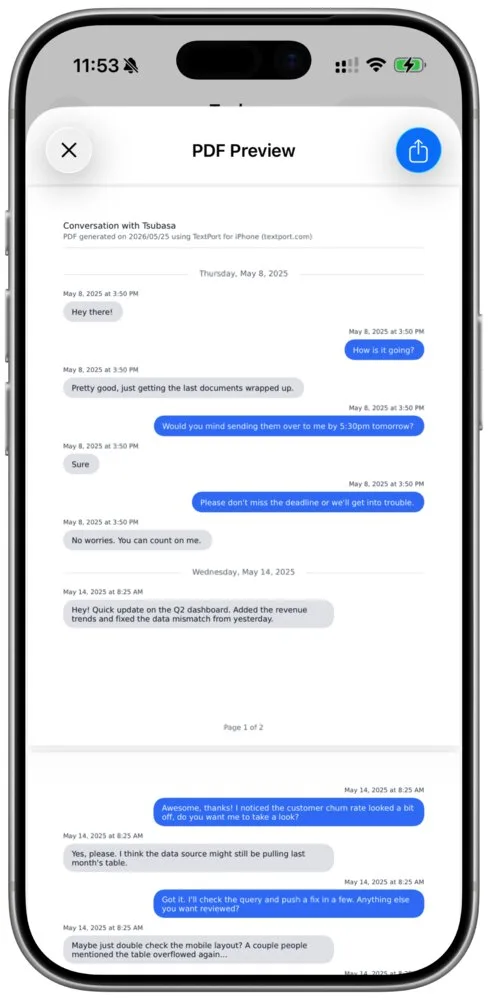
Authentication is easier when the exhibit itself answers the obvious questions: who sent each message, when, and what came before it. That's what TextPort makes on an iPhone, with no computer.
- iMessage and SMS come in through the TextPort Shortcut (iOS 26.4 or later), word for word with each message's own date and time. WhatsApp comes in from WhatsApp's own Export Chat file.
- Messenger, Instagram, Signal and other apps come in from screenshots or a screen recording. TextPort reads the messages from them, so check the imported chat against your phone and fix anything misread before you export.
- The PDF puts the sender's name and the date and time above every message, numbers every page, and can show each person's phone number next to their name. The guide to preparing messages for court walks through it.
Two cautions, because they matter on the stand. TextPort doesn't authenticate anything. It isn't a forensic or certification service, and no app's export is "court certified." You still testify that the printout is a fair and accurate copy, so compare it with your phone before the hearing. And keep the original conversation, and any screenshots you imported, on your phone until the case is over. They're what your printout gets checked against.
Your first three chats import for free; exporting needs a subscription. For the rest of the courtroom routine, see how to print text messages for court.
Frequently asked questions
-
Usually not. In most cases the person who received the messages authenticates them by testifying, and courts have said expert testimony isn't required. A forensic exam is for cases where the other side seriously claims the messages were faked or altered, or where deleted messages need recovering. Even then, a forensic copy shows the data wasn't changed, not who typed it. If that's your situation, talk to a lawyer.
-
Often not by itself. Texas's highest criminal court said a number alone "might be too tenuous," because phones get borrowed and shared. Pair the number with how you know it's theirs and something more: replies that answer your messages, details only they would know, or a call or visit that matched what the text said.
-
Yes, if you were in the conversation. In People v. Rodriguez (2022), New York's highest court held that the victim's testimony that screenshots "fairly and accurately represented" her texts was enough, even though her boyfriend had taken them and she had since deleted the messages.
-
A denial doesn't automatically keep the messages out. If you've given the judge enough to support a finding that they sent them, the judge can admit the messages and then decide whom to believe. Massachusetts's highest court called a defendant's claim that others used his computer "relevant to the weight, not the admissibility" of his emails. Bring your corroboration: call logs, a witness, and their own replies.
-
Only partly. A carrier's records show which numbers texted and when, not what was said, and federal law bars carriers from handing message content to other people. Records showing many texts between the two numbers can back up your testimony, as they did in People v. Rodriguez. iMessages don't appear in carrier text logs at all. See can text messages be subpoenaed for what records you can get.
-
No. No app makes a certified or self-authenticating copy, TextPort included. TextPort makes a clear, dated PDF of the conversation that is easy for a judge to read. You still authenticate it the usual way: by testifying that it's an accurate copy of the messages on your phone and explaining how you know who sent them.

Start exporting your messages
Available for iPhone, Mac, and Windows. No computer required.