
Do Text Messages Hold Up in Court? What Gets Them Thrown Out
Usually, yes. Courts admit text messages every day, and the bar for getting them in is low. When texts don't hold up, it's almost always for one of a few reasons: nobody can show who sent them, the printout is missing phone numbers or dates, the original was deleted, the messages were faked, or they reached the judge too late or in the wrong form. And getting texts admitted is only half of it. Once they're in, the judge decides how much they prove.
Here's what that looks like when it goes wrong. In 2020, a Florida appeals court threw out a stalking injunction in Walker v. Harley-Anderson because the threatening texts, "the sole evidence to support the entry of the injunction," were never properly authenticated. The phone numbers on the texts didn't match the number on the respondent's phone bill, some pages showed "only a day of the week and time, no origination phone number," and the woman who received them didn't even testify that she recognized the sender's number. The respondent represented herself and won by objecting and bringing her phone records.
This guide covers each way text evidence fails, how to avoid it, and, if texts are being used against you, what you can do about them. It's general information, not legal advice. Your state's rules and your judge have the final word.
Getting texts admitted is the easy part
To get a text message admitted, someone has to offer "evidence sufficient to support a finding" that it is what they say it is (Rule 901(a) of the Federal Rules of Evidence, which state rules generally follow). That's a low bar, and many of the courts people bring texts to lower it further. Washington lets judges in protection order hearings skip most evidence rules (RCW 7.105.200), and Texas justice courts, where small claims are heard, don't apply the Rules of Evidence unless the judge decides one is needed to keep things fair.
Admission isn't the finish line. The leading federal opinion on electronic evidence stresses "a distinction between the admissibility of evidence, and the weight to which it is entitled in the eyes of the fact finder" (Lorraine v. Markel, 2007). WashingtonLawHelp's protection order guide says the same about relaxed hearings: "Evidence allowed in a protection order case that wouldn't otherwise be allowed won't be as persuasive as other, more reliable kinds of evidence."
So "holding up" means two things: getting in, and still being believed once you're in.
Seven ways text evidence falls apart
1. Nobody can show who sent them
This is the most common failure. A phone number or a name on the screen isn't proof of authorship by itself, because phones get borrowed and accounts get shared. Texas's highest criminal court called a number alone potentially "too tenuous" in Butler v. State (2015). In Illinois, a conviction was reversed in People v. Watkins (2015) because the only links between the defendant and the texts were that the phone was found in his house, "in a drawer in a common area," and some messages mentioned someone named "Charles."
It cuts both ways. Courts have also refused messages offered by the person who received them. In State v. Eleck (2011), a Connecticut court upheld keeping out Facebook messages a defendant said a witness had sent him, because the fact that she held the account "did not provide a sufficient foundation" when she said it had been hacked.
How to avoid it: be ready to say how you know who sent each message. Their number and how you know it's theirs, replies that answer yours, details only they would know, a call in the middle of the exchange. How to authenticate text messages for court has a script.
2. The printout is missing numbers, dates or context
In Walker, pages with no phone number and only a weekday and a time helped sink the case. In Mississippi, Facebook messages were "cut off at the right margin, thus giving an incomplete account of what the messages contained" (Smith v. State, 2014).
Leaving out the unhelpful parts backfires differently. Under the rule of completeness (Rule 106), the other side can require the rest of a conversation "that in fairness ought to be considered at the same time." That usually doesn't get your excerpt thrown out. As a Pennsylvania court put it, "Rule 106 is not an exclusionary rule" (Commonwealth v. Passmore, 2004). But the missing messages come in anyway, now on the other side's terms, and the judge notices who left them out.
How to avoid it: bring the whole conversation for the dates that matter, with the sender's number and a date and time on every message. WashingtonLawHelp tells people to bring only the messages that support their claim, but warns, "You might have to show some additional messages if the other party asks for context." Have the rest with you.
3. The original is gone
Deleting texts or getting rid of the phone once a case is coming can do more damage than any message in it. In Jones v. Riot Hospitality Group (2024), a federal appeals court upheld the dismissal of an employee's lawsuit because she "deleted text messages and cooperated in the deletion of messages by her witnesses, intending to deprive Riot of their use in litigation."
Under the federal rule, the harshest penalties, such as telling the jury to presume the lost messages were bad for you or dismissing the case, require an "intent to deprive" (Rule 37(e)), and the rule's committee notes ask judges to be "sensitive" to individuals who are less familiar with preservation duties. State courts have their own standards. A phone lost in good faith doesn't automatically doom your screenshots either: other proof of what a message said is allowed when the original was lost "not by the proponent acting in bad faith" (Rule 1004).
Losing messages is common. In TextPort's Texting as Evidence 2026 survey, 78% of U.S. adults said they had deleted or lost messages they later wished they had kept.
How to avoid it: once a dispute starts, delete nothing and keep the phone. On an iPhone, set Settings > Apps > Messages > Keep Messages to Forever.
4. They were faked or edited
Courts take fabricated texts seriously, and experts can often spot them. In Rossbach v. Montefiore Medical Center (2023), the trial court found "by clear and convincing evidence that Rossbach had fabricated the text messages" in her harassment case. A forensic expert testified that the image didn't look like texts on any iPhone, "due to differences in the appearance of icons and contact information, font size and style, and emoji design." Her case was dismissed, and the Second Circuit upheld the dismissal.
Faking texts can also be a crime. In California in 2010, a woman who sent hundreds of threatening texts to herself and blamed her ex-boyfriend was sentenced to a year in jail, according to CBS News.
How to avoid it: never alter an exhibit. Don't crop, mark up, retype or "clean up" messages. If something was edited in iMessage, show the edit history rather than hiding it.
5. They reached the judge too late, or on a phone
Many courts won't look at your phone, and many won't consider evidence the other side hasn't seen.
- On a phone. One Fresno County courtroom's exhibit rules say: "The Judge cannot consider as evidence any text messages, photographs or recordings on your cell phone." Illinois Legal Aid Online warns: "Many courts don't allow phones in the courtroom. Even if phones are allowed, you may not be able to present evidence from them."
- Too late. WashingtonLawHelp: "If you give evidence to the judge to look at for the first time at your hearing, the judge will probably reschedule (continue) the hearing or not consider your evidence at all." Utah's court self-help pages say a party who didn't disclose a document "may not use" it at a hearing unless the failure was harmless or there's good cause (Utah Courts).
- In the wrong file format. E-filed exhibits generally have to be text-searchable PDFs. California's rule 2.256 says a document "must be text searchable when technologically feasible."
How to avoid it: print the messages, label them as exhibits, make copies for the judge, the other side and yourself, and meet your court's exchange or upload deadline. Check your court's self-help page early.
6. They don't prove anything that matters
Relevant texts can still be cut for wasting time or piling on. In a hearing without a jury, a "this is prejudicial" objection rarely works: a federal appeals court called excluding evidence for unfair prejudice in a bench trial "a useless procedure" (Gulf States Utilities v. Ecodyne, 1981). But the same court said excluding cumulative evidence or a waste of time "is clearly a proper exercise of the judge's power."
Hearsay can also block your own messages. The other side's texts offered against them generally aren't hearsay (Rule 801(d)(2)), but your texts offered to prove what they say don't get that pass. A party can't use that rule to put in "his or her own statements" (United States v. McDaniel, 2005).
How to avoid it: pick the exchanges that prove the point you're making, and keep the full thread on hand for context. A judge will read five pages that matter. Three hundred pages may not get read at all.
7. They were taken from someone else's phone
Logging into an ex's phone or account to grab messages is risky, but it doesn't always get the messages excluded. Federal law gives no automatic exclusion for stored messages. In Gurevich v. Gurevich (2009), a New York divorce court admitted emails a wife took from her husband's account without permission, while noting she "may have unlawfully retrieved information." But in O'Brien v. O'Brien (2005), a Florida appeals court held that spyware capturing a husband's chats as they were sent was an illegal interception under state law, and upheld the trial judge's decision to keep the chats out: "Because the evidence was illegally obtained, we conclude that the trial court did not abuse its discretion in refusing to admit it." The snooper can also end up on the wrong side of a lawsuit. In Miller v. Meyers (2011), a husband who used a keylogger to get his wife's passwords to her online accounts, and used what he found in their divorce and custody cases, was held liable under the federal Stored Communications Act.
How to avoid it: use the conversations you were part of. If you need someone else's messages, ask for them through discovery. Can text messages be subpoenaed? explains how.
How to get text messages thrown out of court
If texts are being used against you, here's what actually works and what doesn't.
- Object when they're offered, and say why. An objection must be timely and state "the specific ground" (Rule 103). In State v. Roosma (2021), the defendant asked before trial to keep texts out, but his lawyer said "no objection" when they were offered at trial, and the appeals court held he had given up the challenge. The usual grounds are lack of authentication and hearsay. TexasLawHelp lists both among the common objections in its evidence guide.
- Answer a denial with evidence. "I didn't send that" alone rarely wins. In Walker, the respondent testified and put her phone records in evidence showing the numbers didn't match. The court also reminded the trial judge whose job proof is: "it was the appellee's burden to prove the authenticity of the text messages as being sent by appellant."
- Bring your own copy of the conversation. If you think messages were left out, show what's missing. In an Indiana custody case, a father's complaint that the mother had deleted texts went nowhere because "as a party to the text messages, Father could have obtained a copy of the text message exchange between him and Mother on his phone," and he didn't (In re Paternity of B.B., 2013).
- Ask to see the original. A copy can be challenged when "a genuine question is raised about the original's authenticity" (Rule 1003). Ask whether the messages are still on the phone and whether the printout matches.
- Point out late or undisclosed exhibits. If the texts weren't exchanged by your court's deadline, say so.
- Argue weight if they come in anyway. Gaps, missing numbers, a one-sided excerpt, a thread that doesn't fit the rest of the evidence: all of it affects how much a judge relies on the messages.
Be realistic about your own messages. Texts you sent, offered against you by the person you sent them to, are the hardest kind to keep out. They're not hearsay when offered against you, and the recipient can usually authenticate them by testifying. Don't delete your copy hoping the problem goes away. That creates a bigger one.
How judges weigh texts once they're in
- Corroboration matters most. In Walker, the texts were the only evidence, so when they fell, the case fell. In many criminal appeals where texts shouldn't have been admitted, the result stood anyway because other evidence carried it.
- Complete beats curated. A judge can tell the difference between a whole conversation and three screenshots chosen to sting.
- Readable beats voluminous. Dates, numbers and senders the judge doesn't have to work out, on pages they can flip through.
Make a record that holds up
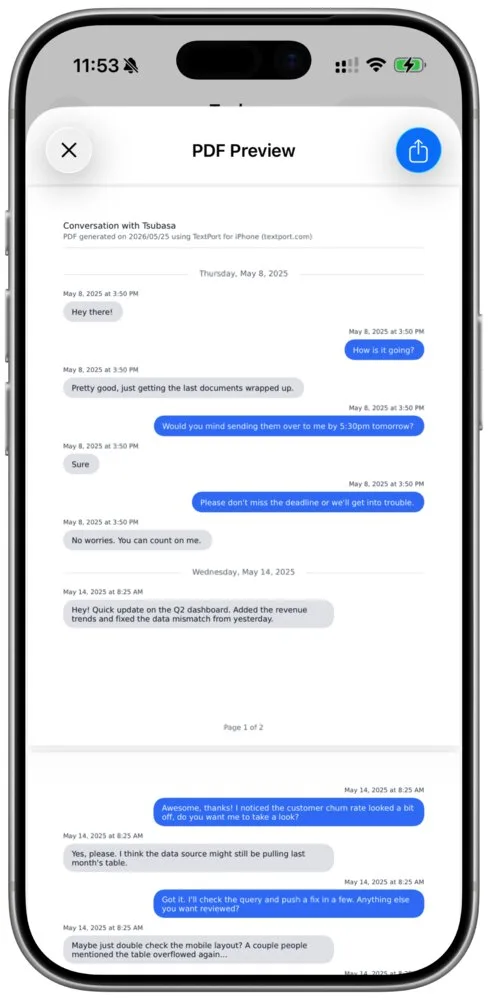
Several of these failures are about the exhibit itself: no phone number, no date, a cropped or cherry-picked thread, evidence stuck on a phone. TextPort turns a conversation on your iPhone into a PDF that puts the sender's name and the date and time above every message, numbers every page, and can show each person's phone number next to their name.
- iMessage and SMS come in through the TextPort Shortcut (iOS 26.4 or later), word for word, for the date range you pick. WhatsApp comes in from its Export Chat file.
- Messenger, Instagram, Signal and other apps come in from screenshots or a screen recording, which TextPort reads, so compare the result with your phone and fix anything misread before you export.
- Print it or file it. The PDF is real text, not pictures of the screen, so it's searchable. The guide to preparing messages for court walks through it.
TextPort doesn't make your texts admissible, and its export isn't a certified or forensic copy. You still testify to what the messages are and who sent them. Keep the original conversation on your phone until the case is over. Your first three chats import for free; exporting needs a subscription.
Frequently asked questions
-
Yes. Your own messages, offered by the other side against you, generally aren't hearsay, because the rules treat a party's own statements differently. They still have to be authenticated, but if the other person was in the conversation, they can usually do that by testifying. Assume anything you've texted could be read aloud in court, and don't delete it: destroying evidence once a case is likely can lead to sanctions.
-
Usually, once someone who was in the conversation testifies that they're accurate. They fail when they're missing who sent each message or when, when they're cropped, or when the phone they came from is gone. Are screenshots of text messages admissible? covers how to take ones that hold up.
-
Yes, if a copy exists: on the other person's phone, in a backup, in screenshots taken before they were deleted, or in Recently Deleted on an iPhone for about 30 days. Courts have admitted screenshots of messages that were later deleted when a participant testified they were accurate. Deleting messages after a case is likely is another matter, and can lead to sanctions.
-
It can end their case and expose them to charges. In Rossbach v. Montefiore Medical Center (2023), a federal appeals court upheld the dismissal of a woman's lawsuit after the trial court found she had fabricated a text message. An expert spotted that its fonts, icons and emoji didn't match any iPhone. Faking evidence can also be prosecuted as perjury or a false report.
-
Often, and judges in custody and divorce cases see them constantly. Some family and protection order hearings relax the formal rules, which makes texts easier to get in but not automatically convincing. What carries weight is a complete, dated thread that fits the rest of the evidence. See can text messages be used in court for custody and divorce specifics.

Start exporting your messages
Available for iPhone, Mac, and Windows. No computer required.