
Can Text Messages Be Subpoenaed? Who Has to Hand Them Over
Yes, text messages can be subpoenaed, but usually not from the phone company. In a divorce, custody or small claims case, federal law bars carriers, Apple and apps like Facebook from handing the content of messages to private parties, and it has no exception for a civil subpoena. A subpoena to Verizon or AT&T gets a log of which numbers texted when, if the records still exist. The words themselves come from people: the other party has to produce them in discovery, and a witness who has them can be subpoenaed.
Police are the exception. With a search warrant, they can search a phone and get stored messages a company still has.
This is general information, not legal advice. Discovery and subpoena rules differ by state and by court, so check yours or ask a lawyer.
Who has to hand over what
| Who has the texts | Civil case (divorce, custody, small claims) | Criminal case (police) |
|---|---|---|
| Phone carrier (SMS, MMS, RCS) | A log of numbers, dates and times, if it still exists. Not the words. | Stored content with a warrant, if the carrier has any. Logs with a subpoena or court order. |
| Apple (iMessage, iCloud) | Not the messages | iCloud content Apple can read, with a warrant. Not with Advanced Data Protection. |
| WhatsApp, Messenger, Signal | Not the messages | Little or none. WhatsApp doesn't keep delivered messages. |
| The other party in your case | Yes, through a discovery request | A warrant to search their phone |
| A witness who has the texts | Yes, through a subpoena for documents | A subpoena or a warrant |
The rest of this guide explains each row.
Why you can't subpoena the phone company for the words
The federal Stored Communications Act says a company providing a messaging service to the public "shall not knowingly divulge to any person or entity the contents of a communication while in electronic storage by that service" (18 U.S.C. § 2702). It lists exceptions, such as police with a warrant and emergencies. A private party's subpoena isn't one of them.
Courts have enforced that. In O'Grady v. Superior Court (2006), a California appeals court refused to make email providers produce stored messages for Apple, because "the Act makes no exception for civil discovery." It added the point that matters for anyone who needs texts for a case: "This does not render the data wholly unavailable; it only means that the discovery must be directed to the owner of the data." A federal court in Los Angeles quashed civil subpoenas to Facebook and MySpace for private messages on the same reasoning in Crispin v. Christian Audigier (2010). Those cases involved email and social media, but the statute covers phone carriers the same way.
The carriers say so themselves. Verizon's transparency report for the first half of 2026 says: "We do not release the contents of communications (such as text messages) ... in response to subpoenas." It releases stored content only to police with a probable cause warrant. AT&T's report says stored text messages "generally also" require a warrant.
Carriers also keep little or no message content to begin with. They don't publish current figures. The last public chart, compiled by the Justice Department in 2010 and released through an ACLU records request, listed text content as "Not retained" at T-Mobile, AT&T and Sprint, and kept for 3 to 5 days at Verizon. It's old, but no carrier has published anything newer.
What a subpoena to the carrier can get
A log. T-Mobile's 2025 transparency report lists "non-content information about past voice calls, text messages or data sessions, such as start time, duration, numbers called or texted" as available by subpoena when it's relevant "to a criminal or civil matter." That can show two numbers exchanged 40 texts on the night in question. It can't show what they said.
Two catches:
- Records disappear. Verizon received 7,616 subpoenas in civil cases in the first half of 2026 and produced no data for 46% of civil discovery requests. The most common reason: "responsive records were no longer available by the time we received the request."
- iMessages aren't in the log. Blue-bubble iMessages travel over Wi-Fi or cellular data, not as carrier texts. AT&T's usage page says iMessages "won't show in your text logs."
Some states add steps. California's court self-help site says: "If you are subpoenaing evidence that includes phone records, email, social media, or texts you must get consent from the owner of those communications by having them sign a release" (California Courts).
Can Apple be subpoenaed for iMessages?
Not in a civil case, and even police get less than people assume. Apple's Legal Process Guidelines say: "iMessage communications are end-to-end encrypted and Apple has no way to decrypt iMessage data when it is in transit between devices. Apple cannot intercept iMessage communications and Apple does not have iMessage communication logs."
iCloud is the opening. Apple says iCloud content, including iPhone backups that "may include ... iMessage, Business Chat, SMS, and MMS messages," may be provided "in response to a search warrant issued upon a showing of probable cause, or customer consent." Whether Apple can read those backups depends on a setting. Under the default, Apple's iCloud security overview says that when iCloud Backup is on, "your backup includes a copy of the Messages in iCloud encryption key." With Advanced Data Protection turned on, "Messages in iCloud is always end-to-end encrypted," and Apple can't decrypt the backup.
A private party can't get a search warrant, so in a divorce or custody case Apple isn't a source.
What about WhatsApp, Messenger and other apps?
The same law applies, and most of these companies hold nothing to give.
- Facebook and Messenger. Meta's help page says: "Private parties cannot obtain the contents of Facebook accounts using subpoenas under federal law." It tells people in lawsuits to export and produce their own account data, and says it won't act on requests that come with "purported user consent."
- WhatsApp. Its law enforcement page says "WhatsApp does not store messages once they are delivered or transaction logs of such delivered messages."
- Signal. After a 2016 grand jury subpoena, Signal said "the only information we can produce in response to a request like this is the date and time a user registered with Signal and the last date of a user's connectivity to the Signal service."
How texts actually get subpoenaed in a civil case
The messages are on phones, so that's where they come from.
1. A discovery request to the other party. In a lawsuit, you can require the other side to produce documents and electronically stored information in their "possession, custody, or control" (Federal Rule 34). In federal court they have 30 days to respond. States have their own versions. In California family court, a party can be served a Notice to Attend and Bring Documents that lists "Electronically stored information (like emails or records)" (California Courts).
Courts can also make a party get messages a company holds for them. In Flagg v. City of Detroit (2008), a federal judge reasoned that because the city could consent to its text provider releasing archived messages, it had to: "if the City can block the disclosure of SkyTel messages by withholding its consent, it surely follows that it can permit the disclosure of these communications by granting its consent." That case involved a business account with an archive. Ordinary phone plans don't keep one.
2. A subpoena to a witness. Someone who isn't a party, such as a friend, relative or coworker who was on the other end of the conversation, can be subpoenaed to produce documents and electronically stored information (Federal Rule 45). Small claims has its own form. California's instructions say: "Take a blank Small Claims Subpoena (form SC-107) to your court clerk's office." The witness can ask to be paid: "Witnesses can ask for $35 a day and 20 cents a mile each way when you serve the subpoena."
3. Your own copy. A text conversation exists on at least two phones. If you were in it, you already have it, and you can export it without anyone's permission.
Can you make someone hand over their phone?
Rarely. When the federal rule-makers let parties ask to test and sample electronic information, they wrote that the change "is not meant to create a routine right of direct access to a party's electronic information system" (Rule 34 committee note). In Hespe v. City of Chicago (2016), the court repeated that "'Mere suspicion' or speculation that an opposing party may be withholding discoverable information is insufficient to support an 'intrusive examination'" of their devices. Courts that allow it, as a federal court in Utah did in Freres v. Xyngular (2014), set a narrow protocol for what gets copied and searched.
Can police get your text messages?
Yes, with a warrant.
- Your phone. The Supreme Court held in Riley v. California (2014) that the answer to what police must do before searching a phone after an arrest "is accordingly simple—get a warrant." Emergencies are an exception.
- The carrier. Carriers release stored content to police with a warrant, if they have any. Verizon received 13,428 warrants for stored content in the first half of 2026. Logs of numbers and times can be had with a subpoena or court order under 18 U.S.C. § 2703, though AT&T notes that "in some states" call detail records need a probable cause court order or warrant. Historical location records need a warrant (Carpenter v. United States, 2018).
- Apple. iCloud content it can read, with a warrant, as above.
Criminal defendants can't get warrants. They can subpoena witnesses, but the same law blocks their subpoenas to providers for private messages. California's Supreme Court held in Facebook v. Superior Court (2018) that defense subpoenas were unenforceable for messages "addressed to specific persons."
Can deleted text messages be subpoenaed?
Usually not from a company. Carriers keep little content, and Apple says it "does not retain deleted content once it is cleared from Apple's servers." Deleted texts can still turn up in other places:
- Recently Deleted on the iPhone. Apple says you can recover deleted texts "for up to 30 days."
- The other person's phone. Deleting a conversation removes it from your devices, not theirs.
- An older backup on a computer or in iCloud.
Once a lawsuit is likely, deleting texts is a serious mistake. In federal court, if a party deleted information intending to keep it from the other side, the judge can "presume that the lost information was unfavorable to the party," or even end the case (Rule 37(e)). State courts have similar powers.
What to do if your texts are subpoenaed or requested
- Delete nothing. On your iPhone, go to Settings > Apps > Messages > Keep Messages and choose Forever. Apple's other options delete messages older than 30 days or a year automatically.
- Find the deadline. A witness served with a federal subpoena who wants to object must do it in writing "before the earlier of the time specified for compliance or 14 days after the subpoena is served" (Rule 45). A party has 30 days to respond to a federal discovery request. State deadlines differ. Utah, for example, gives at least 14 days to copy documents (Utah Courts).
- Raise objections in time. You can object that a request is too broad, too burdensome, or reaches privileged messages, such as texts with your lawyer, and ask the court to quash or narrow it. In California family court, a party files a Request to Quash using form FL-300.
- Don't ignore it. A court can hold someone in contempt for disobeying a subpoena without an adequate excuse.
- Produce what's asked, complete. Give the full conversation for the dates requested, not screenshots of single messages. Federal rules ask for electronic information "in a form or forms in which it is ordinarily maintained or in a reasonably usable form or forms" unless the request names a format.
- Talk to a lawyer if the request is broad, the messages are sensitive, or you're unsure what's relevant.
Exporting texts you have to produce, or want to use
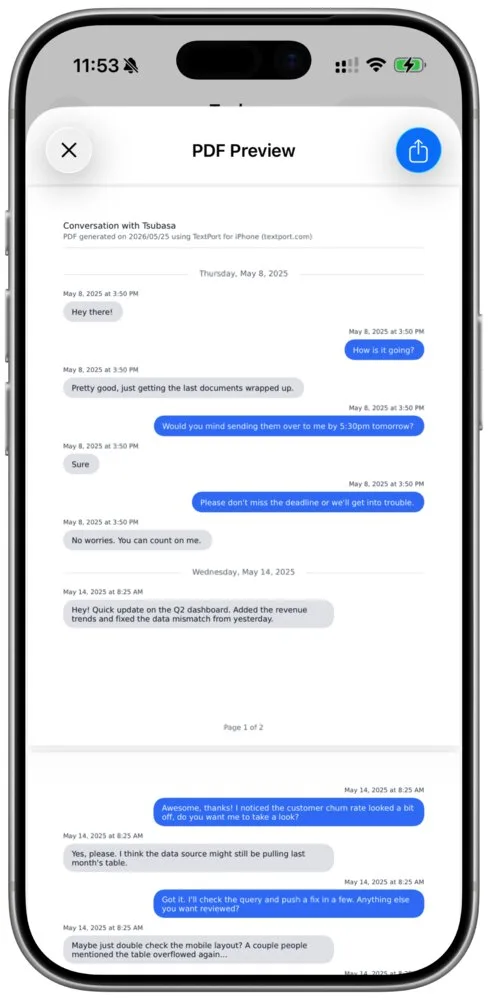
Whether you're producing your own messages or gathering the conversation you were part of, the texts come off the phone. TextPort exports a conversation on an iPhone, with no computer.
- iMessage and SMS come in through the TextPort Shortcut (iOS 26.4 or later), word for word with each message's date and time, for the date range you pick.
- WhatsApp comes in from WhatsApp's own Export Chat file. Messenger, Instagram, Signal and other apps come in from screenshots or a screen recording, which TextPort reads, so check the result against your phone before you export.
- The export is a PDF with the sender, date and time above every message and numbered pages, a CSV spreadsheet your lawyer can sort and search, or plain text. You can send it as a link instead of an attachment.
TextPort isn't a forensic or e-discovery service, and its files aren't certified copies. If authenticity becomes an issue, here's how texts are authenticated. Your first three chats import for free; exporting needs a subscription. For how courts treat texts once you have them, see can text messages be used in court.
Frequently asked questions
-
Yes, but from people, not the phone company. Your spouse or the other parent can be required to produce relevant texts in discovery, and a witness who has them can be subpoenaed. A subpoena to the carrier gets a log of numbers, dates and times at most, because federal law bars carriers from giving message content to private parties. Your own texts are just as reachable, so keep everything.
-
Not from your phone company: iMessages travel over the internet, so carriers don't even log them. Apple says it can't decrypt iMessages in transit and keeps no iMessage communication logs. With a search warrant, police can get iCloud content Apple can read, which can include message backups, unless the user turned on Advanced Data Protection. In a civil case, iMessages come from the people who have them.
-
From a carrier, only as far back as it keeps its logs, and carriers don't publish current retention periods. Verizon said that in the first half of 2026 the most common reason it produced nothing for a civil request was that the records were already gone. From a person, as far back as their phone, computer or backups go. Check your own Keep Messages setting so nothing more disappears.
-
If you're a party to a civil lawsuit, usually yes: federal Rule 45 requires that every party get notice and a copy before a subpoena for documents is served on anyone, and states have similar rules. California requires a signed release from the owner before a subpoena for phone records or texts. Criminal investigations work differently, and a warrant isn't announced in advance. If you've been served, read the deadline right away.
-
A lawyer can request texts from your phone in discovery if you're a party, or subpoena them if you're a witness, and you have to produce what's relevant or object in time. What a lawyer generally can't do is copy your whole phone on a hunch. Courts allow forensic inspection rarely, usually after someone failed to produce what was asked, and under a narrow protocol.

Start exporting your messages
Available for iPhone, Mac, and Windows. No computer required.