
How to File a Wage Claim With the Labor Board

To file a wage claim, gather your pay stubs and a log of the hours you worked, ask your employer in writing for the money, then file with your state's labor agency or the US Department of Labor's Wage and Hour Division before the deadline. California, Texas, New York and Washington take claims online or on a paper form; the federal agency takes them by phone at 1-866-487-9243. Depending on the agency, expect a conference or an investigation, sometimes a hearing, and a decision either side can appeal. A claim can cover unpaid hours, overtime, a final paycheck that never came, and tips your employer kept.
Texts often carry a wage claim. When the time records are missing or wrong, your messages with a manager show the shifts you covered, the hours you reported, the rate you were promised, and the day you asked where your check was.
This is general information, not legal advice. Wage rules differ by state and sometimes by city. For free help, contact your local legal aid office.
How to file a wage claim, step by step
- Gather your pay records and your own log of hours. Collect pay stubs, schedules, bank deposits and payment-app records, and write down your start and end times and breaks for each day, as California tells workers to do. If your employer's records are bad, the Supreme Court held in 1946 that you can still win by showing the hours "as a matter of just and reasonable inference", so your own estimate counts. The Labor Department's free WorkWise Timesheet app logs hours, breaks and overtime on your phone.
- Export the text messages. If your manager or boss texted you about shifts, hours or pay, save the conversation for the dates involved as a PDF with the date and time on every message. TextPort does this on an iPhone, with no computer, so the PDF is ready for the investigator or the hearing, or to upload where the claim form takes attachments. Send the full thread, not a few screenshots: in a 2022 Montana wage-claim hearing, an employer's texts "were rejected because they were not complete copies of the text conversation."
- Ask your employer in writing. Send a short letter, email or text that names the pay period, the amount and a date to pay by, and keep a copy. If it doesn't work, it's still evidence: Miami-Dade County lists "demand letters requesting pay" first among its examples of hearing evidence. Federal law bars retaliation for wage complaints, and the Labor Department says "most courts have ruled that internal complaints to an employer are also protected."
- Pick the right agency. For unpaid pay, the labor board is your state's labor department or the federal Wage and Hour Division, which enforces the federal minimum wage and overtime. The Labor Department's own advice for a missing paycheck is to "contact the Department of Labor's Wage and Hour Division or the state labor department." The National Labor Relations Board handles the right to unionize and act together at work, not wage claims.
- File before the deadline. Use the agency's online or paper form (or call, for the federal agency), list each type of unpaid pay with how you calculated it, and attach copies, never originals. If you don't know the company's legal name, California says "you could write down their vehicle license plate number for the person who pays you."
- Go to the conference or hearing. California usually starts with an informal settlement conference, and "If you fail to attend the conference, your claim will be dismissed, unless you can show good cause for your absence." If it doesn't settle, the next step is a hearing under oath, often called a Berman hearing, and "Only testimony and evidence presented during the hearing will be considered by the hearing officer". New York may hold a compliance conference; a federal investigator interviews employees in private.
- Read the decision and the appeal deadline. Appeal windows are short, and they run from the date the decision was mailed or issued, not the day you open it: in California, 15 days from the date on the decision's certification of service by mail (20 if mailed out of state, 10 if it was handed to you; Labor Code § 98.2); in Texas, 21 days from the date TWC mails the order; in Washington, 30 days from the date L&I issues it. Before you accept a payment, know what it ends: taking a Labor Department-supervised payment in full waives your right to sue for those wages and the equal amount in damages (29 U.S.C. § 216), and accepting the wages L&I assesses in Washington bars a lawsuit on the same claims.
- Collect. Winning isn't the same as getting paid: California's State Auditor found that "about 28 percent of employers did not make LCO‑ordered payments", and its enforcement unit collected the full amount in only 12% of the judgments workers referred to it. New York and Washington both say they can't guarantee collection. Also search the Labor Department's Workers Owed Wages database, which holds back wages it collected but couldn't deliver.
How to file a complaint with the labor board in each state
| Where you worked | Agency | How to file | Deadline |
|---|---|---|---|
| California | Labor Commissioner's Office | Online, email, mail or in person (DLSE Form 1) | 3 years for minimum wage and overtime; 1 to 4 years for other claims |
| Texas | Texas Workforce Commission | Online, or Form WH-1 by mail or fax | 180 days after the wages were due |
| Florida | No state agency: the federal agency, Miami-Dade County's program, or court | Phone (federal); a complaint affidavit by email, mail or fax (Miami-Dade) | Miami-Dade: work within the last 12 months; state minimum wage suit: 4 years (5 if willful); other wage suits: 2 years |
| New York | Department of Labor, Division of Labor Standards | Form LS 223, uploaded or mailed | 3 years at the DOL; 6 years in court |
| Washington | Department of Labor & Industries (L&I) | Online, or form F700-148-000 by mail | 3 years; 180 days for retaliation |
| Anywhere (federal) | US Department of Labor, Wage and Hour Division | Phone: 1-866-487-9243 | 2 years, 3 if willful |
- California: file through the Labor Commissioner; if your hours varied, add DLSE Form 55 from your best estimate. Be ready to wait. The law sets 135 days, but the State Auditor found the agency "had taken a median of 854 days to issue decisions" in 2022–23, and California Rural Legal Assistance says of its clients: "On average the process takes about two years, with some cases taking more than five years." That makes the settlement conference worth taking seriously. The state warns "You may be offered less than the wages and penalties owed", but settling avoids the risk that the employer closes or goes bankrupt first. Since January 1, 2026 (SB 261), an employer that leaves a wage judgment unpaid 180 days after the appeal period can owe a penalty of up to three times the judgment, half of it paid to the workers (Labor Code § 238.05).
- Texas: "The 180-day deadline is a matter of jurisdiction." The Texas Workforce Commission counts the day it receives the claim, so a late claim is dismissed; if only part of your wages fall within 180 days, claim that part. TWC mails the employer your claim, gives it 14 days to respond, then sends both sides a Preliminary Wage Determination Order. TWC may deny a claim against a government employer such as a school district; you may be able to file with the US Department of Labor instead. Past 180 days, or to stay anonymous, TWC's labor commissioner office notes that a federal complaint about minimum wage or overtime "covers more time – up to two years – and all complaints are kept confidential".
- Florida: there's no state wage agency. FloridaLawHelp, the state's legal aid site, lists three routes: complain to your employer, file with the federal Wage and Hour Division, or sue. Florida's minimum wage is $15.00 an hour since September 30, 2026 ($11.98 plus tips for tipped workers). Before you sue for unpaid Florida minimum wage, you must notify the employer in writing of the minimum wage you claim, the dates and hours, and the total owed, and the employer then has "15 calendar days after receipt of the notice to pay". If you worked in Miami-Dade County and are owed more than $60 and no more than $15,000, the county's wage theft program can hold a hearing and order three times the wages claimed. The hearing is in English (bring your own translator), and collecting after you win is up to you. Small claims court takes cases up to $8,000; see how to win in small claims court.
- New York: the Department of Labor won't take wages earned more than three years ago, but a lawsuit under Labor Law § 198 reaches back six years, and that clock pauses while a DOL complaint is pending. The DOL won't take claims for sales commissions, wages owed by a government employer, wages you've already sued for, or pay to an executive, administrative or professional employee who earned over $1,300 a week. Expect a letter with your case number within 25 to 30 business days. The DOL will contact you "via email or phone (text)", so answer quickly. An employer that doesn't pay what's found due gets an Order to Comply that adds 100% liquidated damages and interest.
- Washington: L&I takes complaints about unpaid wages, tips, overtime, breaks and paid sick leave. They aren't confidential: "In order to investigate, we will need to give the employer your name and a copy of your complaint." Investigations "typically take up to 60 days to complete, but some cases may take longer to resolve." L&I can order the wages plus 1% interest a month, going back three years. Amendments passed in 2026 let L&I prioritize which complaints it investigates (RCW 49.48.083), so send your records early and answer the investigator quickly.
- Federal: call the Wage and Hour Division with the company's name, address and phone, your manager's name, your type of work, and "How and when you were paid (e.g., cash or check, every Friday)". Complaints are confidential, and a worker who sues instead can get back pay plus an equal amount in damages and attorney's fees.
Final paychecks, overtime, tips and contractors
- Final paycheck. "Employers are not required by federal law to give former employees their final paycheck immediately." States set deadlines. California: immediately if you're fired, within 72 hours if you quit without notice, or on your last day if you gave 72 hours' notice; a California employer that willfully pays late owes a day's pay for each late day, up to 30 days (Labor Code § 203). Texas: by the sixth day after a firing, or the next regular payday if you quit (§ 61.014). New York: "not later than the regular pay day for the pay period during which the termination occurred". Washington: at the end of the pay period, whether you were fired or quit (RCW 49.48.010).
- Overtime. Federal law requires time and a half for hours over 40 in a workweek for covered nonexempt workers.
- Tips. "An employer may not keep tips received by its employees for any purposes", including handing them to managers or supervisors. New York and Washington list unpaid tips among the claims they take, and California law makes every tip the property of the worker it was left for.
- Called a contractor? File anyway. California says "If you believe your employer is misclassifying you as an independent contractor, file a wage claim." Texas's claim form says that if you're unsure, file and TWC will decide whether you were an employee.
If asking to be paid turns into threats, insults or a hostile workplace, how to report harassment at work covers documenting it.
The texts that prove your hours and pay
Agencies take texts. Miami-Dade County's hearing guidelines list "screen captures of text messages, emails, and written statements" among examples of evidence. Washington's complaint form asks what records you can provide and has a checkbox for "Texts, photos, emails". Legal Aid at Work's California checklist says to save "Texts, emails, or messages about hours, pay, termination, or complaints".
Which texts matter:
- Your manager scheduling you, changing shifts, or asking you to come in early or stay late.
- Messages where you reported your hours or clocked in and out, and photos of timesheets.
- The rate, bonus or tip split you were promised, and any change to it.
- Your requests to be paid and the replies, like I'll pay you Friday.
- Payment-app receipts and messages showing what you got and when.
- Anything about your last day, and any cut to your schedule after you complained.
If your manager used Slack or Teams instead of texting, see how to export Slack conversations and how to export Teams chats.
How to save them:
- To stop your iPhone from deleting old texts, go to Settings > Apps > Messages > Keep Messages and choose Forever.
- Export the whole conversation for the dates involved, including messages that don't help you, with names or numbers visible and photos kept.
- Keep the original conversation on your phone.
How to hand them over:
- With the claim. California's online system lets you "upload forms and documents such as copies of paychecks, paystubs and bounced checks", and Washington lets you attach records to your complaint or send them to L&I later.
- At a California hearing, bring at least three sets of copies: one for you, one for the hearing officer and one for each employer you named.
- For a Texas appeal hearing by phone, mail or fax copies to the hearing officer and the other party early. "Documents may not be used if they are not provided in enough time before the hearing begins."
Saving the texts as one dated PDF
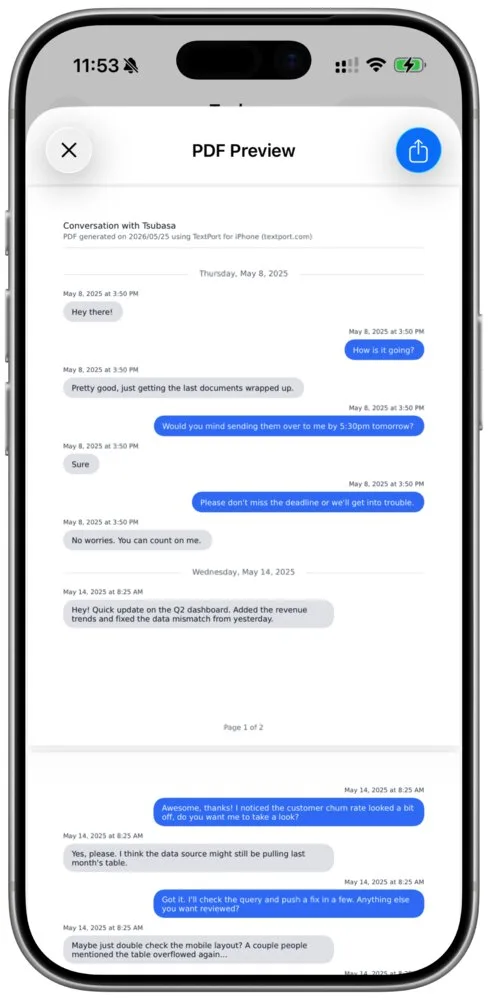
TextPort turns the conversation with your manager or boss into one PDF on your iPhone, with no computer, ready for the investigator or the hearing, or to upload where your claim form takes attachments.
- iMessage and SMS come in through the TextPort Shortcut (iOS 26.4 or later), word for word with each message's date and time, for the date range you pick.
- WhatsApp comes in from WhatsApp's own Export Chat file. Messenger, Instagram, Signal and other apps come in from screenshots or a screen recording, which TextPort reads, so check the result against your phone before you export.
- The export is a PDF with the sender, date and time above every message and numbered pages, a CSV spreadsheet, or plain text. Photos from iMessage and WhatsApp chats print in the PDF. You can send it as a link instead of an attachment.
Frequently asked questions
-
It depends on where you file. Texas is the strictest: the Texas Workforce Commission must receive your claim within 180 days after the wages were due. New York's Department of Labor won't take wages earned more than three years ago, though a New York lawsuit reaches back six years. Washington's L&I takes complaints within three years. California allows one to four years depending on the claim, and three for minimum wage and overtime. Federal law allows two years for minimum wage and overtime claims, or three if the violation was willful.
-
It varies a lot. Washington's L&I says investigations "typically take up to 60 days" though some take longer. New York's Department of Labor sends a letter with your case number within 25 to 30 business days. California is the slowest: the State Auditor found the Labor Commissioner took a median of 854 days to decide claims in 2022–23, against a legal limit of 135 days. Settling at California's conference gets you paid sooner, possibly for less than you're owed.
-
With a state agency, yes. California notifies your employer by mail of the settlement conference, New York's Department of Labor starts its investigation by contacting the employer, Washington's L&I gives the employer your name and a copy of your complaint, and the Texas Workforce Commission mails the employer a copy of your claim. The federal Wage and Hour Division keeps complaints confidential: "The name of the complainant, the nature of the complaint, and whether a complaint exists may not be disclosed." If you still work there and fear retaliation, that's a reason to call the federal agency about minimum wage or overtime.
-
No. Federal law protects you whether you complain orally or in writing, to the Department of Labor or, in most courts, to your employer. California, New York and Washington ban retaliation too, and so does Florida's Constitution for minimum wage complaints. Retaliation has its own deadline: a complaint within one year in California or 180 days in Washington, and a lawsuit within two years in New York. Save any texts about a cut schedule or a firing that came after you asked to be paid.
-
Yes. The federal Wage and Hour Division says "All services are free and confidential, whether you are documented or not." California and Washington take claims regardless of immigration status, and New York's Department of Labor says it doesn't report undocumented workers or witnesses to enforcement agencies. Cash pay is legal, but New York warns it can make payments harder to verify, so keep a daily log of your hours and every payment, and save texts about pay.
-
No. California Rural Legal Assistance says the Labor Commissioner's process "is designed to be accessible to workers with no need for an attorney." Every agency in this article takes claims directly from workers. In California, if your employer appeals and you're low-income, you can ask for a free Labor Commissioner attorney. Consider a lawyer if you'd rather sue: federal law and Florida's Constitution both let a worker who wins in court recover attorney's fees.

Start exporting your messages
Available for iPhone, Mac, and Windows. No computer required.