
How to Report Harassment at Work (and Document It First)

To report harassment at work, write down what happened and save the messages first. Then report it to HR or a manager in writing, following your employer's policy, and keep a copy. If that doesn't stop it, or you're punished for complaining, file a charge with the EEOC through its Public Portal or with your state's civil rights agency. The federal deadline is 180 days, or 300 where a state or local agency enforces a similar law, and an HR investigation doesn't pause it.
Much of it happens in writing now: a supervisor's late-night texts, a coworker's Slack or Teams messages, a group chat. New York's model policy, which every employer there must adopt or match, says calls, texts, emails and social media use can be unlawful workplace harassment even away from work, on personal devices or outside work hours. Those messages also carry the dates every agency asks for.
This is general information, not legal advice. Harassment laws and deadlines differ by state and city. New York's and Illinois's civil rights agencies say filing with them is free and needs no lawyer; legal aid can also help. If someone at work has assaulted you or threatened to hurt you, call 911 or your local police; a complaint at work doesn't replace a police report.
What counts as illegal harassment at work
Under federal law, harassment is illegal when it's tied to who you are. The EEOC defines it as "unwelcome conduct that is based on race, color, religion, sex (including sexual orientation, transgender status, or pregnancy), national origin, older age (beginning at age 40), disability, or genetic information (including family medical history)." It becomes unlawful when putting up with it is a condition of keeping your job, or when it's severe or pervasive enough that a reasonable person would find the workplace hostile or abusive. Isolated incidents don't meet that federal test unless they're extremely serious.
State law can be broader. New York's Human Rights Law bans harassment based on a protected trait whether or not it would count as severe or pervasive under the precedent courts have applied. An employer's defense there is that the conduct was no more than what a reasonable person with the same trait would consider petty slights or trivial inconveniences.
In Harris v. Forklift Systems (1993), the Supreme Court said the factors "may include the frequency of the discriminatory conduct; its severity; whether it is physically threatening or humiliating, or a mere offensive utterance; and whether it unreasonably interferes with an employee's work performance." Build your log around those four things.
The harasser can be a supervisor, a coworker or an outsider "such as a client or customer." It can happen online: the EEOC's Q&A for employees tells a remote worker harassed online by a coworker that they're protected.
Four types, and mental harassment
No U.S. agency or statute we found lists four types of workplace harassment. The lists online (verbal, physical, sexual and so on) describe behavior; they aren't legal tests.
Mental harassment isn't a federal category either. The EEOC says: "Standing alone, personality conflicts, disagreements, or incompatibility are not covered by the federal EEO laws, unless the harassing conduct is based on at least one of the protected characteristics". Once it is, you don't need psychological damage. Harris put it plainly: "Title VII comes into play before the harassing conduct leads to a nervous breakdown." Under federal law, emotional harm counts toward compensatory damages, which together with punitive damages are capped at $50,000 to $300,000 by employer size; age claims allow neither (EEOC).
California requires employers to train staff on preventing abusive conduct, such as "the gratuitous sabotage or undermining of a person's work performance", but that's a training rule, not a separate claim you can file. Bullying with no protected trait behind it is still worth reporting under your employer's policy.
The EEOC's 2024 guidance is gone
Advice built on the EEOC's 2024 harassment guidance is out of date. A federal court in Texas vacated parts of it on May 15, 2025, and the EEOC voted 2-1 on January 22, 2026 to rescind all of it. EEOC Chair Andrea Lucas said: "Federal employment laws against discrimination, harassment, and retaliation, and Supreme Court precedent interpreting those laws, remain firmly in place." The EEOC's harassment page and its 2016 retaliation guidance still apply.
Step 1: Start a dated log and save the messages
Start before you report, and keep going after. Legal Aid at Work suggests keeping a journal. For each incident, note:
- The date, time and place, or the app if it was in a chat.
- Who did it, and their exact words.
- Who saw or heard it.
- How it affected your work.
- Who you told, and when.
If you've lost track of a date, New York's Division of Human Rights says "You may be able to find this in your calendar, emails, texts, or letters." Messages you sent others count too. California's guide for employer investigators says supporting evidence "might include documents, emails, texts, or comments made to others following an event of harassment." A text to a friend that evening about what your manager said is a record from the time.
Keep the log on your own phone or on paper, not a work computer. Your employer may be monitoring it: New York, for one, requires employers that monitor email, phone or internet use to tell employees in writing when they're hired.
Which messages to save
- Texts, direct messages and voicemails from the harasser, including after hours.
- Group chats where the comments were made.
- What you told friends, family or coworkers right after an incident.
- Your report to HR and every reply.
- Anything after you reported: a schedule change, a sudden write-up.
On your iPhone, go to Settings > Apps > Messages > Keep Messages and choose Forever. Save each conversation whole for the dates involved, with the date and time on every message and the sender's name or number visible, and keep the photos. Don't crop or leave out your own replies. Keep the original on your phone: if anyone questions a copy, that's how you show it's real. TextPort can export a conversation on your iPhone as one PDF with the sender, date and time above every message, ready to attach to an HR report. How to prove harassment and stalking has a log template, and documenting harassment text messages covers the rest of the record.
Slack, Teams and work email
Texts on your personal phone are yours; work chats are your employer's. Slack's export tools belong to workspace owners and admins, and on Business+ plans owners can apply to export direct messages. Microsoft says "Messages in 1:1 chats are stored in the Exchange Online mailbox of all chat participants", where eDiscovery tools reach them.
Before copying a work chat to your phone, check your employer's rules; exporting Slack conversations and exporting Teams chats cover your options. Be careful with company documents: forwarding confidential files or company email to a personal account can backfire, so ask an employment lawyer what you may keep.
You can ask coworkers what they saw. EEOC guidance says "talking to coworkers to gather information or evidence in support of a potential EEO claim is protected opposition", if done in a reasonable manner.
Recording a conversation
| Where | Can you record a conversation you're in without the others' consent? |
|---|---|
| Federal law | Yes, unless it's for a criminal or tortious purpose |
| California | Not a confidential conversation: all parties must consent |
| Florida | Not a phone call or private conversation: all parties must consent |
| Illinois | Not secretly, if it's private: all other parties must consent |
| New York | Yes: one party's consent is enough |
| Texas | Yes, if you're a party to it |
Sources: federal, California, Florida, Illinois, New York, Texas.
Penalties: in California, a fine of up to $2,500 per violation, jail or prison time, or both for a first offense, and the person recorded can sue for $5,000 per violation; in Florida, generally a third-degree felony; in Illinois, a Class 4 felony for a first offense. An illegal recording in California generally can't be used as evidence. If you already recorded in California, Legal Aid at Work advises: "don't destroy it but refrain from making such recordings in the future." When unsure, write notes right after the conversation instead.
Step 2: Report it to HR in writing
Your report decides what the employer can argue later.
- A supervisor's harassment that led to firing, a lost promotion or lost pay makes the employer automatically liable (EEOC).
- A hostile environment created by a supervisor lets the employer escape liability only by proving it tried to prevent and correct harassment and you unreasonably didn't use its complaint options. In Faragher v. City of Boca Raton (1998), decided with Burlington Industries v. Ellerth, the Supreme Court said that failure "will normally suffice to satisfy the employer's burden under the second element of the defense."
- Harassment by a coworker or customer makes the employer liable if it "knew, or should have known about the harassment and failed to take prompt and appropriate corrective action." A dated report proves it knew.
Don't wait for it to get worse: EEOC guidance says reporting is protected even before harassment reaches the federal severe-or-pervasive level.
- Find the policy in your handbook, on the intranet or from HR. "If there is a policy, follow the steps in the policy." With none, the EEOC says you can talk to "any supervisor in the organization."
- If your boss is the harasser, go around them. California requires "a complaint mechanism that does not require an employee to complain directly to their immediate supervisor." In Texas, TexasLawHelp says you can "either report it to someone else in the organization or you can go directly to the TWC" (the Texas Workforce Commission).
- Tell the harasser to stop if you feel safe doing it, as the EEOC suggests.
- Write it down. New York's model policy accepts reports made verbally or in writing, and its form is optional, so an email works. If you report in person, follow up by email.
- Name the trait, since federal law reaches only harassment tied to one: your race, your pregnancy, your religion.
- Attach the texts and ask that work chats be kept. New York's model policy has the investigator obtain, review and preserve relevant documents, emails and phone records. Name the chats and dates.
- Keep a copy of what you sent and every reply where you'll still have it if you lose your work account.
Under the anti-harassment policy, I'm reporting harassment by [name], my shift supervisor. Since March 3 he has mocked my religion in person and by text, most recently May 12; texts attached. [Names] saw it on April 20. Please preserve our Teams chats since March 1.
Retaliation is illegal
The EEOC lists "communicating with a supervisor or manager about employment discrimination, including harassment" as protected, along with answering questions in your employer's investigation. Depending on the facts, retaliation can include a review "that is lower than it should be" or more scrutiny. The Supreme Court's test in Burlington Northern v. White (2006) is whether "a reasonable employee would have found the challenged action materially adverse". Log every change after your report.
HR doesn't stop the clock
"Time limits for filing a charge with EEOC generally will not be extended while you attempt to resolve a dispute through another forum such as an internal grievance procedure". Keep counting days while HR investigates.
Step 3: File an EEOC complaint online
The EEOC calls a complaint a charge, and you start one online through its Public Portal. Federal law covers employers with 15 or more employees for most harassment, and 20 or more for age (EEOC). The charge is due within 180 calendar days, or 300 where a state or local agency enforces a law against the same discrimination; for age, a local law alone doesn't count (EEOC). Florida's agency says that's 300 days there. For ongoing harassment, the EEOC counts from the last incident, and in National Railroad Passenger Corp. v. Morgan (2002) the Supreme Court held that "the entire time period of the hostile environment may be considered" if one act falls inside the deadline. Federal employees have 45 days to contact an EEO counselor. Except under the Equal Pay Act, you must file a charge before you can sue under the laws the EEOC enforces.
- Submit an online inquiry in the EEOC Public Portal.
- Schedule the interview, by phone, video or in person. With 60 days or fewer left, the portal gives fast-track directions, or call 1-800-669-4000 to ask for an immediate interview.
- Do the interview with your log and messages in front of you. The charge is completed after it.
- Review and sign the charge.
You can also visit an EEOC office, or mail a signed letter saying what happened, when, and why you believe it was discriminatory (EEOC). Calling starts the process but files nothing: the EEOC does "not take charges over the phone".
What you tell the EEOC stays confidential until you file. Then "By law, we are required to notify the employer of the charge within 10 days of the filing date." Charges aren't made public.
Or file with your state or city agency
| Agency | Deadline | Employers covered |
|---|---|---|
| California Civil Rights Department | 3 years from when you were last harmed | Harassment: every employer, even one with a single employee. Other discrimination: 5 or more |
| New York State Division of Human Rights | 3 years from the most recent incident (acts on or after Feb. 15, 2024) | All employers in the state |
| New York City Commission on Human Rights | 1 year from the last alleged act; 3 years for gender-based harassment | 4 or more employees, counting independent contractors; any employer for gender-based harassment |
| Texas Workforce Commission | 180 days; 300 for sexual harassment | Sexual harassment: 1 or more employees. Other claims: 15 or more |
| Florida Commission on Human Relations | 365 days after the alleged violation | 15 or more |
| Illinois Department of Human Rights | 2 years for most cases | Most claims: 1 or more employees in 20 or more weeks of this or last year. Sexual harassment, disability or pregnancy: every employer |
- California: submit an intake form (online works), then do an intake interview. CRD recommends bringing "e-mails, text messages, screen shots" and needs specific dates. You can let CRD investigate, or get an immediate Right-to-Sue notice, which you need before suing (coverage).
- New York State: DHR calls its Call Center, (844) 697-3471, the easiest way to file; there's also an online form (coverage).
- New York City: the Commission says, on a page updated April 24, 2026, that it no longer automatically cross-files employment claims with the EEOC, and tells workers who may want federal court to file with the EEOC too. It won't take a complaint already filed elsewhere on the same facts, so ask it how to keep both options before filing anywhere (coverage).
- Texas: Labor Code (§ 21.202, § 21.141, § 21.002). TWC takes no complaints by phone. TexasLawHelp's filing page lists 15 or more employees, 180 days and a harm such as demotion or firing as requirements, narrower than the statute. If TWC's form screens you out, get legal aid before the deadline.
- Florida: § 760.11. If the FCHR finds no cause, you can't sue under state law, and "your only remaining option is to request an administrative hearing within 35 days."
- Illinois: email IDHR's Complainant Information Sheet to [email protected], or mail or fax it (IDHR; coverage).
Filing in one place often counts for both: under worksharing agreements, a charge filed with the EEOC or a state or local agency is automatically filed with the other. New York City and Minnesota have stopped doing this automatically, so wherever you file, ask whether it reaches the EEOC.
After you file
In the EEOC Public Portal you can "Upload documents supporting your charge": your log and the exported conversations. If the employer submits a position statement, you can read it there and upload a response, which the EEOC asks for within 20 or 30 days, depending on which of its pages you read, so plan on 20. Dated messages show where its account is wrong. Investigations average about 10 months. Asking for a Notice of Right to Sue early usually ends the investigation. After a Notice of Right to Sue, "you must file your lawsuit within 90 days." Count them from the day the EEOC's email about the notice arrives, not the day you open it. Once 180 days have passed since filing, the EEOC must issue that notice if you ask. Age claims don't need the notice: you can sue once 60 days have passed since you filed the charge, and no later than 90 days after the EEOC tells you its investigation is over.
If you're the manager
New York's model policy says managers and supervisors shouldn't wait for an employee to complain: if they see harassment, they must act, and they can be disciplined for not reporting it.
- Pass reports on promptly, in writing, to HR or whoever your policy names.
- Preserve the evidence. For conduct online, California's investigator guide suggests reviewing "digital documents, such as emails, chats, screenshots, and calendar invites."
- Don't retaliate, including with closer scrutiny or a marked-down review.
- Know the rules. California employers with five or more employees must give supervisors two hours of harassment training every two years; New York requires training for every employee each year. In California, a harasser is personally liable whether or not the employer knew.
Saving the texts as one dated PDF
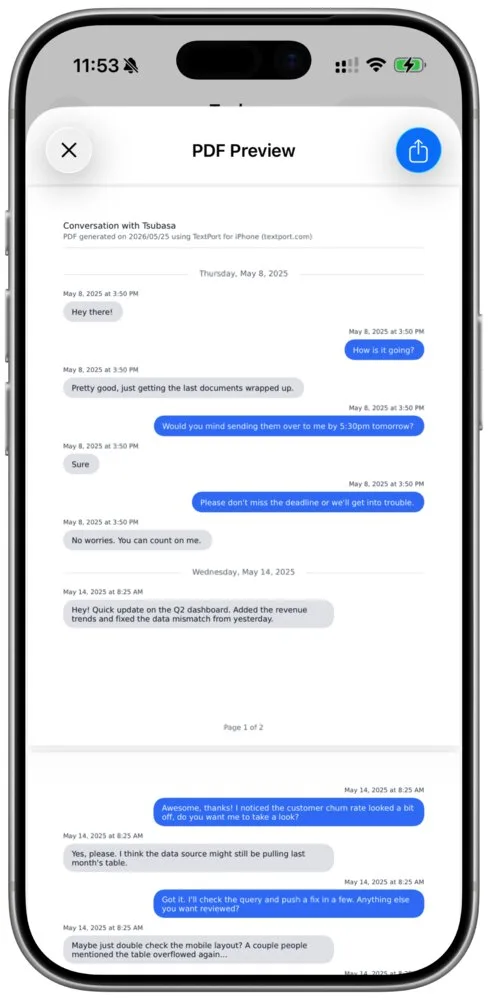
TextPort turns a conversation with a coworker or supervisor into one PDF on your iPhone, with no computer, ready to attach to your HR report or upload to the EEOC Public Portal.
- iMessage and SMS come in through the TextPort Shortcut (iOS 26.4 or later), word for word with each message's date and time, for the date range you pick.
- WhatsApp comes in from WhatsApp's own Export Chat file. Messenger, Instagram, Signal and other apps come in from screenshots or a screen recording, which TextPort reads, so check the result against your phone before you export.
- The export is a PDF with the sender, date and time above every message and numbered pages, a CSV spreadsheet, or plain text. Photos from iMessage and WhatsApp chats print in the PDF. You can send it as a link instead of an attachment.
Frequently asked questions
-
Start with an online inquiry in the EEOC Public Portal, then schedule an interview by phone, video or in person. The charge is completed after the interview, and you sign it. You can also visit an EEOC office, or mail a signed letter with your details, the employer's, what happened, when, and why you think it was discriminatory. The EEOC doesn't take charges over the phone, but calling 1-800-669-4000 starts the process, and the EEOC asks people close to their deadline to call for an immediate interview.
-
With the EEOC, 180 calendar days, extended to 300 where a state or local agency enforces a similar law, as in Florida. For ongoing harassment, the clock runs from the last incident, and earlier incidents still count. Some state agencies allow longer: three years in California and New York State, two years in Illinois, 365 days in Florida. Texas's allows 180 days, or 300 for sexual harassment. An HR investigation doesn't pause the federal deadline.
-
No U.S. law or agency we found lists four types. Lists online (verbal, physical, sexual and others) describe behavior, not legal tests. Under federal law, harassment is illegal when it's based on a protected trait such as race, sex, religion, age 40 or older, or disability, and either becomes a condition of keeping your job or is severe or pervasive enough to make the workplace hostile or abusive. New York State law doesn't require harassment to be severe or pervasive.
-
Mental harassment isn't a category in federal law. Bullying or a boss who is cruel to everyone isn't covered by federal job-discrimination law unless it's based on a protected trait. If it is, you don't have to prove psychological damage: the Supreme Court said in 1993 that Title VII applies "before the harassing conduct leads to a nervous breakdown." California also requires employers to train staff to prevent abusive conduct, such as repeated verbal abuse or sabotaging someone's work.
-
It depends on the state. Federal law, New York and Texas let a person who is part of the conversation record it. California requires every party's consent for a confidential conversation, Florida requires all parties' consent for a phone call or private conversation, and Illinois bars secretly recording a private conversation without the other parties' consent. Breaking these laws can be a crime, so if you're unsure, write detailed notes right after the conversation instead.
-
That would be retaliation, which the laws the EEOC enforces prohibit. Complaining to a manager about harassment and answering questions in your employer's investigation are both protected, and retaliation can include a lower performance review or extra scrutiny, not just firing. Log every change after you report, with dates, and include retaliation in your EEOC charge or state complaint.

Start exporting your messages
Available for iPhone, Mac, and Windows. No computer required.