
How to Prove Harassment or Stalking (With a Stalking Log)

To prove harassment or stalking, you have to show a pattern: two or more acts aimed at you, with no legitimate purpose, that would make a reasonable person afraid or seriously distressed. The proof is ordinary: the messages themselves, saved complete with the sender's number and the date and time; a log of each incident, written as it happens; photos, voicemails and call logs; witnesses; and any police reports you made. Your own testimony counts as evidence too, but the more of it you can back up, the better.
Most of this has to start before you know whether you'll ever go to the police or a court. Messages get deleted, numbers get blocked, and memories of exact dates fade. A log and a saved copy of every message cost little and keep your options open.
This is general information, not legal advice. Harassment and stalking laws differ by state, and so does what counts as enough proof. If you're in immediate danger, call 911. The National Domestic Violence Hotline is at 1-800-799-7233, or text START to 88788, and can connect you with a local advocate.
What you have to prove
Every state words it differently, but stalking and harassment laws ask the same few questions. Here's how the federal stalking law and four large states put them:
| What the judge looks for | What the law says |
|---|---|
| A pattern, not one incident | "a pattern of conduct composed of 2 or more acts, evidencing a continuity of purpose" (federal definition); "two or more acts occurring over a period of time, however short" (California Penal Code § 646.9) |
| Aimed at you, for no good reason | "directed at a specific person which causes substantial emotional distress to that person and serves no legitimate purpose" (Florida § 784.048) |
| They meant it, or knew | Texas requires that the person "knowingly engages in conduct" (Penal Code § 42.072); New York, that they acted "intentionally, and for no legitimate purpose" (Penal Law § 120.45) |
| Fear or serious distress, judged by a reasonable person | Conduct that "places that person in reasonable fear of the death of or serious bodily injury" or "would be reasonably expected to cause substantial emotional distress" (18 U.S.C. § 2261A) |
| Sometimes: they were told to stop | New York's fourth-degree stalking covers repeated contact where "the actor was previously clearly informed to cease that conduct" |
Three things follow from this.
The pattern is the case. One rude text rarely meets the definition. Forty texts over three weeks, a drive-by of your house and a message to your sister about where you work might. That's why documenting each small incident matters: alone it proves little, together they show "continuity of purpose."
Different kinds of contact add up. Texas lets a judge treat "different types of conduct," such as texts, calls and showing up, as one "course of conduct." Texas's harassment law even names "repeated electronic communications" and tracking someone's car or belongings with an app or device without their consent.
Fear is judged by a reasonable person, not only by you. You'll need to show how the behavior affected you and why that reaction makes sense: you changed your route to work, stopped going to the gym, moved your car, told your employer. Those facts belong in your log.
Threats have their own rule. In Counterman v. Colorado (2023), the Supreme Court held that a prosecutor must show the person "consciously disregarded a substantial risk that his communications would be viewed as threatening violence." The case is a reminder of how messaging stalking looks in practice: the man sent "hundreds of Facebook messages" to a woman who never answered, and each time she blocked him, "he created a new Facebook account and resumed his contacts."
Harassment at work is a different test
Workplace harassment under federal law is about discrimination, not just bad behavior. The EEOC says harassment is unlawful when it's based on a protected trait such as race, sex, religion, disability or age, and is "severe or pervasive enough to create a work environment that a reasonable person would consider intimidating, hostile, or abusive." It adds that "petty slights, annoyances, and isolated incidents (unless extremely serious) will not rise to the level of illegality." Harassment through texts and chat counts: "Unlawful harassment can occur in a physical work environment or a virtual one."
Two things matter more at work than elsewhere. First, report it to your employer, in writing, and keep a copy. If a supervisor's harassment creates a hostile environment, the employer can defend itself by showing the employee "unreasonably failed to take advantage of any preventive or corrective opportunities." Second, watch the deadline. A charge with the EEOC generally has to be filed within 180 days, or 300 in many states, "of the last incident of harassment," and the EEOC will still "look at all incidents" from before that.
Is your word enough?
Sometimes, but don't count on it.
WomensLaw, a project of the National Network to End Domestic Violence, reminds people going to court that "your testimony is evidence" and that in many protective order cases your evidence "only has to convince the judge that it's 'more likely than not'" that it happened. But the standard isn't always that low:
- California's civil harassment restraining order requires the judge to find harassment "by clear and convincing evidence" (Code of Civil Procedure § 527.6). The court's own information sheet says: "Witnesses are not required, but it helps to have more proof of the harassment than just your word."
- Texas's civil stalking lawsuit requires the person suing to "submit evidence other than evidence based on the claimant's own perceptions and beliefs" (Civil Practice and Remedies Code § 85.003).
So aim for testimony plus something a judge can see.
What to save, and how
Save everything, even things that seem too small to matter. NNEDV's Safety Net project puts it this way: "While it may be tempting to delete it, saving it could show patterns."
| Evidence | How to save it | The common mistake |
|---|---|---|
| Text messages | The whole conversation, with the sender's number and the date and time of each message | One cropped screenshot of the worst message, with no date and only the name you saved them under |
| Calls | A screenshot of your recent calls list showing dates and times | Deleting the call log to stop seeing it |
| Voicemails | Keep them on the phone and save a copy | Letting them expire or deleting them |
| Emails | Keep the original in your inbox, print it with the header | Forwarding it to someone, which loses the sender's details |
| Social media posts and DMs | Screenshots that include the profile link and the date; an archived copy of public pages | Reporting the post first, so the platform removes it before you capture it |
| Trackers | A screenshot of the alert and the item's details; talk to police before removing it | Throwing it away |
| Damage, notes, gifts | Photos with the date; keep the items | Throwing them out |
| Witnesses | Their name, phone number and what they saw, written down soon after | Assuming you'll remember who was there |
| Reports you made | The officer's or HR contact's name, the report number, a copy of the report | Not asking for the number |
Some details that judges and police care about:
Texts. A guide written for people representing themselves, published by the National Council of Juvenile and Family Court Judges with NNEDV, says "it is important that you capture entire conversations, not just a single message," because "stalking and harassment are usually a series of interactions." It also says to show the sender's real number, not just "the contact name you assigned to that person in your phone," and warns that "you may need to tap or swipe on the message to show the date and time it was sent." If you take screenshots, overlap each one with the last so the judge can see it's one continuous conversation.
Calls and voicemails. Recording calls is legal in some states only with everyone's consent, so check your state before you record a conversation. A voicemail they left you is yours to keep.
Social media. WomensLaw says to include "the full URL web address that is in the bar at the top of the window as well as the abuser's profile page." Some apps tell the other person when you screenshot or screen-record a chat. If that could put you at risk, NNEDV suggests photographing the screen with a second device instead.
Trackers. If an unknown AirTag or other tracker travels with you, your iPhone shows "AirTag Found Moving With You." Tapping the alert shows the item's serial number and "the last four digits of the phone number of the person who registered it." Apple suggests taking a screenshot, and says police can ask Apple for information about the owner. Before you remove a tracker, think about how the person will react; WomensLaw notes that "one option is asking the police to document the evidence before removing it."
Physical evidence. Photograph property damage, keep letters and items left for you, and if you have the damaged property, keep that too.
How to keep a stalking log
A stalking log is a running list of every incident: what happened, when, where, who saw it and what proof you have. It turns a stack of screenshots into the pattern the law asks for, and it helps you testify accurately months later.
A widely used template is the Stalking Incident and Behavior Log from SPARC, the Stalking Prevention, Awareness, and Resource Center, a free PDF available in 10 languages. Its columns are:
- Date
- Time
- Description of Incident
- Location of Incident (physical location, technology used, online platform)
- Witness Name(s) (attach address and phone number)
- Evidence Attached? (photos, video, screenshots, items, etc.)
- Report Made To (name, office/org, badge or identification #)
Here's what a few rows might look like for someone being harassed mostly by text, with SPARC's columns combined to fit a phone. Point each row to its proof, such as the page of an exported conversation:
| When | What happened, where, who saw it | Evidence | Reported to |
|---|---|---|---|
| Mar 3, 11:40 pm | 14 texts in 20 minutes from (555) 010-0199 after I didn't reply. Last one: "I know you're home." No witnesses. | Texts, Mar 3 (export pages 1–3) | Not yet |
| Mar 5, 7:15 am | His car parked across from my building when I left for work. Left when I took a photo. Neighbor Dana R. saw it. | Photo of car and plate | Not yet |
| Mar 5, 9:02 am | Texted "nice jacket" from a new number, (555) 010-0142. | Screenshot of the new number's contact details | Police non-emergency line, Officer Lee #4471, report 26-01887 |
Some rules that keep a log useful:
- Write it as it happens. WomensLaw recommends recording each incident "as the incidents occur." Notes written the same day are far more convincing than a list reconstructed later.
- Log everything, even small things. SPARC's instructions list "harassing or repeated phone calls, texts, and messages; following or waiting for you; sending you letters or gifts; tracking you; damaging your property; spreading rumors about you" and more. The Hotline says to document "anything that makes you feel afraid or uncomfortable, no matter how small it seems."
- Use their exact words. WomensLaw advises against summarizing a threat as "S/he threatened to kill me" and recommends giving exactly what was said.
- Keep facts in the log and feelings somewhere else. The effect on you matters legally, so note what you did because of it: "changed my route," "stayed at my sister's." But SPARC warns that "this information could potentially be introduced as evidence or inadvertently shared with the stalker," so "do not include any information in the log that you do not want the stalker to see." Private feelings can go in a separate journal.
- Never change the evidence. WomensLaw gives the example of an unsigned threatening email: "You cannot add his/her name to the email just because you know that s/he wrote it." Put what you know in the log, not on the evidence.
- Note every report you make. SPARC says to write down "the person's name and agency you reported to, including any badge or identification number," and to ask for a copy. Fewer than a third of stalking victims (29%) reported it to police in 2019, according to the Bureau of Justice Statistics. Each report you do make is a dated record from someone other than you.
Depending on your state's rules, you may be allowed to look at your notes on the stand to refresh your memory, even if you can't read them out.
Don't lose evidence by accident
Some of the most common ways evidence disappears are things people do to feel safer:
- Blocking. On an iPhone, once you block a number, Apple says messages they send "won't be delivered," so you'll have no record of what they kept sending. Blocking may still be the right choice for your safety. Just save the conversation first, and know that the log will then have to carry what you hear about secondhand.
- Reporting to the platform first. NNEDV notes that if you report a post, the site may remove it, and "this could remove potential evidence. Consider documenting the abuse first."
- Auto-delete. iPhones can delete old messages on their own. Go to Settings > Apps > Messages > Keep Messages and choose Forever; Apple's other options delete messages older than 30 days or a year.
- Disappearing messages. Snapchat, view-once photos and disappearing-message modes can erase evidence in minutes. Capture them as soon as you see them, keeping in mind the screenshot warning above.
- Handing over your phone. NNEDV says "if you are presenting your device to the court and not a print out, be prepared that the court could take your device until they make a ruling on the case." Bring printouts, and keep the phone as the original.
Keep your evidence where they can't reach it
If the person harassing you is an ex, a family member or anyone who has had your phone in their hands, assume they might see what you save. NNEDV warns that someone with "physical access to the phone or your cloud accounts" may not need spyware to monitor you, and that remote access "could also enable them to remotely destroy evidence."
- Don't store evidence where they can look. If you share an iCloud or Google account, or they know your passcode, your screenshots and notes may be visible to them.
- Use an account only you know about. The Hotline suggests "creating a separate email address for the sole purpose of documenting abuse," opened on a device the person has never had access to, and sharing copies with someone you trust.
- Check who has access. On an iPhone, Apple's Safety Check lets you review and reset who your location and information is shared with. If you suspect monitoring, NNEDV recommends making changes from a safer device, such as a library computer or a friend's phone.
- Think before you remove spyware or a tracker. NNEDV cautions that "some people may escalate their abusive behavior when stalkerware is removed," and a factory reset also erases evidence. An advocate can help you plan the order of steps.
Putting the evidence to use
Where the evidence goes next depends on what you want to happen:
- Police. A report starts an official record, even if no one is arrested right away. See how to report harassing text messages for what to bring and when to call 911.
- A protective or restraining order. In the states we checked, you can file without a lawyer. California's self-help site says to "make 3 copies of any document you want the judge to see." See can you get a restraining order for text messages for what the petition asks and what to bring.
- Your employer or school. Report in writing and attach the log and the messages. Keep a copy of what you sent and any reply.
- Court. You'll usually testify that your printouts match the messages on your phone and explain how you know who sent them. How to authenticate text messages for court has a script.
Whatever route you take, a local advocate can help you plan it. SPARC's instructions say it plainly: "Documenting stalking behavior can be a difficult and emotionally exhausting task." You don't have to do it alone.
Turning text conversations into evidence
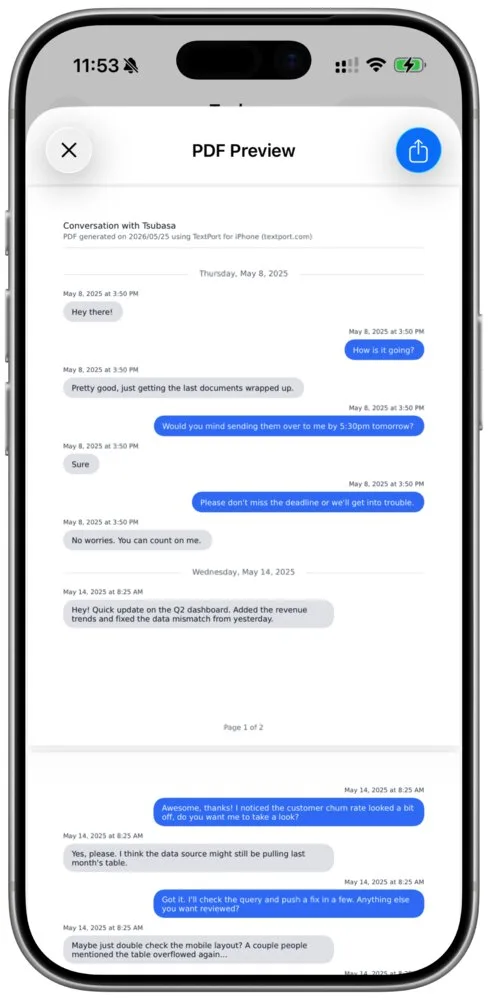
When most of the harassment is in texts, the conversation itself is your strongest exhibit, and dozens of overlapping screenshots are a clumsy way to show it. TextPort turns a conversation on your iPhone into one dated PDF, with no computer.
- iMessage and SMS come in through the TextPort Shortcut (iOS 26.4 or later), word for word with each message's own date and time, for the date range you pick.
- WhatsApp comes in from WhatsApp's own Export Chat file. Instagram, Messenger, Snapchat, Signal and other apps come in from screenshots or a screen recording, which TextPort reads, so check the result against your phone before you export.
- The PDF puts the sender and the date and time above every message, numbers the pages so your log can point to them, and can show each person's phone number next to their name.
TextPort never contacts the other person. It isn't a forensic service, and its PDFs aren't certified copies; you still tell the judge the printout matches your phone. Keep the original conversation on your phone, and store the PDF somewhere the other person can't reach. Your first three chats import for free; exporting needs a subscription. For more on saving harassing messages, see documenting harassment text messages.
Frequently asked questions
-
Your own testimony is evidence, and in many protective order cases the judge only has to find it more likely than not that the harassment happened. But it's much harder on your word alone, and some laws ask for more. California's court form says it helps to have "more proof of the harassment than just your word," and Texas's civil stalking law requires evidence beyond your own perceptions and beliefs. Start saving messages and keeping a log now, even if the earlier incidents left no trace.
-
Usually two or more. Federal law defines a course of conduct as "2 or more acts, evidencing a continuity of purpose," and California and Florida use similar wording, with no minimum time between them. One act can be enough when it's a serious threat of violence, depending on the law. Different kinds of acts, like texts one week and showing up at your work the next, can count together as one pattern.
-
Often it helps, but think about safety first. Some laws, like New York's fourth-degree stalking law and Texas's civil stalking law, look at whether the person was clearly told to stop. Stalking advocates suggest saying it once, in writing if you can, and then not replying again. If you're afraid that contact will make things worse, talk to an advocate before you send anything.
-
Courts accept circumstantial proof: details only that person would know, the way they write, messages that start right after you blocked their old account, or a call or visit that matches what a message said. Keep every account name, number and profile link, and log when each one appeared. Police can also ask the phone company or platform for account records, which you can't get yourself.
-
It depends on your state. Some states let you record a call you're part of without telling the other person; others require everyone's consent. Check your state's law before you record. Voicemails they leave you are different: you can save those, and should.
-
Only if the person you're documenting has no access to it. Stalking advocates warn that a log can end up as evidence or be seen by the stalker, and that someone with your passcode or your iCloud or Google password can read your notes and photos. A paper log in a safe place, or an account the person doesn't know about, opened only on a device they've never had, is safer.

Start exporting your messages
Available for iPhone, Mac, and Windows. No computer required.