
Can You Get a Restraining Order for Text Messages? What Evidence You Need
Yes, you can get a restraining order for text messages. Every state we checked counts texts as a way to harass, stalk or abuse someone. But the texts have to meet your state's test: usually either a real threat of violence, or a pattern of unwanted messages that would seriously distress a reasonable person and serves no legitimate purpose. One angry message rarely qualifies. Weeks of messages after you've asked them to stop often does.
What you need is mostly paperwork: printed copies of the texts showing the sender's number and the date and time of each message, a clear written description of each incident with dates, and anything that backs it up, such as police reports, photos, voicemails and witnesses. Which order you ask for depends on your relationship with the person.
This is general information, not legal advice. Orders, names and rules differ by state. If you're in immediate danger, call 911. The National Domestic Violence Hotline is at 1-800-799-7233, or text START to 88788.
Which order to ask for
Most states have two tracks. One is for abuse by a partner, ex or close family member, usually called a domestic violence or family violence order. The other is for everyone else: a neighbor, coworker, stranger, an acquaintance or a distant relative.
| State | Partner, ex or close family | Anyone else |
|---|---|---|
| California | Domestic violence restraining order (form DV-100) | Civil harassment restraining order (form CH-100) |
| Florida | Injunction for protection against domestic, dating, repeat or sexual violence | Injunction for protection against stalking, which includes cyberstalking |
| Texas | Protective order for family violence | Stalking protective order |
| New York | Family offense petition in Family Court | Generally an order issued in a criminal case |
| Washington | One petition with six types, including domestic violence | Antiharassment or stalking protection order |
Picking the right one matters. California's self-help site warns: "If you file the wrong type, the judge won't be able to make a decision in your case and you'll have to start the process over." Its line between the two is whether you had "a relationship with (more than friends)" or are a close family member, which California defines as "not an aunt, uncle or cousin." Washington, by contrast, says a petition "must not be dismissed or denied" because the facts would fit a different type of order.
In New York, Family Court is for people related by blood or marriage, with a child in common, or in an "intimate relationship," which WomensLaw notes "does not have to mean a sexual one." For anyone else, Family Court isn't an option, and protection generally comes through a criminal case: New York's criminal courts can issue a temporary order of protection "when any criminal action is pending" (Criminal Procedure Law § 530.13).
Do text messages count?
Yes, and several states say so in the statute itself:
- California defines "disturbing the peace," a form of domestic abuse, as conduct that "destroys the mental or emotional calm of the other party," committed "by any method or through any means including, but not limited to, telephone, online accounts, text messages" (Family Code § 6320). Civil harassment covers "sending harassing correspondence to an individual by any means" (Code of Civil Procedure § 527.6).
- Texas harassment includes "repeated electronic communications," defined to include a "text message, a social media platform or application" (Penal Code § 42.07), and its stalking law builds on that.
- Washington lists "text messages, contact through social media applications" as contact (RCW 7.105.010), and says a course of conduct includes "the sending of an electronic communication."
- Florida cyberstalking means a course of conduct to communicate words or images "through the use of electronic mail or electronic communication" (§ 784.048).
California's court forms also say abuse can "take place anywhere, including online."
One text, or a pattern?
This is where most text-message petitions are won or lost.
A single text can be enough if it's a real threat. California's "credible threat of violence" can be "a knowing and willful statement or course of conduct that would place a reasonable person in fear for the person's safety." New York treats one threatening electronic message as aggravated harassment (Penal Law § 240.30), which is a family offense. Washington accepts a single threat for an antiharassment order, but only a narrow kind: a malicious threat of the sort its hate-crime law covers, or one involving a gun or other weapon.
Otherwise you need a pattern. California's civil harassment form puts it simply: "A course of conduct is more than one act." El Dorado County's court packet says: "A one-time, non-violent incident is not sufficient for a Civil Harassment Restraining Order."
A burst of messages may count as one incident. In Carvajal v. Ferretti (2026), a Florida appeals court reversed a stalking injunction. The messages had been "sent via text message, WhatsApp, and email," and when the petitioner blocked one channel, the sender resent them on another "within minutes." The court held that "the October 23 barrage of messages, however offensive the Wife may deem the messages to be, amounts to only one incident as a matter of law." It added that "a reasonable person does not suffer substantial emotional distress easily," and that the petitioner's fear, lost sleep and anxiety weren't enough on their own. Other Florida courts have read the injunction statute differently, so how many incidents you need can depend on where you file.
In California, domestic violence orders are easier. California's appeals courts have upheld orders built largely on texts and posts. In Phillips v. Campbell (2016), the man "repeatedly harassed respondent by sending text messages to her, posting her personal information and photos of her on Facebook," and the court said "there is no DVPA requirement of a physical threat." In Burquet v. Brumbaugh (2014), an ex kept contacting her "by e-mail and text" after she asked him to stop, and showed up at her home; the court called that a disturbance of her "peace" and therefore "abuse." In both cases, texts weren't the only thing the court heard about, and in the appeals cases we found, the messages came with something else: a visit, a prior incident, a police report. Not every state is this broad. Texas defines family violence around physical harm or a threat that "reasonably places the member in fear of imminent physical harm" (Family Code § 71.004), and Florida's domestic violence injunction covers violence and crimes such as stalking, so harassing texts without threats may need a stalking order there.
Legitimate subjects get more leeway. Courts give room to messages about children, money or a shared business. The Florida court in Carvajal noted that "communications about financial support for a child constitute conduct with a legitimate purpose."
What evidence you need
Courts don't give a fixed list, but the court and legal-aid pages we checked converge on the same items:
- The texts, printed. California's self-help pages list "text messages" alongside pictures and emails as evidence to gather, and say to "make 3 copies of any document you want the judge to see." Placer County Superior Court tells petitioners to bring texts "in a form (for example: printed out) that can be marked as an exhibit and left with the court," because "the court will not be able to look at the item on your phone or computer."
- The sender's number and the dates. Print the whole conversation for the dates that matter, with the phone number visible, not just the name you saved them under, and the date and time on every message.
- A written account of each incident. Dates, what happened, what was said, who saw it. A log kept as things happened is the easiest way to write this. See how to prove harassment or stalking for a template.
- Your request to stop. If you told them to stop contacting you, that message matters. Washington's law treats whether "the respondent has been given clear notice that all further contact with the petitioner is unwanted" as a factor.
- Police reports. TexasLawHelp says: "If you have made reports before, it is more likely that a PO will be granted."
- Voicemails, call logs, photos, emails and social media posts. Some judges want a written transcript of a recording; California says to check with your self-help center first.
- Witnesses. Bring them to the hearing. Some courts won't accept a letter in place of a witness who can be questioned.
Skipping the printouts can sink a case. A Florida court summary describes Reid v. Saunders (2017), where an injunction was reversed because "the petitioner did not provide documentation of the numerous phone calls, emails and texts referenced during the hearing, and, without those, there was no way for the trial court to determine whether the communications would have created substantial emotional distress."
Bring your phone too, with the original messages still on it, in case the other side claims the printout was changed. But don't count on showing it instead of paper. If the other side says they didn't send the messages, how to authenticate text messages for court has a script for explaining how you know it was them.
What the petition asks
The petition is your sworn statement, and at the first stage it may be all the judge reads. In Florida, for a temporary injunction, "evidence other than verified pleadings or affidavits may not be used" unless the other person is present. California's self-help site says of the description section: "The judge will decide whether to grant (give) you a restraining order based on what you write in this section."
The forms ask about texts directly:
- California DV-100, item 5f: "Give more details about how the person in 2 was abusive on this day. Details can include what was said, done, or sent to you (examples: text messages, emails, or pictures), how often something happened, etc." Item 5g asks how often: "Just this once," "2–5 times," "Weekly," or other.
- California CH-100 asks when the most recent harassment happened, who else was there, how they harassed you, and then whether they "harassed you at other times," with dates.
- Washington's petition asks "How were any statements made? (in person, mail, text, phone, email, social media)" and has a Supporting Evidence checklist with a box for "Text/email/social media messages."
- Florida's stalking petition asks you to describe each incident, and "for cyberstalking, please include a description of all evidence of contacts and/or threats made by Respondent in voice messages, texts, emails, or other electronic communication."
Tips from the courts' own instructions:
- Start with the most recent incident. California: "Start with the most recent incident, even if it is not the worst one."
- Quote the messages. Tell the judge "what they said each time they harassed you." Write the threat in the sender's words, not a summary.
- Estimate when you're unsure. "If you don't remember the exact day something happened, give an estimate and write down that it is an estimate."
- Attach the texts if you can. California says: "If you have proof (like an email or a text message), you can include it with your request."
- Assume they'll read it. Washington's form warns: "The restrained person will see this Petition and any other evidence you file with the court."
- Be accurate. You sign it under penalty of perjury.
How the process works
The steps are similar everywhere:
- File the petition. A judge decides on a temporary order quickly. In California, "the judge will make a decision the same day or by the next business day."
- The other person is served. You can't serve the papers yourself. In California, a sheriff or marshal can usually do it for free, and "once they are served, the police can arrest them if they violate the order."
- The hearing. Usually within about three weeks: California's civil harassment law sets 21 days, or 25 for good cause; Florida's temporary injunction lasts up to 15 days, with the hearing before it expires; Texas hearings usually happen "within about two weeks." Both sides can present evidence and witnesses. The person you're filing against can usually ask for more time.
- The decision. If the judge grants it, the order lasts for a set time.
| State | Filing fee | How long a final order can last |
|---|---|---|
| California | None for domestic violence. Civil harassment: $435–$450, waived if you allege violence, stalking or threats, or get a fee waiver | Up to 5 years |
| Florida | None for domestic violence or stalking | Until the court changes or ends it |
| Texas | None | Family violence usually 2 years; stalking can be for life |
| New York | None | Usually up to 2 years, up to 5 in some cases |
| Washington | None for domestic violence or stalking; antiharassment may have a fee | A fixed time or permanent |
You don't need a lawyer. California's site says "you do not have to have a lawyer" for a domestic violence order, Florida's stalking law says the case "does not require either party to be represented by an attorney," and New York can appoint a free lawyer for low-income petitioners in Family Court. TexasLawHelp publishes a do-it-yourself kit but calls going without a lawyer a "last resort." Court self-help centers and domestic violence agencies help with the forms. TexasLawHelp adds a warning worth taking: "Don't delay in applying for a protective order... Waiting will reduce your chances of getting a PO because the threat of immediate danger has passed."
If they text you after the order
A text can violate a no-contact order. California's civil harassment order lists contact "by email, by text message, by fax, or by other electronic means." TexasLawHelp says "even a text or a message through a family member or friend can be considered a violation."
If it happens:
- Save it. Don't delete it or reply.
- Report it. California tells people to "call 9-1-1 if you want the police to enforce your restraining order," which is valid in all 50 states. Get a report number.
- Keep your copy of the order with you. California suggests photographing every page on your phone.
In Florida, continuing to harass someone after an injunction can be aggravated stalking, a felony. Under California's and New York's rules, the order binds the restrained person, not you. Still, texting them yourself can make a judge doubt that contact is unwanted, so avoid it.
Getting the texts ready for court
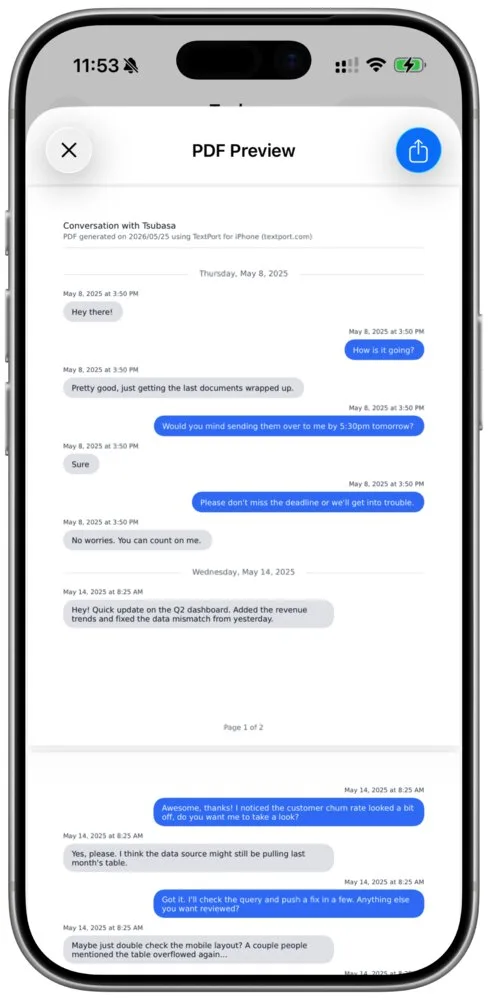
Printing a long conversation from an iPhone usually means dozens of screenshots with dates missing from most of them. TextPort turns the conversation into one PDF on the phone itself, with no computer, which you can print three times for the hearing.
- iMessage and SMS come in through the TextPort Shortcut (iOS 26.4 or later), word for word with each message's own date and time, for the date range you pick.
- WhatsApp comes in from WhatsApp's own Export Chat file. Instagram, Messenger, Snapchat, Signal and other apps come in from screenshots or a screen recording, which TextPort reads, so check the result against your phone before you export.
- The PDF puts the sender and the date and time above every message, numbers every page so your petition can point to them, and can show each person's phone number next to their name.
TextPort never contacts the other person. Its PDFs aren't certified copies, and no app makes a "court-certified" export: you still tell the judge the printout matches your phone, so keep the original messages on it. Your first three chats import for free; exporting needs a subscription. For more on saving harassing texts, see documenting harassment text messages, and for reporting them to police, how to report harassing text messages.
Frequently asked questions
-
In some states, yes. California's domestic violence order doesn't require a threat: the law counts conduct that "destroys the mental or emotional calm" of the other person, including through text messages. Other states are stricter: Texas's family violence order centers on physical harm or threats of it, so non-threatening texts from an ex may fit its stalking order better. Against anyone else, harassment orders usually need a pattern of unwanted contact that serves no legitimate purpose and would seriously distress a reasonable person. A few rude texts in one argument usually aren't enough.
-
There's no set number. Most harassment and stalking orders need more than one incident, and a burst of messages sent within minutes may count as only one. A Florida appeals court held in 2026 that texts, WhatsApp messages and emails sent within minutes about the same thing were one incident "as a matter of law." A single text can be enough when it's a real threat of violence, depending on your state.
-
No. California's and Florida's courts say you can file without one, Texas legal aid publishes a do-it-yourself kit, and court self-help centers and domestic violence agencies help with the forms for free. TexasLawHelp still recommends a lawyer if you can get one, and a lawyer helps most when the other side has one, when custody is involved, or when your case is mostly texts without threats.
-
Yes. The person you're filing against gets a copy of your petition and what you attach to it. Washington's form warns that "the restrained person will see this Petition and any other evidence you file," and Texas's kit says the same about your sworn statement. If you've moved and don't want them to know where, ask the clerk or self-help center how to keep your address confidential before you file.
-
Usually not on their own. Courts treat genuine messages about children, money or a shared business as having a legitimate purpose. A Florida appeals court said messages about child support are "analytically distinct from alleged harassment." What can count is the same subject used as cover for threats, insults or dozens of messages a day after you've asked them to keep it to logistics.
-
It doesn't disqualify you, but it can make your case harder. Judges look at whether the contact was unwanted, and Washington's law lists whether contact "was initiated by the respondent only or was initiated by both parties" as a factor. Include your replies in the record anyway; leaving them out looks worse. If it's safe, one clear message asking them to stop, followed by no more replies, puts the line in writing.

Start exporting your messages
Available for iPhone, Mac, and Windows. No computer required.