
How to File a Police Report for Harassment (and Press Charges)
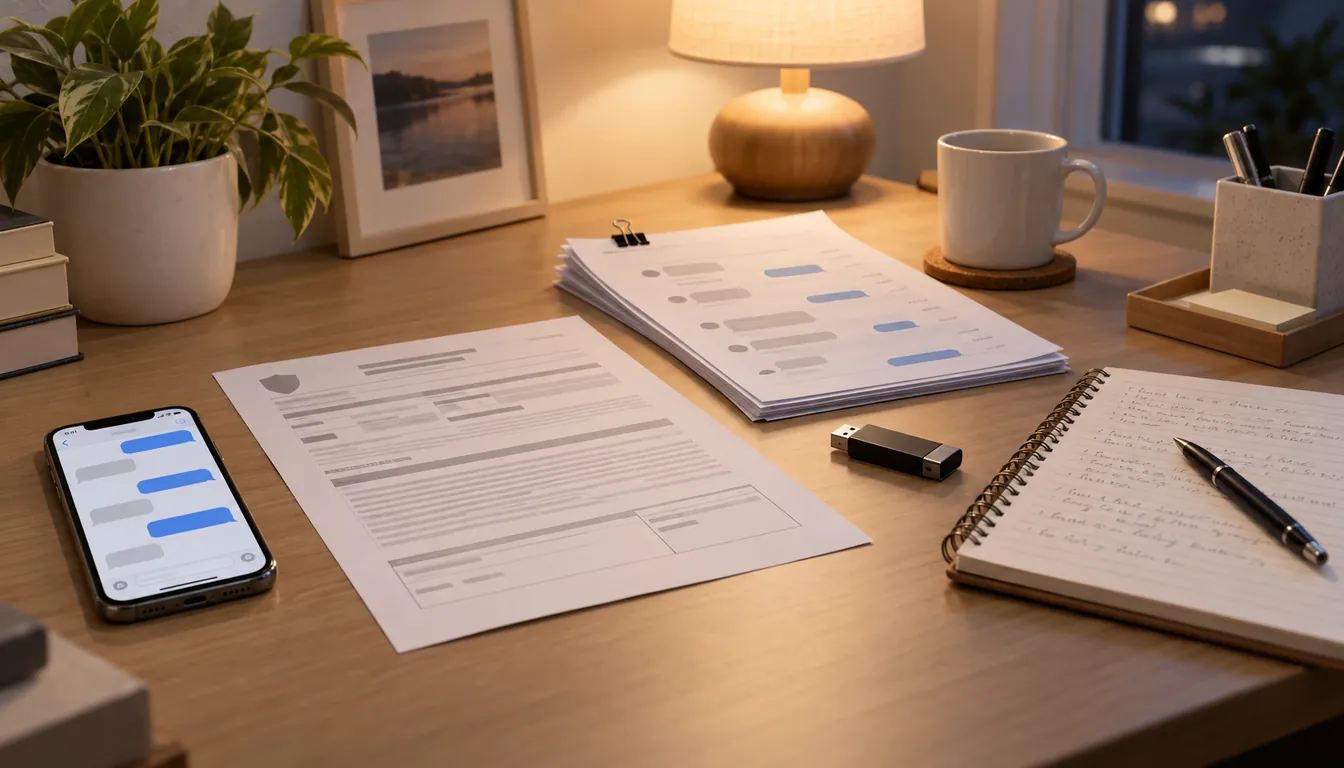
To report someone for harassment to the police, call 911 if you're in danger right now. Otherwise, go to the station, call your department's non-emergency line, or file online if your department allows it; Los Angeles, San Jose and Seattle take online reports only when you don't know who's doing it. Bring the saved messages, a list of every number the person used and a short timeline, and leave with a report number. You don't press charges yourself: a prosecutor decides. But some states, including Pennsylvania, Massachusetts and New Jersey, let you put a complaint in front of a prosecutor or a court yourself.
When the harassment comes by text, the messages are what the officer, the prosecutor and the judge will read. Your copy may be the only one. NNEDV's evidence guide for police says "Most phone companies do not store the actual content of a text message for long, if at all."
This is general information, not legal advice. Reporting rules differ by state, county and police department. If you're in immediate danger, call 911. The National Domestic Violence Hotline is at 1-800-799-7233, or text START to 88788.
911, the non-emergency line, or online
Call 911 when a message threatens violence and you think it could happen. How to report harassing text messages covers that call and what to save first.
Otherwise, you report in person, by phone or online, depending on the department. Philadelphia takes no reports by phone or online: "To file a report, please visit any Police District in person or call 911 to have an officer dispatched to your location."
Filing a harassment complaint online has a catch: many systems are only for strangers.
| Department | Harassment reports online? | If you know who's doing it |
|---|---|---|
| Los Angeles (LAPD) | Yes: harassing calls, texts and emails | Not online: call the non-emergency line |
| San Jose | Yes, or by phone at (408) 277-8900 | Not online: go to the station or call (408) 277-8900 |
| Houston | Yes: harassment by electronic means | Online is fine, except some threats (see below) |
| Chicago | Online reports only when you don't know who did it | Call 311 |
| New York (NYPD) | No: only lost property, petit larceny, criminal mischief and graffiti | Go to your precinct |
| Philadelphia | No online or phone reports | Go to a police district or call 911 |
| Seattle | Yes: harassing phone calls | Not online: call the non-emergency line |
Sources: LAPD, San Jose, Houston, Chicago, NYPD and NYPD Online, Philadelphia, Seattle.
Houston asks for the suspect's name, phone number and address "whether the suspect is known or unknown", from anyone 17 or older with an ID number and an email address. But if the harasser is an ex or a relative, read the exclusion: "Threats involving weapons, family or household relationships, schools ... may not be eligible for online reporting."
An online report is often filed, not investigated. Seattle says "we won't be able to investigate most cases." If you know who's harassing you, talk to an officer.
Which department. In several states, you can report where you got the messages. California law lets harassment by electronic message be treated as committed where it was sent or "first viewed by the recipient", and Pennsylvania, Washington and New Jersey can count it where it was sent or received. In those states, the police where you live can take the report, even if the person is in another state. Elsewhere, ask your department whether it will.
What to bring and what to say
- The conversation, printed: the whole thread for the dates involved, with the sender's number and the date and time on every message.
- Every number and account the person has used.
- A short timeline of incidents, with each threat in the sender's exact words. A stalking log makes this easy.
- Their name and address, if you know them, and your ID. A citizen complaint in Philadelphia or Massachusetts needs the person's address.
Tell the officer what happened, how often and since when, and whether you told the person to stop. If you're told texting isn't a crime, point to the law. Texas's harassment law covers anyone who, with intent to harass, annoy, alarm, abuse, torment, or embarrass another, "sends repeated electronic communications in a manner reasonably likely to harass, annoy, alarm, abuse, torment, embarrass, or offend another". In Florida, repeated harassing texts that cause substantial emotional distress and serve no legitimate purpose fit the cyberstalking law, § 784.048, not the harassing-phone-call law. Stick to what you know: a false report is a crime.
Before you leave, write down the officer's name and badge number, the report number, and the precinct or district.
Handing over your texts and your phone
Ask the officer how they want the messages:
- An upload link. San Francisco officers can use Axon Community Request to text or email you "a link to upload the video/photos/audio." Ask whether a PDF of the conversation is accepted.
- An upload page. In Bryan, Texas, you enter the officer's case number, and "you will receive a private link to share photos and videos."
- A USB drive. San Francisco officers "should seize the storage device and book accordingly." Don't hand over your only copy.
- Paper. Printed screenshots are one of the ways texts get into a case, according to NNEDV's tips for prosecutors.
Your phone. NNEDV's guidance for investigators says survivors should be told what will be collected before their devices are examined. Ask what they'll take and when you'll get it back, and keep printouts of your own.
Ask for a preservation request. You can't make a carrier or app keep its records, but police can. Under federal law, a provider must preserve them "upon the request of a governmental entity" for 90 days, renewable for 90 more. Ask the officer to send one soon.
Which texts to bring:
- Every message from the person, including from new numbers or accounts.
- Your replies, and any message where you told them to stop.
- Each threat, with the messages before and after it.
- Photos, voicemails and call logs that go with them.
Save the whole conversation with its dates and the sender's number, not cropped screenshots. To stop your iPhone from deleting old texts, go to Settings > Apps > Messages > Keep Messages and choose Forever. Keep the original on your phone. TextPort can turn the conversation into one PDF on your iPhone, with the sender and the date and time above every message, to print for the officer. For more, see documenting harassment text messages.
Your report number and a copy of the report
If you file online, the first number you get is only temporary. At LAPD, "Once the report has been approved, a LAPD report number will be issued and a copy of the final report will be emailed back to you." Houston's temporary case number comes with a warning: "This is not an official HPD Incident Number. It is a reference number only". Use the official number with the prosecutor, in a protective order petition and with your phone company, as San Jose advises. To add later incidents at LAPD, call the detective on your case once you have the final number.
| Where | What you get | Cost and timing |
|---|---|---|
| New York | A copy of the police report, by state law | Free |
| NYPD | A verification of the complaint report, a short summary; you need the complaint number from your precinct | Free, online or by mail |
| California | Incident reports, for victims of domestic violence, sexual assault, stalking and some other crimes | Free, within 5 working days (10 with good cause) |
| Houston | Usually only the public information portion | Same day at the Records Division counter, with the incident number |
| Miami-Dade Sheriff | A copy of the report | 15 cents a page; $1 a page certified |
New York's law entitles a victim "without charge to a copy of a police report of the crime", but NYPD's free verification, requested at GetMyReport.NYPDonline.org, is a summary: "A Verification Report is not the same as a complaint report." The other rows come from California Family Code § 6228, Houston police and the Miami-Dade Sheriff's Office.
Pressing charges: the prosecutor decides
The state brings criminal charges; you're the victim and a witness.
- California: "Only the prosecutor can file or dismiss charges." (Riverside County DA)
- Texas: "The State of Texas files the charge against the defendant." (Harris County DA)
- New York: "charges can only be brought by the District Attorney's Office, not by the victim." (Broome County DA)
- Florida: the State Attorney's office "has discretion whether to prosecute a person for a crime" and must tell you its decision.
You can't drop charges on your own either. The Tarrant County DA says "The victim's wishes alone do not dictate whether or not a case will be filed, tried or dismissed." In New York domestic violence cases, "No criminal charges can be dropped unless the District Attorney's office and the judge agree to drop the charges." Harris County says a case can take from several months to two years or more.
What the police can do about harassment
- Take the report, contact the person and investigate.
- Ask the carrier or app to preserve records, then get them with a subpoena or warrant. NNEDV warns that even that "will not get the actual content of a text message unless done quickly."
- Arrest, when the law allows. In Florida, an officer can arrest without a warrant on probable cause of stalking or cyberstalking (§ 784.048); for other misdemeanors, such as harassing phone calls, an arrest without a warrant generally requires that the officer saw it, with exceptions such as domestic violence (§ 901.15).
- Send the case to the prosecutor, who decides.
Deadlines to charge
These are the prosecutor's deadlines to file charges, not deadlines to report. Report as soon as you can.
| State | Offense | Charges must be filed within |
|---|---|---|
| California | Misdemeanors, such as harassing electronic contact (Penal Code § 653m) | 1 year |
| Texas | Class A and B misdemeanors, such as harassment (Penal Code § 42.07) | 2 years |
| New York | Harassment in the second degree, a violation | 1 year |
| New York | Aggravated harassment in the second degree, a class A misdemeanor | 2 years |
| Florida | First-degree misdemeanors, such as stalking and cyberstalking | 2 years |
| Florida | Second-degree misdemeanors, such as harassing phone calls | 1 year |
| Washington | Gross misdemeanors, such as harassment and cyber harassment | 2 years |
| Pennsylvania | General rule | 2 years |
Sources: Cal. Penal Code § 802, Tex. Code Crim. Proc. art. 12.02, N.Y. Penal Law § 240.26, § 240.30 and CPL § 30.10, Fla. Stat. § 775.15, RCW 9A.04.080, 42 Pa.C.S. § 5552.
How to file a harassment charge against someone yourself
Pennsylvania, Massachusetts and New Jersey let you take a complaint to a prosecutor or a court yourself; in Texas, you can ask a prosecutor to take a sworn complaint. Elsewhere, ask your local criminal court's clerk whether a citizen can apply for a complaint or warrant.
How to file harassment charges in Pennsylvania
Pennsylvania's harassment law, 18 Pa.C.S. § 2709, grades the offense by what the person did:
| Conduct | Grade | Maximum penalty |
|---|---|---|
| Physical contact or threats of it, following you in public, or a course of conduct with no legitimate purpose: (a)(1) to (3) | Summary offense (third-degree misdemeanor if they've violated a protection from abuse order for you or your family) | 90 days in jail, $300 fine |
| Lewd, threatening or obscene messages, or repeated messages that are anonymous, at extremely inconvenient hours, or otherwise harassing: (a)(4) to (7) | Misdemeanor of the third degree | 1 year in jail, $2,500 fine |
The law's definition of communicating includes electronic means, so (a)(4) to (7) cover harassing texts, and those are misdemeanors.
Report it to police, or file a private criminal complaint under Rule 506. When officers didn't see what happened, Lehigh County's law library notes, "the police may instruct you to file a private complaint."
- Get the form from the magisterial district judge's office or the state courts' website.
- Write the facts in detail: who, what, when and where, with the person's name and address. Attach the printed messages.
- Cite the law, for example 18 Pa.C.S. § 2709(a)(7).
- Submit it where your county says: Lehigh sends you to the district judge where it happened, Lancaster to the DA's office.
- Wait for review. Because texting harassment is a misdemeanor, the DA's office has to approve it: "Felonies and Misdemeanors must be reviewed by an Assistant District Attorney."
You have to show probable cause, and "Filing a private criminal complaint in no way guarantees that criminal charges will be filed." If the DA disapproves it, the reasons go on the form, and you can ask the Court of Common Pleas to review the decision.
In Philadelphia, go to the DA's Private Criminal Complaint Unit, 4th Floor, 1425 Arch Street. "You must bring with you, the police report, district control number and the accused's full name and address (home or work)." Another Municipal Court page says "Anyone can submit a criminal case with the court, even if there is not a police report", so if you have no report, ask the unit before you go. Philly311 says the unit handles misdemeanors only, including harassment by communication, and that you must have witnessed the crime or have a witness. An approved complaint costs $39.10 to file with Municipal Court and goes before a trial commissioner; unresolved ones go to mandatory mediation.
How to file harassment charges in Texas
Texas's Penal Code § 42.07 names text messages and covers threats sent from disposable numbers. It's a Class B misdemeanor, punishable by up to 180 days in jail, a fine of up to $2,000, or both (§ 12.22).
Start with the police where it happened; that's where the Tarrant County DA sends people who ask how to press charges. You can also go to the prosecutor. Code of Criminal Procedure art. 2A.107, in effect since January 1, 2025, says that when a complaint is made before a district or county attorney, the attorney is to write it down, "cause the complaint to be signed and sworn to by the complainant", and for a misdemeanor, file an information. The prosecutor still decides whether a case is filed, as the Tarrant County DA says above. Call the office that handles misdemeanors in your county, ask whether it takes sworn complaints from victims, and bring the printed messages.
Massachusetts: apply to the court
Mass.gov lists the steps: fill out a Police Incident Report form at the station nearest where it happened, take a copy to the nearest District Court or Boston Municipal Court, apply for a criminal complaint and pay $15 (or ask for a fee waiver). A hearing is then usually scheduled, which both of you must attend, and "if the clerk-magistrate finds probable cause (sufficient evidence), the criminal complaint will issue." The District Court's standards say you may apply without going to police first, but you have "no right to a show cause hearing on such an application, no right to have a criminal complaint authorized, and no right to appeal its denial."
New Jersey: a citizen complaint in municipal court
Harassment in New Jersey is a petty disorderly persons offense (2C:33-4). You can start a complaint at the municipal court or the police department. The courts' 2019 directive favors the police, because officers can advise on "what charge(s) to file, something court staff is precluded from doing." Camden's court guide warns that a filed complaint can't be withdrawn and generally can't be dismissed without the prosecutor's consent, and that you can ask for mediation instead.
If the police won't take a report or won't act
- Go to a prosecutor or a court, as above. In Florida, a State Attorney's office "may pursue a case directly submitted to the office" but will likely send it back to police.
- In New York, a victim of a family offense who says reporting locally is a hardship can report to any police agency in the state, which "shall take a police report of the matter".
- Ask for a protective order. "An arrest is not required for the issuance of Supreme Court or Family Court orders of protection" in New York. See can you get a restraining order for text messages.
- For threats over the internet, file with the FBI's IC3. It forwards complaints to law enforcement but doesn't investigate: "You will not hear from the IC3." It takes no attachments and won't email you a copy, so save your complaint before closing the page and keep your originals.
- Keep reporting each new incident under your report number, and keep a log.
Saving the texts as one dated PDF
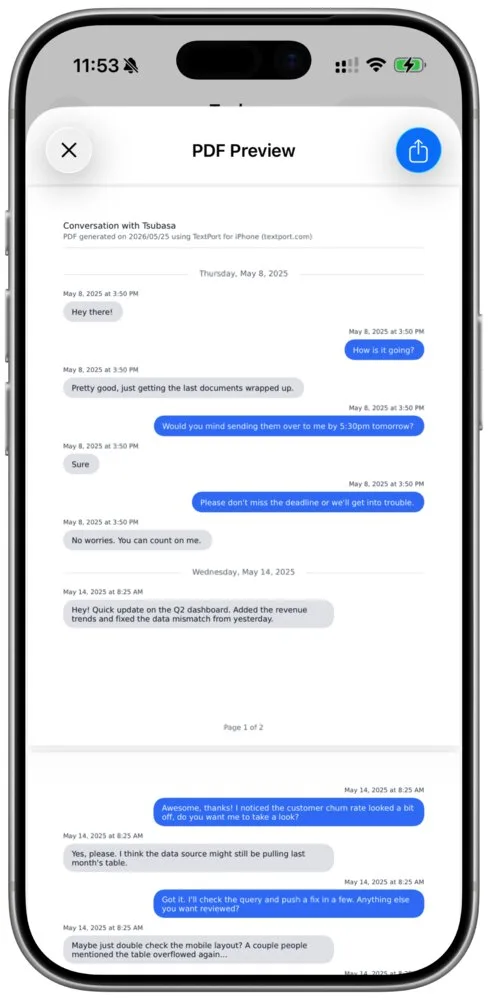
TextPort turns the conversation with the person harassing you into one PDF on your iPhone, with no computer, ready to print for the officer or attach to a private criminal complaint.
- iMessage and SMS come in through the TextPort Shortcut (iOS 26.4 or later), word for word with each message's date and time, for the date range you pick.
- WhatsApp comes in from WhatsApp's own Export Chat file. Messenger, Instagram, Signal and other apps come in from screenshots or a screen recording, which TextPort reads, so check the result against your phone before you export.
- The export is a PDF with the sender, date and time above every message and numbered pages, a CSV spreadsheet, or plain text. Photos from iMessage and WhatsApp chats print in the PDF. You can send it as a link instead of an attachment.
Frequently asked questions
-
Sometimes. Los Angeles and San Jose take harassing call and text reports online, and Seattle harassing phone call reports, but only when you don't know who's doing it, and Chicago sends anyone who knows the offender to 311. Houston is the exception: it takes harassment by electronic means online even when you know the person, except for threats involving weapons, family or household members, schools and similar cases. Philadelphia takes no reports online or by phone. Seattle says it won't be able to investigate most online reports, so if you know who it is, talk to an officer.
-
Report it to the police, or file a private criminal complaint under Pennsylvania Rule of Criminal Procedure 506. Harassment by texts or calls (18 Pa.C.S. § 2709(a)(4) to (7)) is a misdemeanor of the third degree, so an assistant district attorney has to approve the complaint before charges issue. Get the form from the magisterial district judge's office, describe the facts in detail, cite the statute, and attach the printed messages. In Philadelphia, file at the DA's Private Criminal Complaint Unit, 1425 Arch Street, 4th floor, with the person's full name and address and, if you have them, the police report and district control number. If the DA disapproves it, you can ask the Court of Common Pleas to review the decision.
-
Report it to the police department or sheriff where it happened; that's where Tarrant County's district attorney sends people who ask how to press charges. Texas Code of Criminal Procedure article 2A.107 also says what a district or county attorney does when someone makes a complaint before them: put it in writing, have the complainant sign and swear to it, and for a misdemeanor, prepare and file an information. The prosecutor still decides: Tarrant County's DA says the victim's wishes alone don't decide whether a case is filed. Harassment by repeated texts is a Class B misdemeanor under Penal Code § 42.07, punishable by up to 180 days in jail, a fine of up to $2,000, or both, and it has to be charged within two years.
-
They can take a report and give you a report number, contact the person, ask the phone company or app to preserve its records (only a government agency can require that under federal law), get records through a subpoena or warrant, arrest when the law allows it, and send the case to the prosecutor. They can't guarantee charges: the prosecutor decides. Online reports made without a known suspect are often reviewed but not investigated.
-
In several states, you can report it where you got the messages. California law lets a harassing electronic message be treated as committed where it was sent or where you first viewed it, and Pennsylvania, Washington and New Jersey can count it where it was sent or received. So in those states, your local police can take the report; elsewhere, ask yours whether they will. Whether the person is charged is up to the prosecutor. For threats over the internet, you can also file with the FBI's Internet Crime Complaint Center (IC3), which forwards complaints to agencies but doesn't investigate them itself.
-
Not on your own. Prosecutors in Tarrant County, Texas, and Kitsap County, Washington, say only a prosecutor, with a judge's approval, can drop charges; Kitsap adds that the victim's wishes are taken into account. In New York domestic violence cases, the DA and the judge both have to agree. In New Jersey, Camden's municipal court guide says a complaint you signed can't be withdrawn and generally can't be dismissed without the prosecutor's consent.

Start exporting your messages
Available for iPhone, Mac, and Windows. No computer required.