
How to Win in Small Claims Court: Prepare Your Case and Evidence
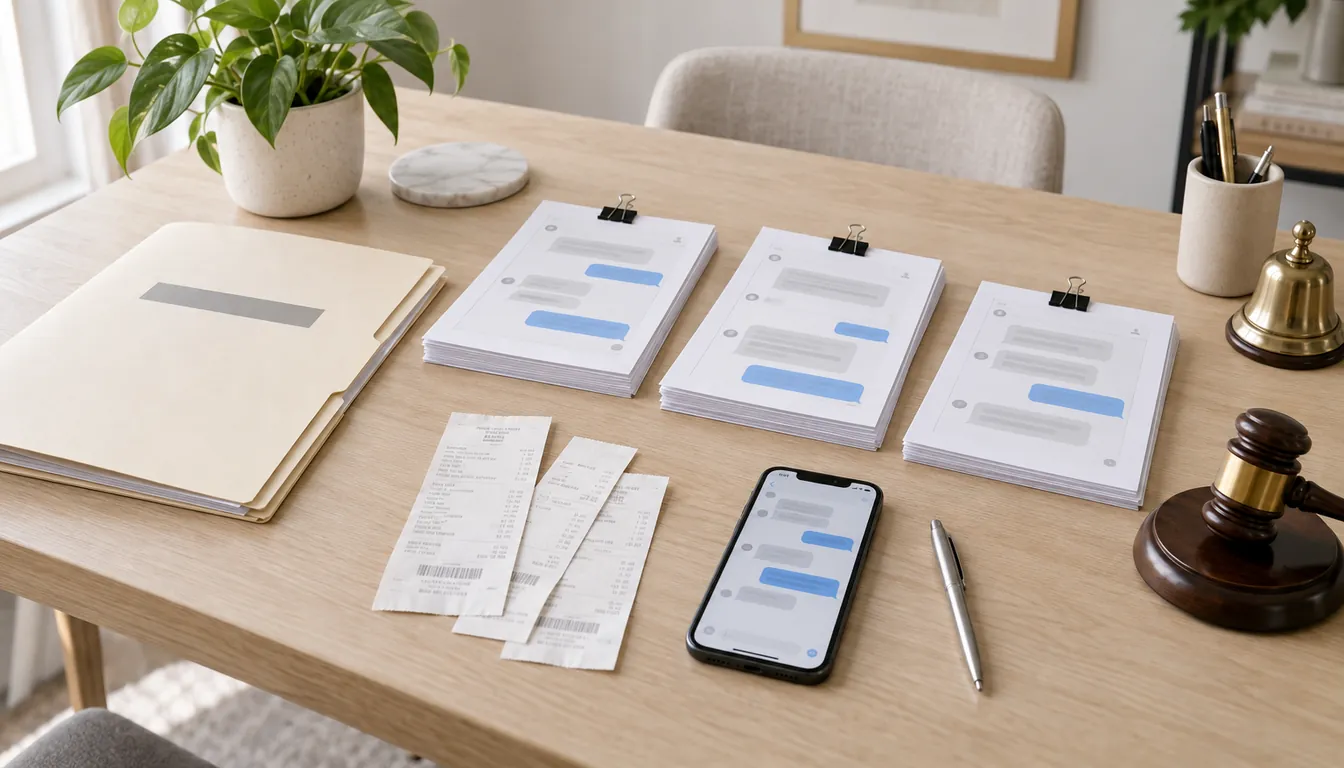
To win in small claims court, ask for the money first, sue for no more than your state's limit, have the papers served properly, and bring organized copies of your proof: the agreement, receipts, photos, estimates and texts. At the hearing, tell the judge in a few minutes and in date order what happened, how much you're owed and why. Then plan to collect, because the court won't do it for you.
Texts matter because many small claims cases have no written contract. The loan, the price of the job and the promise to pay you back by Friday often exist only in a text thread. New York's small claims guide for courts outside NYC lists "Printed evidence from your computer or cell phone" next to receipts and photos.
This is general information, not legal advice. Small claims rules differ by state and often by county, so read your court's self-help pages before you file. For free help, ask your court's self-help center or local legal aid.
Is small claims court worth it?
It depends on whether your claim fits under the limit, whether you can prove it, and whether the other side can pay.
| State | Where you file | Limit | Filing fee |
|---|---|---|---|
| California | Small claims court | $12,500 for individuals; $6,250 for businesses | $30 to $75 by amount ($100 for frequent filers) |
| Texas | Justice court | $20,000, including any attorney fees | $54, plus a service fee set by county |
| Florida | County court | $8,000, not counting costs, interest and attorneys' fees | $50 to $295 by amount, plus a $4 clerk fee and a summons fee |
| New York | Small claims part of your local court | $10,000 in NYC; $5,000 in City Courts, Nassau and western Suffolk; $3,000 in eastern Suffolk and in Town and Village Courts | $15 or $20 ($10 or $15 in Town and Village Courts) |
| Washington | District court small claims department | $10,000 for individuals; $5,000 for others | $35 or $50, by county |
Sources: California, Texas, Florida rules and fees, New York limits and fees, Washington.
- California allows only two claims over $2,500 per calendar year, statewide (§ 116.231), and you can give up any amount over the limit to stay in small claims.
- Texas hears small claims in justice court; it abolished its separate small claims court in 2013.
- New York lets only individuals sue: "Corporations, partnerships, associations, or assignees cannot sue in Small Claims Court."
California's courts put the real question plainly: "If you win in court, does the other side have the money to pay you?"
Expect a trial 1 to 2 months after filing in California; Texas gives at least 45 days' notice of trial. California's common deadlines to sue are 4 years from a broken written agreement and 2 years from a verbal one; whether a text counts as written is its own question (are text messages legally binding).
The most common cases have their own guides: security deposits, contractor disputes and money someone owes you.
Step 1: Ask for the money first
In California, it's required: "You must ask the defendant (in person, in writing, or by phone) to pay you before you sue." You don't have to if there's a restraining order or asking would be dangerous. Washington legal aid recommends a demand letter, partly to show the judge you tried to settle: "Your demand letter can simply state the facts of what happened (with dates and times), why what happened cost you money, and state how much the person owes you." Texas and Florida don't require one for small claims, and New York's rule covers only businesses, but a demand is the cheapest way to get paid.
Give a deadline and say you'll sue if they don't pay. Send it by letter or email, keep a copy, and save any reply by text: an admission, a lower offer or a refusal is often your best evidence.
Step 2: File and get the papers served
After you file and pay the fee, the other side must be served formally, and not by you:
- California: an adult who isn't in the case serves the papers at least 15 days before the court date (20 if the other side is in another county), or 10 days earlier than that if they leave the papers with another adult at the home or workplace. File the Proof of Service at least 5 days before the hearing. The clerk's $15 certified-mail option often fails. Santa Clara County's court warns: "Phoning, faxing, e-mailing, or leaving papers on a doorstep or windshield is not proper service."
- Texas: a sheriff, constable, certified process server, the clerk by restricted-delivery mail or an adult the court authorizes serves the papers, never a party. One Grayson County justice court charges $105 per defendant.
- New York City: the clerk mails the notice for you.
- Washington: service "must be complete at least ten calendar days prior to the first hearing".
Step 3: Build your evidence file
New York's guide lists photos, agreements, letters, bills, canceled checks, receipts and printed evidence from your phone. For repair money, "bring 2 signed itemized written estimates as proof to support your claim."
Courts want copies they can keep, and the count varies even within a state: California's guide says one for the judge and one for the other side, keeping the originals; San Mateo County at least 3; Santa Clara County one of each document; a Volusia County, Florida judge the original and two copies. Ventura County wants exhibits exchanged at least 5 days before trial. Washington legal aid adds: "You won't be able to submit evidence after the trial, so if in doubt, bring it with you."
Put it all in date order in a folder with tabs, because "You won't have time to look for papers in a stack while at your hearing."
Witnesses. If someone else made a document, they may need to come. The Volusia judge warns that "Estimates, letters and affidavits may be inadmissible (excluded) if an objection is raised". In California, a declaration under penalty of perjury (form MC-030) "can be used instead of live witness testimony in Small Claims Court". In Washington, legal aid says you can't subpoena a witness to small claims court, so line up witnesses who will come on their own.
Text messages, screenshots and your phone
Courts take texts in a form they can keep. The Volusia judge's notice says: "If you have photos, videos, text messages, etc, you will need to have a way to show the court, and have a way to submit that evidence to the clerk... printed hard copies or on a CD/DVD/flash drive". A Texas justice court in Grayson County wants printed or USB copies. Ohio legal aid, writing about court evidence generally, is blunt: "But you can't just come to court and show the judge your phone." Bring the phone as backup.
Which texts to save:
- The deal: the price, the amount, what was promised.
- Payments and admissions: sent, I know I owe you.
- Your demand and their reply, or their silence.
- Photos sent in the chat, and messages that fix dates, like when the work stopped.
How to save them:
- Stop deletion. On your iPhone, go to Settings > Apps > Messages > Keep Messages and choose Forever.
- Save the whole conversation for the dates involved, not just the good messages.
- Show who and when: the date and time on every message, the other person's name or number, and the photos.
- Keep the original on your phone, and bring the phone, charged.
Print the conversation, number the pages, and make as many copies as your court asks for. TextPort makes the PDF on an iPhone: one file with numbered pages and the date and time above every message, ready to print. For a remote hearing, California says "you need to find out how to get your evidence to the court" and send it to the other side beforehand. Ventura County takes emailed exhibits only up to 10 pages in total, so a long thread may have to be mailed or brought in. Alameda County has a digital evidence portal.
For more on printing texts, see text messages in small claims court. If the other side says they're fake, see how to authenticate text messages for court.
How long a small claims hearing takes, and what happens
San Mateo County's court says "Small claims trials last between 10-15 minutes so you want to keep to the point and be brief." Los Angeles County's consumer affairs department says most last 15 to 20 minutes; Washington legal aid says many take 30 minutes or less. The wait is longer: California says "You may be in court for 4 or more hours." If you can, watch a few hearings first.
In California, the plaintiff speaks first, then the defendant. Other rules vary:
- Texas: hearings are informal by law, and the rules of evidence apply only where the judge decides fairness needs them (Gov't Code § 27.060). Either side can get a jury by filing a written demand at least 14 days before trial and paying $22.
- New York City: hearings are usually at 6:30 p.m., and "Small Claims Court cases are mostly decided by volunteer Arbitrators." Either side can choose a judge instead, which can matter for an appeal.
- Lawyers: banned in California (§ 116.530), allowed in Washington only with the judge's consent (RCW 12.40.080), and allowed but not needed in Texas, Florida and New York.
Show up. In California, a plaintiff who doesn't come has the case dismissed, and "If the defendant doesn't show up and the plaintiff can prove their case, the plaintiff will likely win."
How to present your case in a few minutes
California's guide: "In a few minutes, you will tell the judge what you want and why."
- Start with the amount and the reason, in one sentence.
- Tell it in order. San Mateo: "It is usually best to present them in chronological order and group facts together."
- Point to the page of each exhibit as you go.
- Give the legal reason. The judge "can't make a decision based simply on feelings of unfairness." Name the agreement or the damage, and show how you got to the amount.
An opening can be this short:
I lent the defendant $1,800 on March 3. She agreed by text to pay it back by June 1; that's page 2. She paid $300 on May 10, in the Venmo record at tab B. I asked for the other $1,500 in writing on July 1, page 5, and she didn't answer. I'm asking for $1,500.
How to defend yourself in small claims court
If you're sued, your first deadline may come early:
- Texas: file a written answer by the end of the 14th day after you were served (Rules, Part V). A general denial is enough; miss the deadline and the plaintiff can get a default judgment.
- California: you file no answer. Come on the court date with your witnesses and evidence, and counter-sue with form SC-120 if they owe you. If you skip court, "You will probably lose the case and owe the other side money."
- Florida: go to the pretrial conference. "A default may be entered against a defendant for missing the pretrial conference."
- New York, outside NYC: the court waits one hour for you, then hears the case without you.
Then prepare like a plaintiff. Your texts can help you too: the thread may show they agreed to a lower price, accepted the work, or called the money a gift.
What happens if you lose: who can appeal
| State | Who can appeal | Deadline |
|---|---|---|
| California | Only the defendant, or a plaintiff who lost on the defendant's counterclaim | 30 days after the notice of entry of judgment; $75 fee |
| Texas | Either side, for a new trial in county court | 21 days after the judgment is signed |
| Florida | Set by the appellate rules | 30 days from the order (Orange County clerk) |
| New York (outside NYC) | Either side, if a judge decided, but only on whether there was substantial justice; nobody after a default or an arbitrator you chose | 30 days after the judgment |
| Washington | Nobody, if the claim was under $250; the filer, only if they claimed $1,000 or more (RCW 12.40.120) | 30 days |
- California: "The plaintiff in a small claims action shall have no right to appeal the judgment on the plaintiff's claim". For a plaintiff, the hearing is the one chance.
- Texas: the county court hears the case again from scratch. A plaintiff posts a $500 bond and a defendant twice the judgment, or files a Statement of Inability to Afford Payment of Court Costs (Rules, Part V).
- New York: outside NYC, "if you arbitrate, you and the other side agree to accept the arbitrator's decision. Neither side can appeal." Where a court makes arbitration mandatory, either side that didn't default has 35 days from the mailing of the award to ask for a new trial before a judge, for $75. In NYC, both sides sign a consent affirming "that the decision of the arbitrator is final and that no appeal shall lie from the award", so ask for a judge if you might want to appeal. A judge's decision there can be appealed only on the ground "that substantial justice has not been done between the parties".
- Florida: a Volusia County judge warns, "Your non-jury trial will not be recorded," so ask the clerk about a court reporter if you might appeal.
If you lost and owe money, pay or work out a plan. A California loser who neither pays nor appeals must send the winner a statement of assets (form SC-133). A Florida judge can order you to fill out a Fact Information Sheet within 45 days; skip it and "a writ of bodily attachment may be issued and you could be arrested."
How do you collect on a small claims judgment?
Winning gets you a judgment, not a check. Texas's justice court guide says "you will almost surely not walk out of court with a check in the full amount of the judgment," and California's warns that "you may not even collect any of it." Offer a deal for quick payment first, as California suggests. If that fails, find their assets and use the court's tools.
- California: wait 30 days after the Notice of Entry of Judgment. A debtor who hasn't paid or appealed must send you form SC-133, which "tells you what they own, where they work, and where they bank"; if not, ask for a debtor's exam. A Writ of Execution lets the sheriff garnish wages or levy a bank account; an Abstract of Judgment puts a lien on real estate (how to collect). The judgment lasts 10 years unless renewed.
- Texas: wages are generally exempt, but "bank accounts and stocks may be subject to garnishment." The tools: post-judgment discovery (at least 30 days to answer), an abstract of judgment (a lien on land), a writ of execution (from 30 days after judgment) and a writ of garnishment. Judgments generally last ten years and can be renewed.
- Florida: the judge can order the debtor to fill out a Fact Information Sheet (form 7.343) within 45 days. The Hernando County clerk issues a writ of execution 10 days after final judgment. A head of family's wages are exempt up to $750 a week, and above that unless they agreed in writing to garnishment.
- New York: a sheriff or city marshal collects from wages or bank accounts, but "The enforcement officer will not look for the judgment debtor's assets without your assistance." The NYC clerk sells an information subpoena for $3, and an income execution costs up to $50 in advance. A judgment over $1,000 from a car case, unpaid for more than 15 days, can get the debtor's license suspended.
- Washington: if the loser doesn't pay within 30 days, "garnishment, execution, and other process on execution provided by law may issue thereon", and the judgment grows by enforcement costs and interest.
Keep saving texts after the hearing. A message about payday or a new job tells you where to aim a garnishment.
Saving the texts as one dated PDF
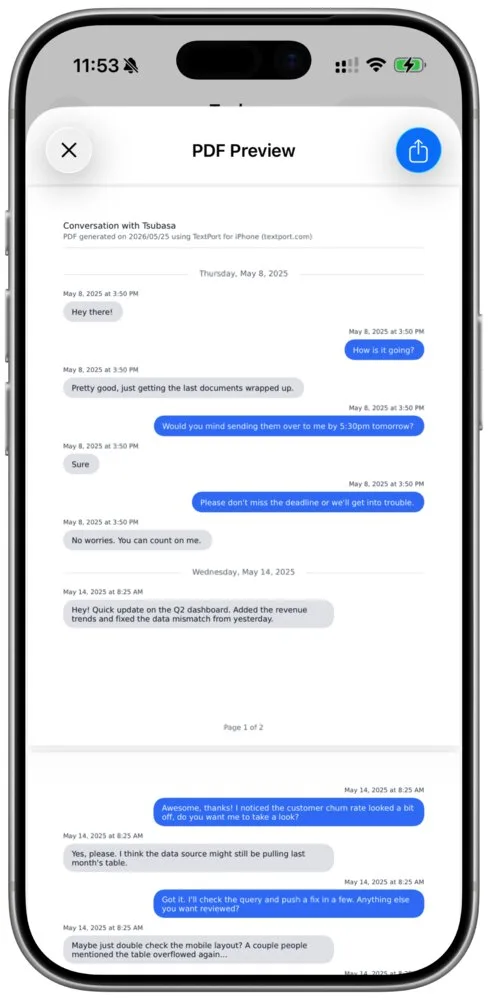
TextPort turns the conversation with the other side into one PDF on your iPhone, with no computer, ready to attach to your demand letter and to print in as many copies as your court asks for.
- iMessage and SMS come in through the TextPort Shortcut (iOS 26.4 or later), word for word with each message's date and time, for the date range you pick.
- WhatsApp comes in from WhatsApp's own Export Chat file. Messenger, Instagram, Signal and other apps come in from screenshots or a screen recording, which TextPort reads, so check the result against your phone before you export.
- The export is a PDF with the sender, date and time above every message and numbered pages, a CSV spreadsheet, or plain text. Photos from iMessage and WhatsApp chats print in the PDF. You can send it as a link instead of an attachment.
Frequently asked questions
-
Often, for a clear claim against someone who can pay. Filing costs $30 to $75 in California, $54 plus a service fee in Texas, and $35 or $50 in Washington, and you don't need a lawyer. California's courts ask you to weigh two things first: "If you win in court, does the other side have the money to pay you?" and whether the time to sue, go to court and collect is worth it. The court won't collect for you, and California's guide warns that you "may not even collect any of it."
-
The hearing itself is short. San Mateo County's court says 10 to 15 minutes, Los Angeles County's consumer affairs department says most last 15 to 20, and Washington legal aid says many take 30 minutes or less. The wait is longer, because other cases are set for the same time: California tells you to plan on 4 or more hours at court. In New York City, small claims hearings are usually held at 6:30 p.m.
-
Texas small claims cases are heard in justice court, for up to $20,000 including any attorney fees. Hearings are informal, and the rules of evidence apply only where the judge decides they're needed to keep the hearing fair, so clear copies and a short, dated story matter more than legal form. Either side can get a jury by filing a written demand at least 14 days before trial and paying $22. If you're the one sued, file a written answer within 14 days of being served. If you win, wages generally can't be garnished in Texas, but bank accounts can.
-
You owe the judgment, and whether you can appeal depends on your state. In California, a plaintiff can't appeal a loss on their own claim, and a defendant has 30 days. In Texas, either side can appeal within 21 days and get a brand-new trial in county court. In Washington, the person who filed can appeal only if they claimed $1,000 or more. If you owe money and don't pay, California requires you to send the winner a statement of your assets, and a Florida judge can order you to fill out a Fact Information Sheet within 45 days.
-
You collect it yourself, with the court's enforcement tools. First find out where they work, bank and own property: in California they must send you an asset statement, Texas allows post-judgment discovery, Florida has a Fact Information Sheet, and New York has an information subpoena. Then a sheriff, constable or marshal can garnish wages or levy a bank account, or you can put a lien on real estate. Texas generally protects wages, and Florida protects a head of family's wages up to $750 a week, and above that unless they agreed in writing to garnishment.
-
Yes. New York's small claims guide for courts outside NYC lists "Printed evidence from your computer or cell phone" among the evidence to organize, and a Florida county judge's notice says text messages must be submitted to the clerk as "printed hard copies or on a CD/DVD/flash drive." Print the whole conversation with the date and time on every message, bring copies for the judge and the other side, and bring your phone with the original messages as backup.

Start exporting your messages
Available for iPhone, Mac, and Windows. No computer required.