
How to Get Your Security Deposit Back From a Landlord
To get your security deposit back, give your landlord a forwarding address in writing, wait out your state's deadline (14 to 30 days), and if the money doesn't come or the deductions look wrong, send a demand letter that names the amount, the law and a date. If that fails, file in small claims court. In California, Texas and New York, the landlord has to prove the deductions were reasonable, and a landlord who keeps a deposit in bad faith can owe two or three times the amount.
Your texts with your landlord often carry the case. They show what you paid, when you reported the leaky faucet, when you returned the keys, where you asked them to send the refund, and what they said when they walked through the empty unit. California even lets you prove the deposit with "prior consistent statements or actions of the landlord or tenant".
This is general information, not legal advice. Deposit rules differ by state and sometimes by city. For free help, contact your local legal aid office or tenant union.
How long your landlord has to return it
| State | Deadline | If they miss it | Extra you can win |
|---|---|---|---|
| California | 21 days after you move out, with an itemized statement | They lose the right to keep any of it | Up to twice the deposit for bad faith |
| Texas | 30 days after you move out or give a written forwarding address, whichever is later | Presumed bad faith | $100, plus three times the amount withheld, plus attorney's fees, for bad faith |
| Florida | 15 days if no claim; 30 days to send a notice of claim by certified mail (or e-mail, if you agreed to it) | They can't claim against the deposit | Court costs and attorney's fees, for whoever wins |
| New York | 14 days, with an itemized statement | They lose the right to keep any of it | Up to twice the deposit for a willful violation |
| Washington | 30 days, with a full statement and receipts | They owe the full deposit | Up to twice the deposit for an intentional refusal |
- California: the landlord must return the deposit or account for it no later than "21 calendar days after the tenant has vacated the premises". According to the state's 2026 tenant guide, when the landlord misses that deadline, "the landlord loses the right to keep any of the security deposit and must return the entire deposit to you." It can still claim real damage or unpaid rent as a set-off or a counterclaim.
- Texas: "the landlord shall refund a security deposit to the tenant on or before the 30th day after the date the tenant surrenders the premises." A landlord who doesn't refund or itemize by then "is presumed to have acted in bad faith."
- Florida: a landlord who makes no claim returns the deposit within 15 days. To keep any of it, it must send you written notice within 30 days "by certified mail to the tenant's last known mailing address" or by e-mail if you both signed an e-mail addendum. Missing that, "he or she forfeits the right to impose a claim upon the security deposit."
- New York: the New York Attorney General puts it plainly: "If your landlord doesn't give you this receipt within 14 days of moving out, then they must return your entire security deposit, whether there is damage or not." Rent-stabilized apartments follow the same 14-day rule under § 7-107; rent-controlled apartments are left out of these rules.
- Washington: the deadline went from 21 to 30 days on July 23, 2023, and the statement must come with copies of estimates or invoices (RCW 59.18.280).
What a landlord can and can't deduct
A landlord can deduct unpaid rent and the cost of fixing damage you caused. It can't charge you for the apartment getting older.
Texas defines normal wear and tear as "deterioration that results from the intended use of a dwelling", not deterioration from "negligence, carelessness, accident, or abuse." TexasLawHelp gives examples on both sides:
| Wear and tear (can't be deducted) | Damage (can be deducted) |
|---|---|
| Worn carpet, peeling paint, dusty fixtures | A broken window, a hole in the wall, a large carpet stain |
Seattle's renter guide adds "paint fading, scuff marks on linoleum, wear patterns on carpet" to the wear-and-tear side.
State rules go further:
- California limits cleaning charges to what's needed to return the unit "to the same level of cleanliness it was in at the inception of the tenancy," and bars charging for professional carpet cleaning unless it's reasonably necessary. A lease can't call any part of the deposit nonrefundable. The state's tenant guide suggests charging for carpet and paint only for the useful life left. Its repainting method assumes paint lasts two years, so a tenant who stayed two years or more pays nothing for repainting. But the guide calls its suggestions "not necessarily the law in this area," and some landlords assume paint lasts three years or more. It adds: "Generally, minor marks or nicks in walls are the landlord's responsibility as normal wear and tear".
- New York limits deductions to unpaid rent, damage beyond normal wear and tear, unpaid utilities the landlord bills, and moving and storing your belongings. "The landlord may not retain any amount of the deposit for costs relating to ordinary wear and tear of occupancy or damage caused by a prior tenant."
- Washington bars charging to repair or replace fixtures, equipment, appliances or furnishings whose condition wasn't recorded on the move-in checklist, and a landlord who took a deposit without a checklist "is liable to the tenant for the amount of the deposit". Neither checklist rule covers deductions for unpaid rent or other charges you owe (RCW 59.18.280).
Don't skip your last month's rent to use up the deposit. In Texas, a tenant who does that in bad faith owes "three times the rent wrongfully withheld and the landlord's reasonable attorney's fees".
Before you hand back the keys
Most deposit fights are won or lost in the last week of the lease.
- Ask for a pre-move-out inspection. California and New York give you the right to one. In New York, it happens "no earlier than two weeks and no later than one week before the end of the tenancy," and you get the chance to fix what the landlord lists. In California, a landlord generally can't deduct later for cleaning or repairs it didn't list at that inspection. Seattle's guide notes a landlord there isn't required to do a walk-through, but you can ask.
- Photograph and video every room, including inside the oven, fridge and closets, with the date. California landlords must now photograph the unit themselves after you move out and again after any repairs or cleaning, and send those photos with deductions for that work, but take your own.
- Give your forwarding address in writing. In Texas, a landlord doesn't have to refund anything until it has your address in writing. TexasLawHelp says: "It does not need to be where you live, only a reliable place to receive mail. Keep a copy of the notice." The Texas Tenant Advisor adds: "It is best to have the landlord sign acknowledging receipt of the forwarding address."
- In Texas, check your lease for a move-out notice rule. A lease can make advance notice of move-out a condition of getting the deposit back, but only if that rule is underlined or in conspicuous bold print (§ 92.103). TexasLawHelp says a lease may require 30 or 60 days' written notice, and many landlords require 60. If yours does, give it in writing and keep a copy.
- In Florida, if you're leaving early or on a month-to-month (or other periodic) lease, give at least 7 days' written notice with your new address by certified mail or personal delivery, unless your lease says otherwise (§ 83.49(5)). Skip it and the landlord no longer has to send you the 30-day notice of claim, though you keep your right to the deposit.
- Return the keys in a way you can prove, and save the conversation where you told the landlord you'd left. TextPort can save that thread as one PDF on your iPhone, with the date and time above every message.
Does a text count as notice?
Not reliably. No law or court page we found says a text message satisfies a deposit notice rule, and the e-mail rules have conditions:
- California: the landlord can e-mail the itemized statement only if you agreed to it.
- Texas: for leases signed or renewed on or after September 1, 2025, deposit notices "may be sent by e-mail if the tenant and the landlord or landlord's agent have previously communicated by e-mail." Texts aren't mentioned.
- Florida: notices by e-mail count only if you both signed a lease addendum agreeing to it (§ 83.505).
- Washington: legal aid says to give your new address "by email or another way you can prove."
So send your forwarding address by letter (certified mail if you can) or e-mail, and text it too. If the landlord later says it never got your address, the text with its reply is good evidence that it did.
Read the itemized statement
When the statement arrives, check every line against your photos and your texts.
- California: if deductions top $125, the landlord "must attach a copy of any invoices or receipts with the itemized statement". Its photos of the unit before and after the repairs or cleaning must come too, by mail, e-mail, flash drive or a link. Under $125, you can still ask for the receipts and photos within 14 days of getting the statement, and the landlord has 14 days to send them.
- Washington: the statement must be "full and specific" and include estimates or invoices. Charges without that documentation can't be sent to collections or reported to a credit agency.
- Texas: the landlord must give "a written description and itemized list of all deductions." It can skip the list only if you owed rent when you moved out and the amount isn't in dispute. A landlord who skips the list in bad faith forfeits the right to keep any of the deposit.
- Florida: the notice of claim gives you 15 days to object. Its required wording says you "must object in writing to this deduction from your security deposit within 15 days after the time you receive this notice." Object in writing, and keep proof you sent it. If you miss the 15 days, "The failure of the tenant to make a timely objection does not waive any rights of the tenant to seek damages in a separate action."
If a check comes with "final settlement" on it, read the FAQ below before you cash it.
Write a security deposit demand letter
In California, asking for the money first isn't optional, and a letter is the best way to do it because it leaves a record. The courts' demand letter tool says: "This is a step you must take before filing a small claims court case." Elsewhere it's still the fastest way to get paid, because it shows the landlord you know the rules.
Put in the letter:
- Your name, the rental address, your move-in and move-out dates, and the deposit amount.
- Your forwarding address, again.
- What the landlord did: sent nothing, sent the statement late, or deducted for wear and tear. Quote the state law.
- What you want: the full amount, or the amount you dispute, by a specific date. Washington legal aid's sample gives one week; a Los Angeles legal aid checklist says to wait 7 to 14 days for an answer.
- A request for proof. The Texas Tenant Advisor suggests you "demand that the landlord show proof of any work done to the apartment unit including pictures, receipts and work orders."
- That you'll file in small claims and ask for the state's penalty if you're not paid.
Sample security deposit demand letter
Copy this and fill in the brackets. Keep the sentence that fits your situation and delete the other.
[Your name], [your new mailing address]
[Date]
Re: Security deposit for [rental address]
Dear [landlord or property manager's name],
I moved out of [rental address] on [move-out date] and returned the keys on [date]. I paid a security deposit of $[amount] on [date]. My forwarding address is above; I also sent it to you by [letter, email or text] on [date].
If nothing came back: It has been more than [your state's deadline] days since I moved out, and I have not received my deposit or an itemized statement of deductions.
If you dispute deductions: Your statement dated [date] deducts $[amount] for [item]. That is normal wear and tear, or was there when I moved in, as my move-in photos and our text messages from [date] show.
Under [your state's law, such as California Civil Code § 1950.5, Texas Property Code § 92.109, Florida Statutes § 83.49, New York General Obligations Law § 7-108 (§ 7-107 if rent-stabilized) or RCW 59.18.280], please return $[amount] by [a date 7 to 14 days from now], by [check to the address above, or the payment method I used]. If you claim any damage, please send me copies of the receipts, invoices and photos for each deduction.
If I don't receive payment by that date, I will file a claim in small claims court for the deposit and any penalty the law allows.
Sincerely, [your name], [phone number]
Attach copies, never originals: your move-out photos, the itemized statement if you got one, and the texts that back you up, such as the landlord confirming the deposit or saying the unit looked fine.
Send it by certified mail with a return receipt, as both California's tenant guide and Washington legal aid recommend, and keep a copy. E-mail a copy too.
Free templates: the California courts' online tool, the Legal Aid Foundation of Los Angeles letters (its 2022 guide predates the current deposit cap and small claims limit, so use it for the letters only), WashingtonLawHelp's sample letters, and LawHelpNY's sample. In New York, the Attorney General also "offers mediation services to assist tenants in recovering rent security deposits and interest".
Taking your landlord to small claims
If the letter doesn't work, sue. You don't need a lawyer.
| State | Where to file | Limit |
|---|---|---|
| California | Small claims | $12,500 |
| Texas | Justice court | Up to $20,000 |
| Florida | Small claims | $8,000 |
| New York | Small claims | $10,000 in New York City; $5,000 in Nassau, western Suffolk and city courts outside NYC; $3,000 in eastern Suffolk, town and village courts |
| Washington | Small claims | $10,000 |
Sources: California courts, Texas State Law Library, Miami-Dade Clerk, New York Attorney General, RCW 12.40.010.
What helps you in court:
- The landlord has to justify the deductions. In New York, "the landlord shall bear the burden of proof as to the reasonableness of the amount retained." California and Texas say the same.
- Ask for the penalty. In California, you can sue for the deposit plus up to twice the deposit if the landlord acted in bad faith. In Texas, ask for $100, three times the amount wrongfully withheld, and attorney's fees; Texas RioGrande Legal Aid publishes a petition form that does exactly that.
- Watch the clock. California's guide says "you will have up to 4 years to sue pursuant to a written rental agreement and 2 years pursuant to an oral one." Washington legal aid: "You must start your lawsuit within 3 years of your tenancy ending."
- Know what you give up. In California, the guide warns that "you, as a Plaintiff in small claims court, will have no right to appeal a decision" on your own claim.
- Expect a counterclaim. A landlord can claim damage or unpaid rent back. Bring proof of the unit's condition and your rent payments.
For how a hearing runs and what judges look for, see how to win in small claims court.
Your evidence: photos, receipts and texts with your landlord
Courts take texts. The Santa Cruz County court's small claims guide lists "Letters, Emails, Texts" as evidence and says: "Bring 3 copies of everything (including photographs)." San Mateo County asks for "Printouts of electronic documents, like emails, text messages, or social media posts". The New York Attorney General notes that "The court might permit you to introduce photographs showing the condition of the apartment when you left it."
Bring:
- The lease and proof of the deposit: a canceled check, a receipt, a bank or payment-app record.
- Move-in and move-out photos and video, and the move-in checklist.
- The itemized statement, the envelope it came in (the postmark shows when it was sent), and your demand letter with the mail receipt.
- Your texts with the landlord or property manager, printed as one conversation with the date and time on every message.
Which texts matter:
- The landlord confirming the deposit amount.
- Problems you reported at move-in, and repairs you asked for during the lease. If you made requests through an app or portal, Washington legal aid says to "take screenshots of your request in case it gets deleted."
- Your move-out date, the key return and your forwarding address.
- Anything the landlord said at the final walk-through, like a text that the place looked fine.
- Photos you sent or received in the chat.
Print the whole conversation for the dates involved, not just the good messages, so the landlord can't say you left something out. To stop your iPhone from deleting old texts, go to Settings > Apps > Messages > Keep Messages and choose Forever. Keep the original conversation on your phone and bring the phone to the hearing.
A Texas justice court's self-help page put the printing problem simply: screenshots work for a few messages, but "larger text strings generally require software installed on your computer." If the landlord says the messages aren't real, how to authenticate text messages for court covers what to say. For landlord disputes beyond the deposit, see text messages in landlord disputes.
Saving the texts as one dated PDF
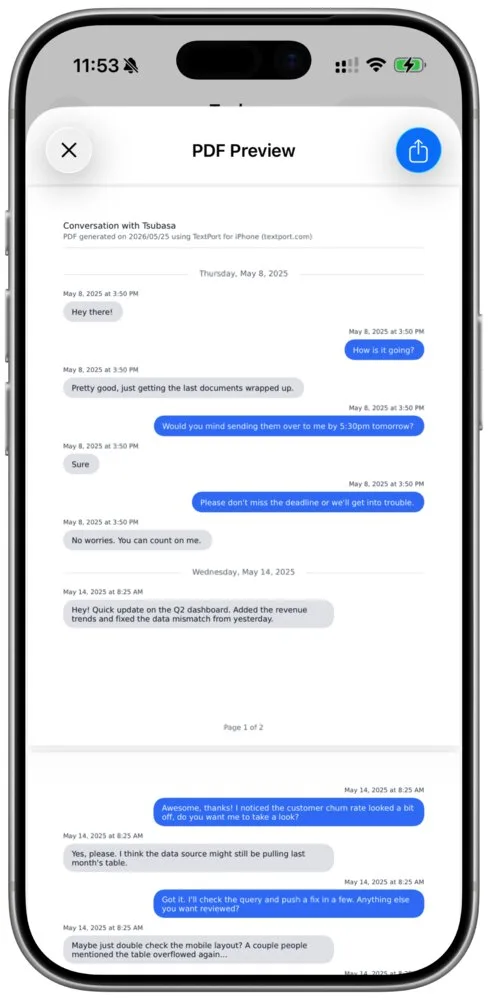
TextPort turns the conversation with your landlord into one PDF on your iPhone, with no computer, ready to attach to a demand letter or print three times for small claims.
- iMessage and SMS come in through the TextPort Shortcut (iOS 26.4 or later), word for word with each message's date and time, for the date range you pick.
- WhatsApp comes in from WhatsApp's own Export Chat file. Messenger, Instagram, Signal and other apps come in from screenshots or a screen recording, which TextPort reads, so check the result against your phone before you export.
- The export is a PDF with the sender, date and time above every message and numbered pages, a CSV spreadsheet, or plain text. Photos from iMessage and WhatsApp chats print in the PDF. You can send it as a link instead of an attachment.
Frequently asked questions
-
The landlord loses the right to keep any of it. California's Department of Real Estate says that under a California Supreme Court decision, a landlord who misses the 21 days "must return the entire deposit to you." The landlord can still claim real damage or unpaid rent as a set-off or a counterclaim. If a judge finds the landlord kept the deposit in bad faith, they can owe up to twice the deposit on top of it.
-
In Texas and Washington, 30 days is the landlord's deadline. A Texas landlord who neither refunds nor sends an itemized list by day 30 is presumed to have acted in bad faith, but the clock only runs once you've given a written forwarding address. In Washington, a landlord who misses 30 days owes the full deposit. In Florida, 30 days is the deadline to send a notice of claim by certified mail (or e-mail, if you agreed to it); with no claim, the landlord has only 15 days. Send a demand letter, then file in small claims.
-
It depends on the state and the step. In Florida, you have 15 days to object in writing to a landlord's notice of claim, though missing that window doesn't stop you from suing later. To sue, California's Department of Real Estate says you have up to 4 years on a written lease and 2 years on an oral one, and Washington legal aid says 3 years from the end of the tenancy. Don't wait: evidence and memories fade.
-
Only for damage beyond normal wear and tear. Worn carpet and peeling paint are wear and tear; a large carpet stain or a hole in the wall is damage. California bars charging for professional carpet cleaning unless it's needed to get the unit back to move-in condition, and Washington bars carpet cleaning charges without documented excess wear. California's tenant guide suggests charging for carpet and paint only for the useful life left. Its repainting method assumes paint lasts two years, so a tenant who stayed two years or more would pay nothing, but these are suggestions, not law, and some landlords assume paint lasts longer.
-
Be careful. The Texas Tenant Advisor, run by Texas RioGrande Legal Aid, calls cashing a partial refund a risk. If you cash it anyway, cross out any wording like "Final settlement of deposit" and write "Partial refund, all rights reserved" in its place. Keep a photo of both sides of the check.
-
Don't plan on it. California's tenant guide says the landlord "will almost always be able to insist a tenant pay rent for their last month," even if it called the deposit last month's rent. A Texas tenant who withholds the last month's rent in bad faith can owe three times the rent withheld plus the landlord's attorney's fees. Pay the last month and get the deposit back the normal way.

Start exporting your messages
Available for iPhone, Mac, and Windows. No computer required.