
Someone Owes You Money? How to Get It Back, Step by Step
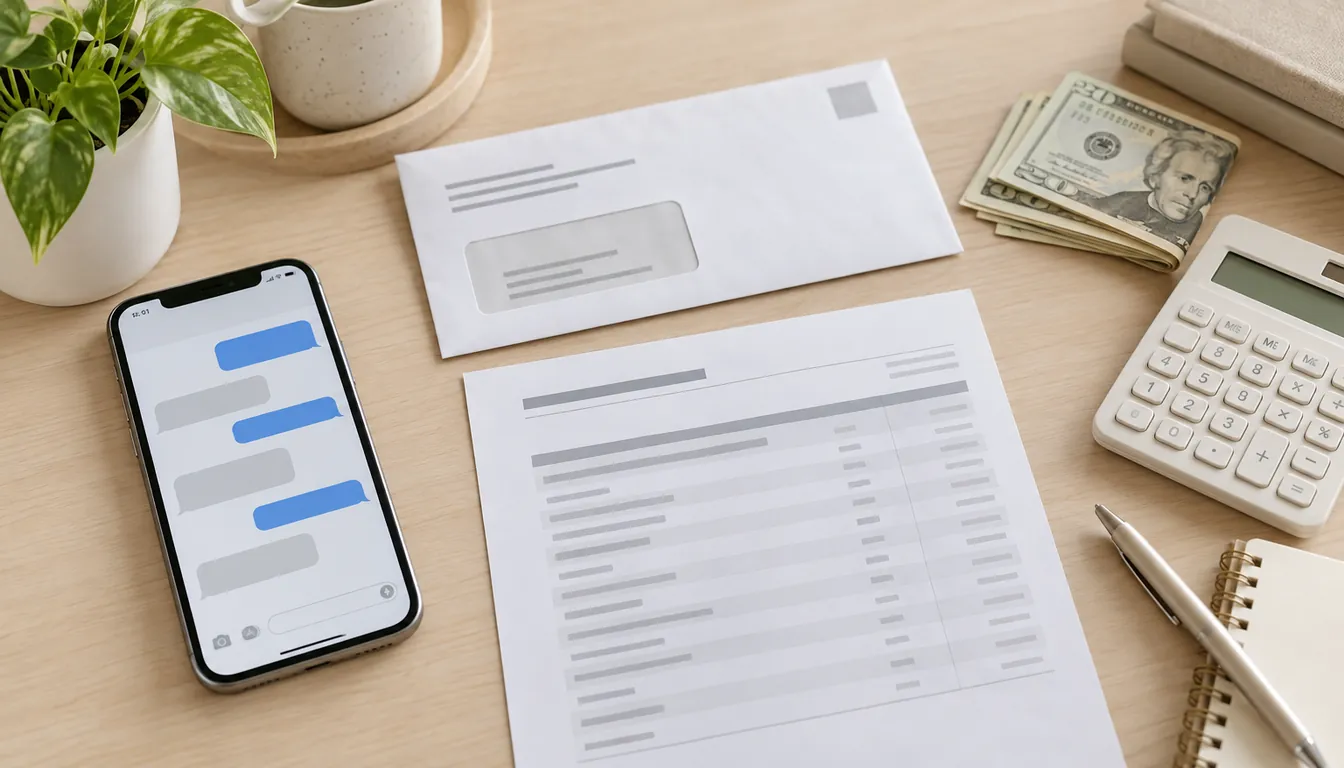
If someone owes you money and won't pay, ask for it in writing with a firm date, then send a demand letter that says how much they owe and that you'll sue if they don't pay. If that fails, sue in small claims court before your state's deadline, 2 to 6 years in the states below. You'll need to show it was a loan, not a gift. Winning gets you a judgment, not a check: collecting is up to you, usually from their bank account or, outside Texas, their wages.
Loans between friends, family and exes are often agreed by text and sent by Venmo, Zelle or Cash App. The payment record proves the money moved. The texts prove why: that they asked to borrow it, and when they said they'd pay it back.
This is general information, not legal advice. Rules and deadlines differ by state. For free help, try your local legal aid office or, in California, the county's free small claims advisor (§ 116.260).
What you have to prove: a loan, not a gift
You have to show that you gave them the money, that they agreed to pay it back, and that they haven't. If they say it was a gift, the fight is over the second point.
In California, a loan is a contract where the borrower "agrees to return at a future time a sum equivalent to that which he borrowed." A gift is a transfer "made voluntarily, and without consideration."
In J.D. v. A.D. (2017), a New York trial court case, a father advanced his daughter and son-in-law $280,000 toward a property for the son-in-law's electrical business. After the couple split, the son-in-law testified it was a gift. The court said the person enforcing a contract has to prove it, but someone claiming a gift "has the burden of proof to show, by clear and convincing evidence" that it was one. That's one New York court stating New York law.
The son-in-law's own texts to his wife undid his story: "Borrowing $280,000 From one of the greatest souls I ever met is a bold move and puts us closer to where we want to be", and later, "we have 6 months to fix it and get the money out to pay back your dad." The court found his testimony "patently incredible and controverted by his own written statements." The father had also written loan to purchase house in the memo line of his first check. We couldn't read the end of the decision; a New York law firm's summary reports: "The court ultimately concluded that the transaction was a loan and entered judgment in favor of the father."
- Your testimony is evidence. A Texas justice court guide for plaintiffs says: "You can also testify yourself and show any evidence you may have".
- A spoken loan can be enforced when the terms are clear and both sides agreed, the New York court noted. But New York requires a signed writing for an agreement that by its terms "is not to be performed within one year" (General Obligations Law § 5-701). Whether a text exchange forms a contract is covered in are text messages legally binding.
Gather the evidence
The texts
Save every conversation where the loan comes up. The texts that matter:
- The ask: when they asked, how much, and what for.
- Their promises: borrow, loan, pay you back, a date.
- Excuses after the due date, like I know I owe you, I'll have it Friday.
- Partial payments and what was said with them.
- Your requests, and their reply or silence.
- Their texts to other people. In J.D. v. A.D., the key texts went to the son-in-law's wife. If family or friends have messages like that, ask them to save them.
On your iPhone, go to Settings > Apps > Messages > Keep Messages and choose Forever. Save the whole conversation for the dates involved, with the date and time on every message, their name or number visible, and any photos or payment screenshots from the chat. Keep the original on your phone. TextPort can save the conversation on your iPhone as one PDF with the date and time above every message, ready to attach to a demand letter.
Payment records
- Venmo: Settings > Statements in the app, or Statements > Download CSV on venmo.com, one month at a time (Venmo).
- Cash App: Profile > Documents > Account Statements, or cash.app/account. Statements include "your account and routing numbers", so black those out before you share one.
- PayPal: activity "for up to the past seven years" as a PDF or CSV, 12 months per request.
- Zelle: it's in your bank's app. Wells Fargo, for example, shows the last 24 months of Zelle payments in Activity and on monthly statements (Wells Fargo).
- Your bank: your statements, and a copy of any canceled check, front and back.
Print them for court
Courts take texts on paper. Kitsap County District Court in Washington: "A judge will not look at a device such as a phone or computer to look at your exhibits." A trial sheet for one Osceola County, Florida, courtroom: "The Court also CANNOT receive evidence by looking at someone's phone." San Mateo County, California, asks for "the originals and 2 copies of each document": one set each for the judge, you and the other side.
Print all of it, not just the best messages. Bring the phone in case they say the printout was changed. If they claim the texts are fake, see how to authenticate text messages for court.
Send a demand letter for the money owed
Ask first, ideally in writing. In California it's expected: "The court wants you to ask the other side for the money you think they owe you before you start a small claims case." You can ask in person, by letter or by email, and you don't need to ask if there's a restraining order between you or asking would be dangerous. Elsewhere, a letter still shows the judge you tried.
Washington's legal-aid guide says a demand letter can "simply state the facts of what happened (with dates and times), why what happened cost you money, and state how much the person owes you," and that you'll sue in small claims if they don't pay. Add a deadline and how to pay you. California's courts have a free demand letter program that asks you questions and writes the letter.
A short sample:
Dear Jordan,
On March 3, 2026, you asked me by text to borrow $1,800 for rent and said you'd pay me back by June 1. I sent it by Zelle that day. You paid $300 on June 20. The other $1,500 is unpaid, and you haven't answered my messages since August 2.
Please pay the $1,500 by December 15, 2026, by Zelle or by check to the address below. If you can't pay it all at once, tell me by then what you can pay and when, and we'll put a plan in writing.
If I don't receive the money or a signed plan by December 15, I will file a claim against you in small claims court for $1,500.
Sam Rivera, 88 Oak Avenue, Sacramento, CA 95816, November 25, 2026
Mail or email it, keep a copy, and text them that it's coming. If time is short, California's guide says: "Don't wait if you have a filing deadline that's coming up soon."
What not to do
- Don't threaten to call the police. California's Supreme Court said in Flatley v. Mauro: "The law does not contemplate the use of criminal process as a means of collecting a debt." It added that "belief that the victim owes a debt is not a defense to the crime of extortion", though tough pre-lawsuit demands "that may include threats to file a lawsuit, report criminal behavior to authorities or publicize allegations of wrongdoing" aren't necessarily extortion, and its ruling turned on extreme facts. Texas's debt collection law bars "threatening to file a charge, complaint, or criminal action against a debtor when the debtor has not violated a criminal law" and lists "threatening to institute civil lawsuits or other judicial proceedings to collect a consumer debt" among the things it doesn't prevent; it's written for debt collectors, so don't count on it as permission. The safe line: threaten only to sue.
- Don't shame them in public. New York's extortion law covers threatening to "publicize an asserted fact, whether true or false, tending to subject some person to hatred, contempt or ridicule". Florida's collection law bars posting names on what is "commonly known as a deadbeat list"; the law is aimed at debt collection, so don't test it with a personal loan. And calling a friend who's late a thief online risks a libel claim, which in California means a "false and unprivileged publication".
- Don't flood their phone. In Texas, it's a crime to send, with intent to harass or annoy, "repeated electronic communications in a manner reasonably likely to harass, annoy, alarm, abuse, torment, embarrass, or offend another", and California has a similar law (Penal Code § 653m).
Your texts end up in the same printout as theirs, so keep yours calm.
Take them to small claims court
You don't need a lawyer in small claims. California doesn't let one represent you in court (you can ask one for advice beforehand), and Washington allows one only with the judge's consent.
| State | Most a person can sue for | Filing fee |
|---|---|---|
| California | $12,500 | $30 to $75 by amount ($100 for frequent filers) |
| Texas | $20,000, in justice court | $54 plus a service fee that varies by county (2024 figure) |
| Florida | $8,000, not counting costs and interest | $50 to $295 by amount, plus a $4 clerk fee and a summons fee |
| New York | $10,000 in New York City; $5,000 in Nassau, western Suffolk and City Courts outside New York City; $3,000 in eastern Suffolk and in Town and Village Courts | $15 or $20 by amount; $10 or $15 in Town and Village Courts |
| Washington | $10,000 | Usually $35 or $50 |
Sources: California courts and § 116.230, Texas State Law Library and plaintiff packet, Florida rules and fees, New York courts, New York City fees and guide, RCW 12.40.010 and WashingtonLawHelp.
Rules that catch people out:
- Installment loans in California. If a friend borrowed $5,000 at $100 a month and missed two payments, California's guide says you can "only sue for the missed payments (which in this example is $200, unless your agreement with them says something else)." You can sue again later, or wait until the loan's term ends.
- Attach the writing in Florida. If your claim is based on a written document, a copy "shall be attached to the statement of claim."
If they're avoiding you
- Find an address. In California, the Postal Service may give you someone's new address "if it's only to be used to serve the person in a lawsuit".
- Have someone else serve them. You can't serve the papers yourself in California or Texas. In California, if they dodge the server, "The server can hand the forms to an adult at the other side's home or work." The server then mails a copy to the same address.
- If they moved away, Washington's guide says you can sue "even if they live in a different state"; ask the clerk whether your case qualifies. You can serve them by registered or certified mail with a return receipt they sign (RCW 12.40.040). California's guide says you may not be able to sue them in small claims unless they return.
For the hearing itself, see how to win in small claims court and text messages in small claims court.
Check the statute of limitations
Each of these five states sets a deadline to sue, the statute of limitations. If you file late, California's guide warns, the other side can ask the judge to rule against you: "They'll probably win, even if you had a good case against them."
| State | Written agreement | Unwritten agreement |
|---|---|---|
| California | 4 years | 2 years |
| Texas | 4 years (any debt) | 4 years |
| Florida | 5 years | 4 years |
| New York | 6 years, but may be 3 for a personal loan | 6 years, but may be 3 for a personal loan |
| Washington | 6 years | 3 years |
Sources: California courts, § 337 and § 339, Tex. Civ. Prac. & Rem. Code § 16.004, Fla. Stat. § 95.11, N.Y. CPLR 213 and 214-i, RCW 4.16.040 and RCW 4.16.080. California counts from the day the agreement was broken.
Does a loan agreed by text count as written? The law doesn't settle it: no court decision or official guidance in these five states says whether a loan agreed by text message is a written contract for the longer deadline. In Texas it doesn't matter. In California, Florida and Washington, treat the shorter deadline as yours.
New York may give you 3 years, not 6. CPLR 214-i gives 3 years to sue a borrower over credit "extended to an individual" for something "primarily for personal, family or household purposes." A loan to a friend for rent or bills can fit, so in New York, file within 3 years.
Late payments and apologies may not buy you time. In Dawadi v. Adhikari (2026), a California appeals court looked at a written loan to a corporation controlled by the man who was sued, due in January 2016. About five and a half years later, he made three $1,000 payments, two with Loan Payment in the memo line. By then the four-year deadline had run, and the court called the memo "an accounting notation, not an acknowledgment." California's statute says "no such payment of itself shall revive a cause of action once barred." A partial payment made before the deadline runs out can extend it, the court noted, citing a 1967 case, but it didn't say whether that covers an informal loan; the statute's payment rule is written for promissory notes.
In all five states, a promise to pay or an acknowledgment of a past-due debt counts toward the deadline only in a writing signed by the borrower. Washington says one made after the deadline "shall not restart, revive, or extend the limitation period." Under New York's 3-year rule, no later payment or promise, written or oral, revives the claim once that period has run (CPLR 214-i). In Florida, a partial payment pauses the clock only on an obligation "founded on a written instrument." Whether a text counts as a signed writing is unsettled, so don't rely on one to extend your deadline.
Collect what you win
A judgment is not a check. New York's guide: "No. The Court will not collect the money for you." Ask first: the other side "may just agree to pay you by cash, check, or cash app", and you give them a signed, dated receipt.
If they don't pay:
- California: wait at least 30 days after you get the Notice of Entry of Judgment. The loser must send you a list of what they own, where they work and where they bank (form SC-133); if they don't, ask for a debtor's examination ($60). If the judgment is marked as consumer debt (money owed for personal or household things), use the court's consumer debt forms. With a Writ of Execution, the sheriff can take up to about 20% of their pay (the exact cap is in § 706.050) or levy their bank account, for a fee usually around $50. Each levy takes money only once, so the court suggests timing it "right after they're paid or right before they pay rent."
- Texas: no wage garnishment. "While some property is exempt from garnishment in Texas, such as wages, other property such as bank accounts and stocks may be subject to garnishment." Once wages land in a bank account, they can be garnished (TexasLawHelp).
- Florida: a head of family's disposable earnings are exempt up to $750 a week, and above that unless they agreed in writing to garnishment; anyone else's can be garnished up to the federal limit, generally 25% (§ 222.11, U.S. Department of Labor).
- New York: an income execution takes up to 10% of gross income, never more than 25% of disposable earnings, and nothing in a week when disposable earnings are 30 times the minimum hourly wage or less (CPLR 5231). In New York City, the court suggests finding their bank on "the back of a cancelled check" you gave them.
- Washington: if they haven't paid within 30 days, ask the clerk to certify the judgment. That lets you garnish or place a lien for 10 years, renewable once (WashingtonLawHelp).
Saving the texts as one dated PDF
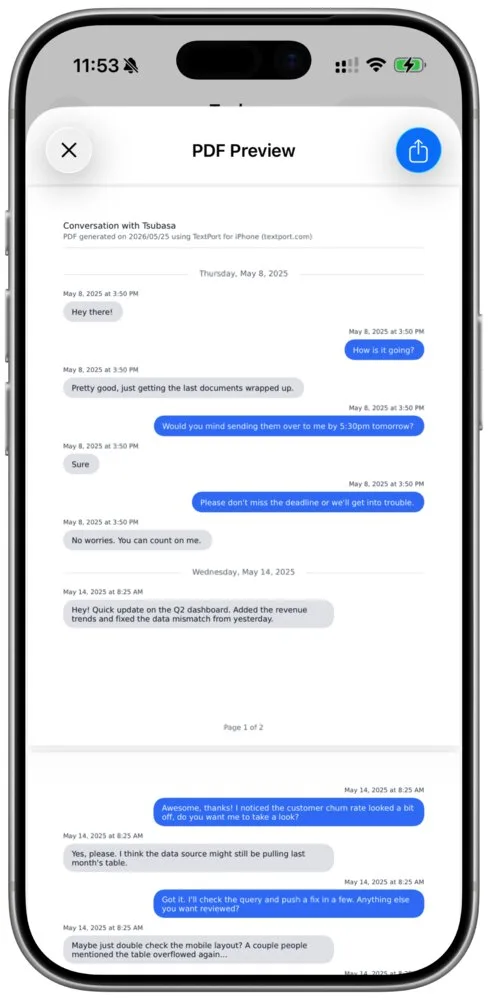
TextPort turns the conversation with the person who owes you into one PDF on your iPhone, with no computer, ready to attach to a demand letter or print for the judge and the other side.
- iMessage and SMS come in through the TextPort Shortcut (iOS 26.4 or later), word for word with each message's date and time, for the date range you pick.
- WhatsApp comes in from WhatsApp's own Export Chat file. Messenger, Instagram, Signal and other apps come in from screenshots or a screen recording, which TextPort reads, so check the result against your phone before you export.
- The export is a PDF with the sender, date and time above every message and numbered pages, a CSV spreadsheet, or plain text. Photos from iMessage and WhatsApp chats print in the PDF. You can send it as a link instead of an attachment.
Frequently asked questions
-
Yes. A loan agreed in person or by text can be enforced if you can show what was agreed and that both of you agreed to it. A New York court said an oral agreement to repay a loan can be enforceable when the terms are clear, though New York requires a signed writing for an agreement that by its terms isn't to be performed within a year. The catch is time: in California, Florida and Washington, unwritten agreements get a shorter deadline to sue (2, 4 and 3 years). Your texts and payment records are the proof.
-
Not to collect it. California's Supreme Court said: "The law does not contemplate the use of criminal process as a means of collecting a debt." Threatening to report someone unless they pay can be extortion in California even when they really owe you, and Texas's debt collection law bars threatening criminal charges against someone who hasn't broken a criminal law. A bounced repayment check has its own remedy: in California, you can sue for the check plus three times its amount (at least $100, at most $1,500 more) if a certified-mail demand that explains Civil Code § 1719 and states the check amount and the service charge goes unpaid for 30 days. That doesn't apply if they stopped payment over a good-faith dispute.
-
You don't need their cooperation to sue. Send the demand letter to their last address and email, then file in small claims. You'll need an address to serve them. In California, the Postal Service may give you a forwarding address if it's only for serving a lawsuit, and if they won't take the papers, your server can leave them with an adult at their home or work and mail a copy. You can't serve the papers yourself in California or Texas.
-
It depends on the state and on whether the agreement was written: 4 years for a written agreement and 2 for an unwritten one in California, 4 years for any debt in Texas, 5 and 4 years in Florida, 6 years for most contracts in New York but possibly 3 for a personal loan, and 6 and 3 years in Washington. The law doesn't say whether a loan agreed by text counts as written, so in California, Florida and Washington, file before the shorter deadline. In New York, file within 3 years in case the personal-loan rule applies.
-
It proves the money moved, not why. The why comes from what was said: texts where they asked to borrow, promised to pay you back or apologized for being late. A memo helps too. In a New York case, the lender had written "loan to purchase house" on his check. Download the statement from the app or your bank and save the texts that go with it.
-
Don't count on it. In California, no payment revives a claim whose deadline has already passed: in a 2026 case, three $1,000 checks, two marked as loan payments, came years too late and didn't help. Washington says a promise made after the deadline doesn't revive the claim, and New York's 3-year rule for personal loans says the same of any later payment or promise. Florida pauses the clock for payments only on written obligations. In all five states, a promise to pay a past-due debt counts only in a writing signed by the borrower, and no court we found has said whether a text counts. File before your deadline.

Start exporting your messages
Available for iPhone, Mac, and Windows. No computer required.