
Contractor Dispute? How to Get Your Money Back or the Work Fixed
If your contractor did bad work, didn't finish, or took a deposit and disappeared, start with a letter that lists each problem, says what you want (the repair or a refund) and sets a deadline, sent by certified mail or as a PDF attached to an email. Stop paying ahead of the work and photograph everything. If the deadline passes, escalate in order: the notice Texas, Florida and Washington require before a defect lawsuit, a licensing complaint, a bond or recovery fund claim, a credit card dispute, then small claims court or a lawyer.
Texts often hold the deal: the price for the extra outlet, the promise to be back Monday, the request for more money before the cabinets arrive. On many jobs, that thread is the only record of what changed. California's licensing board tells homeowners making a bond claim to "Have copies of your contract, payments, messages, and any proof of the contractor's mistakes or violations."
This is general information, not legal advice. Contractor rules differ by state and sometimes by city. For free help, contact your local legal aid office or your state's contractor licensing agency.
First: document the job and stop paying ahead
- Photograph and video the problems before anyone fixes them. California's Contractors State License Board (CSLB) says: "Before hiring a new licensed contractor, take pictures of the defective and incomplete work."
- Gather the paperwork: the contract or estimate, change orders, invoices, receipts and payment records.
- Save the texts, as described below. TextPort can export the thread on your iPhone as one PDF, with photos from iMessage chats in place.
- Stop paying ahead of the work. In California, apart from the down payment, a contractor may "neither request nor accept payment that exceeds the value of the work performed or material delivered" unless it has a CSLB-approved bond or joint control covering the whole job. In a good-faith dispute over the quality of the work, TexasLawHelp says you may withhold up to 110% of the disputed difference on Texas homes of up to four units.
- Look up the license on your state's site. In California, the license record also names the bond company.
Send a written notice with a deadline
Give the contractor a written chance to fix it. CSLB "recommends you express in writing what these are, along with your requested resolution, with a reasonable deadline for this to occur", and when you complain, it "will ask if you have formally notified your contractor". In California small claims, asking for the money is "another step you must take before filing a court case."
List each problem with photos, what you've paid, what you want by what date, and your next step if you don't hear back, such as hiring another licensed contractor and filing a complaint (CSLB's sample letter). Send it as "a letter sent by first class and certified mail or attached to an email as a portable document format (PDF or something similar)", and keep a copy.
The texts are the record, the letter is the notice
Once you may need another contractor, CSLB suggests you "limit your informal back-and-forth communications with your contractor, such as texts and emails". The thread you already have still shows what was agreed, so export it and attach it to the letter. After that, keep texts to scheduling and put demands in letters or PDF emails.
The notice Texas, Florida and Washington require before a defect suit
These states require a specific notice before you sue over construction defects. Send it the way the law says, before you file any lawsuit.
| State | Law | Notice before suing |
|---|---|---|
| Texas | Property Code ch. 27, which covers remodels, repairs and additions | 60 days, by certified mail, return receipt requested, with your evidence |
| Florida | Chapter 558 | 60 days, describing each defect |
| Washington | RCW 64.50, for new homes and substantial remodels only | 45 days |
- Texas: the notice must describe "in reasonable detail the construction defects that are the subject of the complaint" and come with "any expert reports, photographs, and video or audio recordings" of the defect, which can mean photos from your text thread. The contractor can ask to inspect, up to three times in the 35 days after it gets your notice, and make a written settlement offer within 60 days. If you think the offer is unreasonable, say why in writing, in reasonable detail, within 25 days; the contractor then has 10 days to make a better one. Reject a reasonable offer and your recovery is capped at "the fair market value of the contractor's last offer of settlement" plus costs and fees already incurred. A Deceptive Trade Practices Act claim needs its own 60-day notice (§ 17.505).
- Florida: serve a written notice of claim "at least 60 days before filing any action" that refers to Chapter 558. Serving it pauses the 4-year deadline to sue, but not the 7-year outer limit (see the deadlines below).
- Washington: L&I says "Only contracts for sale, construction, or substantial remodel can require this process." A substantial remodel costs more than half the home's assessed value, and the process applies only if you were given notice of it (RCW 64.50.020).
If the contractor took a deposit and disappeared
| State | Rule on up-front money |
|---|---|
| California | Down payment of $1,000 or 10% of the price at most, whichever is less; no payment ahead of the work (neither applies if the contractor has a CSLB-approved bond or joint control covering the whole job) |
| Florida | Over 10% up front: permits applied for within 30 days, work started within 90 days of permits, unless you agreed in writing to longer |
| New York | Payments before substantial completion held in a New York bank escrow account, or a bond |
| Texas | Homestead jobs over $5,000: payments go into a construction account (Attorney General) |
| Washington | L&I advises a reasonable down payment, then paying only as each phase is finished (L&I); see the bond below |
- California: breaking either rule is a misdemeanor: a $100 to $5,000 fine, up to a year in county jail, or both (§ 7159.5). Diverting construction money is a separate crime (Penal Code § 484b).
- Florida: missing those deadlines without just cause is a crime graded by the amount paid. If the contractor misses a deadline, your demand must be a letter "sent via certified mail, return receipt requested, mailed to the address listed in the contracting agreement." Ignoring it for 30 days lets a court infer it had no just cause. A contractor holding more than its work is worth "may not fail or refuse to perform any work for any 90-day period", or a different period set in the contract. If it stops without just cause, and not because you ended or breached the contract, that's a crime graded by the excess, a third-degree felony from $1,000 to under $20,000. The same certified demand letter and 30-day inference apply.
- New York: the contractor must tell you within ten business days where your money is held (Attorney General); New York City advises paying "no more than 25% of the total contract amount upfront".
Just signed? The FTC's Cooling-Off Rule lets you cancel covered sales made at your home "until midnight of the third business day after the sale". California, Florida, Texas and New York have their own three-day rules for some contracts; California's is five days for seniors and allows cancelling by email (§ 7159).
How to file a complaint against a contractor
| State | Where to complain | What it can do |
|---|---|---|
| California | CSLB: online, by mail, or 800-321-CSLB (2752) | Mediation, free arbitration, fines up to $30,000, orders to repair or pay |
| Texas | Attorney General or local consumer protection office | No state license for general contractors |
| Florida | DBPR, online or by mail; unlicensed contractors at 1-866-532-1440 | Its licensing board can order a licensee to pay restitution |
| New York | In New York City, DCWP: 311 or nyc.gov/dcwp | Mediate; Trust Fund claims |
| Washington | L&I: unregistered or fraudulent contractors, 1-888-811-5974 | Money disputes go to court |
Sources: CSLB, TexasLawHelp, Florida DBPR (complaints, unlicensed activity), NYC DCWP, Washington L&I.
A complaint isn't a reliable way to get paid. CSLB says: "The purpose of a CSLB investigation is not to obtain restitution... Consumers whose primary goal is to recover financial restitution from a contractor should consider pursuing damages through the courts." Still, CSLB citations can order a contractor "to make repairs to your project or pay you to hire others to do so."
Claims on the contractor's bond or a recovery fund
| State | Source of money | Most it pays |
|---|---|---|
| California | $25,000 license bond | The bond; up to $8,125 ordered in small claims |
| Washington | $30,000 (general) or $15,000 (specialty) bond, then the Homeowner Recovery Fund | The bond; the fund up to $25,000 |
| Florida | Homeowners' Construction Recovery Fund, licensed contractors only | $100,000 (Division I) or $30,000 (Division II), contracts from July 1, 2024 |
| New York City | Home Improvement Contractor Trust Fund, licensed contractors only | $20,000 after DCWP mediation; $40,000 with a judgment or award |
| Texas | None: general contractors needn't be bonded (TexasLawHelp) | Sue the contractor |
- California: "Reach out directly to the surety company listed for the contractor." If it won't pay, name it in small claims (CSLB).
- Washington: sue the contractor and bond company in superior court within two years of when the work was substantially completed or abandoned (RCW 18.27.040). The bond can be served only through L&I: mail it three copies of the summons and complaint and a $66.20 fee by certified or registered mail (L&I). The winner gets attorney fees, which cuts both ways, and must send L&I a certified copy of the judgment or settlement within 10 days or risk a penalty of at least $250. The Homeowner Recovery Fund needs you to own and live in the home (a house or building of up to four units, not a condo) and win a superior court judgment ordered after July 1, 2026; apply within 90 days after the case ends.
- Florida: "The fund is a last resort after all civil remedies have been exhausted." You need a judgment, arbitration award or licensing board restitution order, must exhaust any bond or insurance, and must claim within a year after the case ends (§ 489.141; caps: § 489.143).
- New York City: the $20,000 claim uses a notarized form after a failed DCWP mediation (DCWP).
If you paid by credit card
Under the Fair Credit Billing Act, you can withhold the unpaid balance of the charge from your card issuer if you first tried in good faith to resolve it with the contractor (your letter shows that), "the amount of the initial transaction exceeds $50", and the purchase was in your state or within 100 miles of your mailing address. The FTC says "to use this federal right you must withhold payment," and the issuer "cannot report you as delinquent" until the dispute is settled.
For a billing error, such as work not delivered as agreed, your letter must reach the issuer "within 60 days after the first bill with the error was sent to you." Attach your letter and the texts showing the agreed price.
Mediation and arbitration
CSLB mediates by phone, then sends qualifying cases to arbitration: mandatory up to $25,000 in alleged damages, voluntary from $25,000 to $50,000. "CSLB will pay for the hearing, the Arbitrator and one state-appointed expert witness if appropriate." The award is binding and due within 30 days. There's no appeal, neither side gets attorney fees, and CSLB doesn't forward its complaint file, so send your evidence to the arbitrator yourself. The bond company doesn't have to pay an award made against the contractor alone, so if you're counting on the license bond, weigh that before you return CSLB's arbitration form. New York City's DCWP also mediates, and Washington's L&I suggests mediation before suing. Check your contract for an arbitration clause.
Suing a contractor: small claims or a lawyer
| State | Small claims limit | Deadline to sue on a contract |
|---|---|---|
| California | $12,500 for individuals | 4 years written, 2 years not in writing |
| Texas | $20,000 (justice court) | 4 years |
| Florida | $8,000 | 4 years for construction claims, from the earliest of a certificate of occupancy, a certificate of completion or abandonment (hidden defects: from discovery, but within 7 years of that earliest date); other claims 5 years written, 4 not in writing |
| New York | $10,000 in New York City; $5,000 in City Courts, Nassau and western Suffolk; $3,000 in eastern Suffolk and Town and Village Courts | 6 years |
| Washington | $10,000 | 6 years written, 3 years not in writing |
Limits: California courts, Texas State Law Library, Miami-Dade Clerk, New York courts, New York courts' handbook, RCW 12.40.010. Deadlines: California (unwritten), Texas (residual), Florida, New York, Washington (unwritten). Which deadline fits your claim is a legal question.
- Don't shrink a big claim to fit. Texas: "You cannot agree to accept less money just so you can file in a small claims court." New York doesn't let you split a claim to get under the limit. In California, a plaintiff who loses in small claims can't appeal.
- Bring repair estimates. New York's handbook asks for "2 signed itemized written estimates".
- A California judgment brings leverage. CSLB can't collect for you, "but it can suspend the contractor's license until the judgment has been satisfied."
- Bigger cases need a lawyer. CSLB says: "For matters involving greater damages, an attorney should be consulted." That includes defect suits under the notice laws above and Washington bond suits.
For the hearing itself, see how to win in small claims court.
If the contractor wasn't licensed
You lose the bond and fund routes, but the contractor loses ground too.
- California: a license is needed for jobs of $1,000 or more in labor and materials, or that need a permit or use employees. CSLB "cannot require an unlicensed person to make repairs to your project or pay restitution," but you can sue "to recover all compensation paid to the unlicensed contractor", and it can't sue you to collect.
- Florida: its contracts are "unenforceable in law or in equity by the unlicensed contractor", and the Recovery Fund won't pay. DBPR "does not have statutory authority to order an unlicensed person to refund your money", but it refers the case to the State Attorney, and a criminal judge can.
- New York: New York City requires a DCWP license for work over $200, and "You are not eligible for Trust Fund repayment options if you use an unlicensed home improvement contractor." There and in Suffolk, Rockland, Putnam, Westchester and Nassau counties, a contractor suing you must allege its license, or you can move to dismiss (CPLR 3015(e)).
- Washington: an unregistered contractor can't sue to collect (RCW 18.27.080), and the Recovery Fund covers registered contractors only.
Surprise bills, change orders and liens
- California: a home improvement contract "and any changes to the contract shall be in writing and signed by the parties" before the work they cover starts. Your contract must tell you that extra work "is not enforceable against a buyer unless the change order also identifies all of the following in writing": the scope, the price change and the effect on payments. You may still owe the value of work done, under rules against unjust enrichment.
- New York: the contract and every amendment must be a writing "signed by all the parties to the contract".
- Texts: unsettled. Federal law says a record can't be denied legal effect "solely because it is in electronic form", but neither state's rule says whether a text exchange counts as a signed writing. See are text messages legally binding.
To dispute the bill, ask in writing for an itemized invoice, compare it with the contract and the texts where prices were agreed, pay what you don't dispute, and dispute the rest in writing.
Watch for liens. Unpaid subcontractors and suppliers can claim against your home even if you paid the contractor; Washington's required disclosure warns "you could pay twice for the same work." In California, you "may withhold all further payments until these releases are furnished", meaning lien releases.
Your texts with the contractor: which to save and how to hand them over
Which texts matter:
- The quote, the price and the scope.
- Every extra: what you asked for, the price named, and your answer.
- Payment requests and confirmations.
- Dates and promises, kept or not.
- Problems you reported, the replies, and any offer to redo the work.
- Photos and videos sent either way.
Save the whole conversation for the job, not just the good messages, with the date, time and sender on every message. To stop your iPhone deleting old texts, go to Settings > Apps > Messages > Keep Messages and choose Forever. Keep the photos with their messages, and keep the original thread on your phone.
How to hand them over:
- To CSLB, on paper: "Send CSLB copies (not the original documents) of all relevant printed documentation (no CDs or flash drives)."
- To small claims, printed. The Santa Cruz County court's small claims guide lists "Letters, Emails, Texts" and says: "Bring 3 copies of everything (including photographs)."
- To the contractor in Texas, with your Chapter 27 notice. To a surety, fund, card issuer or insurer, attached to the claim by email or upload.
If the contractor says the messages aren't real, how to authenticate text messages for court covers what to say.
Saving the texts as one dated PDF
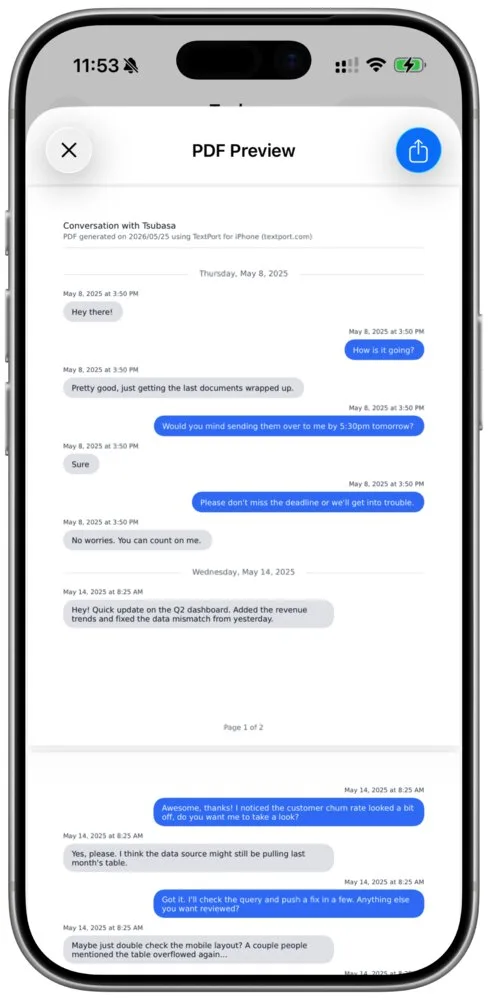
TextPort turns the conversation with your contractor into one PDF on your iPhone, with no computer, ready to attach to a demand letter, a licensing complaint or a card dispute, or to print for small claims.
- iMessage and SMS come in through the TextPort Shortcut (iOS 26.4 or later), word for word with each message's date and time, for the date range you pick.
- WhatsApp comes in from WhatsApp's own Export Chat file. Messenger, Instagram, Signal and other apps come in from screenshots or a screen recording, which TextPort reads, so check the result against your phone before you export.
- The export is a PDF with the sender, date and time above every message and numbered pages, a CSV spreadsheet, or plain text. Photos from iMessage and WhatsApp chats print in the PDF. You can send it as a link instead of an attachment.
Frequently asked questions
-
Not ahead of the work, and not for more than it's worth. In California, apart from the down payment, a contractor may "neither request nor accept payment that exceeds the value of the work performed or material delivered" unless it has a CSLB-approved bond or joint control covering the whole job. TexasLawHelp says that in a good-faith dispute over whether the work was done properly, you may withhold payment, up to 110% of the disputed difference on homes of four units or less. Put your reasons in writing. In Texas, read the Chapter 27 repair-offer rules before you sue.
-
Yes. California's definition of a home improvement contract covers an agreement "whether oral or written." You usually get less time to sue on an unwritten deal: 2 years in California (4 on a written contract), 3 years in Washington (6) and 4 years in Florida (5). But Florida gives 4 years for any claim over the construction of an improvement to your home, written or not, counted from the earliest of a temporary or final certificate of occupancy, a certificate of completion, or abandonment of the job, and even a hidden defect must be sued on within 7 years of that date. You also have to prove the terms another way, and texts where the contractor agreed to the price and the scope can do that.
-
To the agency that licenses contractors where the work was done. In California, that's the Contractors State License Board: online, by mail, or call 800-321-CSLB (2752) for a form. In New York City, call 311 or go to nyc.gov/dcwp. In Florida, complain about a licensed contractor to the DBPR online or by mail, and report unlicensed contractors to its Unlicensed Activity Hotline at 1-866-532-1440. In Washington, report unregistered or fraudulent contractors to Labor & Industries at 1-888-811-5974. Texas doesn't license general contractors, so complain to the Attorney General or your local consumer protection office.
-
You can try, and in some states the conduct is a crime. In California, taking construction money and willfully diverting it, without finishing the work or paying for labor and materials, is a crime under Penal Code § 484b, and taking an oversized down payment is a misdemeanor. In Florida, a contractor holding more money than its work is worth who stops working for 90 days (or another period set in the contract) without just cause, and not because you ended or breached the contract, commits a crime graded by the amount, a felony once the excess reaches $1,000. Send a demand by certified mail first: 30 days with no work or refund lets a court infer there was no just cause. Whether police take a report is up to your local department. Florida's DBPR sends unlicensed-activity cases to the State Attorney.
-
On a written contract, 4 years in California and Texas and 6 in New York and Washington; on an unwritten one, 2 years in California and 3 in Washington. In Florida, a claim over the construction of an improvement to real property has 4 years, counted from the earliest of the temporary or final certificate of occupancy, the certificate of completion, or the date the job was abandoned; for a hidden defect, the 4 years run from when it was or should have been discovered, but you must still sue within 7 years of that earliest date. Other Florida claims get 5 years on a written contract and 4 on an unwritten one. A Washington suit against the contractor's bond must be filed within two years of when the work was substantially completed or abandoned. Which deadline applies to your claim is a legal question, so don't wait.
-
That's unsettled. California requires a home improvement contract and any changes to be "in writing and signed by the parties" before the work they cover starts, and New York requires every amendment to be a signed writing. Federal law says a record can't be rejected just because it's electronic, but neither state's rule says whether a text exchange counts as a signed writing. Keep the texts anyway: they show what was agreed and when.

Start exporting your messages
Available for iPhone, Mac, and Windows. No computer required.