
How to Export Text Messages for an Insurance Claim
To export text messages for an insurance claim, save the whole conversation from your phone as a PDF that shows the sender, date and time above every message, then send it to your adjuster with the rest of your claim documents. A complete, dated thread shows what the other driver, contractor, landlord or seller actually said, and when. Cropped screenshots of a few messages don't.
Texts matter in insurance claims because so much of what happens around a loss is agreed by text: the other driver's apology, the plumber's "I'll be there Tuesday," the Marketplace seller's receipt, the adjuster's promise to call back. In TextPort's 2026 survey of 1,081 U.S. adults, 26.5% of people who had saved or screenshotted messages as a record said they did it for an insurance or financial matter.
This is general information, not legal or insurance advice. Policies and claim rules differ by state and by insurer, so read your policy and ask your agent, your state insurance department or a lawyer about your situation.
Which texts help an insurance claim
Save any conversation that shows what happened, what it cost, or what someone promised.
| Claim | Texts worth saving |
|---|---|
| Car accident | Messages with the other driver: an apology, an admission, their insurance details, an offer to pay you directly. Texts with witnesses, the tow company and the body shop. |
| Water damage or a home repair | Texts with the plumber, contractor, landlord or HOA: when you reported the leak, quotes, photos sent in the chat, promises to fix it. |
| Theft | Chats that prove you owned the item and what you paid: a Marketplace or Craigslist purchase, a seller's messages, photos of the item someone sent you. |
| Renters | Texts to your landlord reporting the problem, and their replies. |
| Health or disability | Texts with your employer about missed work, restrictions or your last day, and with providers about appointments. |
| Any claim | Every text with your agent or adjuster. |
Your own messages count as much as theirs. A text you sent the night of a storm saying "water is coming through the ceiling" fixes the date of the damage in writing.
What insurers and regulators ask you to keep
No insurer we checked tells you to send text messages by name. Regulators use the word "correspondence," and a text thread is correspondence.
- California. The Department of Insurance's residential property claims guide says: "Keep a log of all phone calls and correspondence, and make copies of all correspondence you send to, or receive from, your insurance company."
- Contractors. The same department's disaster guide says your job file should include "any letters, notes, or correspondence of any kind with the contractor," and tells you to "Get everything the contractor discusses in writing."
- Texas. The Department of Insurance's claim tips: "Keep copies of all documents and take notes about all calls you have with the insurance company or HMO." And: "Follow up your phone calls to the company with an email or letter."
- Indiana: "Whenever you communicate with your insurance company, be sure to keep copies and records of all correspondence" (Indiana Department of Insurance). Georgia's version is shorter: "Keep copies of all correspondence" (Georgia).
As for how adjusters use what you send, Allstate's accident guide says the adjuster "will determine who's at fault based on an inspection of the vehicles/property damaged, information provided by you and the other parties involved in the accident, and any supporting documentation, like the police report or photographs from the scene." A text from the other driver is information from the other party, in their own words.
Texts are a record, not a formal notice
For anything formal, such as reporting the claim, disputing a denial or giving a contractor notice, use a letter or an email you can prove you sent. California's contractor licensing board says formal writing "should be a letter sent by first class and certified mail or attached to an email as a portable document format (PDF or something similar)," and suggests that once a dispute may escalate, "you may wish to limit your informal back-and-forth communications with your contractor, such as texts and emails" (CSLB).
The texts you already have are still evidence. Export them, and attach the export to that letter or email.
How to export text messages for an insurance claim
- Stop anything from deleting. On your iPhone, go to Settings > Apps > Messages > Keep Messages and choose Forever. The other options delete old messages automatically.
- Export the whole conversation, not just the good part. Pick a date range that starts before the loss and runs to today, so the adjuster sees the context.
- Choose PDF. A PDF with the sender, date and time above every message and numbered pages is what an adjuster can read, print and put in the claim file. Add a spreadsheet (CSV) if the thread is long and someone may want to sort or search it.
- Keep the photos. Pictures sent in the chat, such as the damage, the item or the other car, belong in the export next to the messages they came with. If your export can't include them, save them separately and say which message each belongs to.
- Check the names. Make sure each person shows with their name or phone number, so nobody has to guess who "Mike" is.
- Keep the original on your phone. If anyone questions the export, the live conversation is how you show it's real.
TextPort does steps 2 to 5 on the iPhone, with no computer. Photos come along for iMessage, SMS and WhatsApp imports:
- Open TextPort, tap Add Chat, then Import from Messages. The first time, tap Add Shortcut to install the TextPort Shortcut (iOS 26.4 or later).
- Tap Find chats and select the conversation.
- Choose the date range, then tap Start import.
- Check the imported thread against the original.
- Tap Export and choose PDF. Spreadsheet (CSV) and Text (TXT) are there too.
On an older iOS version, record your screen while scrolling the chat and TextPort reads the messages from the recording. For WhatsApp, use WhatsApp's own Export Chat file (how to export WhatsApp chats).
Free options
- Screenshots. Fine for a short exchange. Swipe left and hold so the time shows on every message, overlap each shot by a message or two, keep the contact name at the top, and don't crop or mark them up.
- TextPort for Mac reads the Messages already synced to your Mac and exports a conversation to PDF, CSV or TXT. Free.
- TextPort for Windows reads an iPhone backup and exports the same files. Free.
Sending the texts to your adjuster
- Email the PDF, or upload it in your insurer's app or claim portal if it has one. Put your claim number in the subject line and the file name.
- Say in one or two sentences what it shows. "Texts with the other driver on March 3, page 2: he says he ran the light." Adjusters handle many files.
- Send a link if it's too big to email. A long thread with photos can pass an email limit. TextPort can share an export as a link that works for 7 days.
- Keep a copy of what you sent and when. Your sent email shows when the insurer got it, and in several states that date starts a clock.
Your texts with the adjuster are part of the record
Insurers have deadlines to answer you, and your messages show when those deadlines started.
| State | Deadline |
|---|---|
| California | Acknowledge your claim and answer your messages within 15 days |
| Florida (property) | Acknowledge your claim and your messages within 7 days |
| New York | Acknowledge your claim and answer your messages within 15 business days |
| Texas | Acknowledge your claim within 15 business days |
| Washington | Acknowledge your claim and answer your messages within 10 business days |
California and Florida count calendar days. Washington's times are for individual policies; group policies get 15 business days.
California's rule covers "any communication from a claimant, regarding a claim, that reasonably suggests that a response is expected" (10 CCR § 2695.5). New York requires "an appropriate reply" within 15 business days "on all other pertinent communications" (11 NYCRR § 216.4). Washington's rule was amended effective October 18, 2026 (WAC 284-30-360). Florida's is in § 627.70131, and the Texas deadlines come from the Texas Department of Insurance, which notes they "don't apply if another driver's insurance is paying the claim."
The NAIC's model law on claims handling calls "Failing to acknowledge with reasonable promptness pertinent communications" an unfair claims practice (NAIC Model 900).
So save every conversation with your adjuster, and export it if the claim drags on. A dated thread showing three unanswered messages over a month is far stronger than "they never called me back."
What your insurer can ask you for
Most policies list your duties after a loss: report it promptly, cooperate, and back up what you claim. California's standard fire policy, the baseline for property policies there, requires a sworn proof of loss within 60 days, lets the insurer examine you under oath, and says you "shall produce for examinations all books of account, bills, invoices, and other vouchers" (Cal. Ins. Code § 2071). The federal flood policy says: "You must cooperate with the adjuster or representative in the investigation of the claim" (44 CFR Part 61).
There are limits. In California, an insurer "may conduct an examination under oath only to obtain information that is relevant and reasonably necessary to process or investigate the claim," and you "may be represented by counsel and may record the examination proceedings in their entirety" (§ 2071.1).
In practice, give the adjuster the conversations that relate to the loss. If you're asked for your whole phone or every message for months, ask in writing what they need and why, and get advice before you hand it over.
For health and disability plans through an employer, federal rules let you "submit written comments, documents, records, and other information relating to the claim," and get copies of the plan's own claim file free of charge (29 CFR 2560.503-1). Texts with your employer about your work and absences can go in with an appeal.
Don't edit, crop or leave out messages
An export that has been changed can sink a claim and cause much worse problems.
- California makes it a crime to present "any written or oral statement" in support of a claim "knowing that the statement contains any false or misleading information concerning any material fact" (Penal Code § 550).
- Texas defines a "statement" to an insurer as including "a record or documented representation of fact," and adds: "The term includes computer-generated information" (Penal Code § 35.01). An edited screenshot is one.
- Florida covers statements with "false, incomplete, or misleading information" (§ 817.234). Leaving out the messages that hurt you is a risk there.
Policies say the same. California's standard policy is void "in case of any fraud or false swearing by the insured relating thereto."
Send the whole conversation for the dates involved. If part of it is private and unrelated, tell the adjuster what you left out and why, rather than cutting it silently.
If the claim ends up in court
When an insurer denies part of a claim, or the other driver's insurer won't pay, the next step is often small claims court against the person responsible. Courts there take texts. The Santa Cruz County court's small claims guide lists "Letters, Emails, Texts" as evidence and says to "Bring 3 copies of everything." San Mateo County asks for "Printouts of electronic documents, like emails, text messages, or social media posts" (San Mateo).
The export you made for the adjuster is the one you print for the judge. See text messages in small claims court and how to authenticate text messages for court for what to bring and say.
If your insurer stops answering
Your state insurance department takes complaints for free. Your saved messages show it what you sent and when.
- California: the Department of Insurance hotline, 1-800-927-4357. Its auto guide says: "If they are not responsive, or you believe there is an unreasonable delay in settling your claim, contact the Department of Insurance."
- Texas: the TDI Help Line, 800-252-3439. "If you think an insurance company has treated you unfairly, you can file a complaint with us" (TDI).
- Florida: the Division of Consumer Services, 1-877-693-5236. "We will advocate on your behalf. Our services are free" (Florida DFS).
A department checks how the insurer handled your claim, not the facts. Washington's commissioner says it "can't establish the facts of a claim, determine values or fault" (Washington OIC). Your documents, including your texts, still have to make the case.
Exporting your texts with TextPort
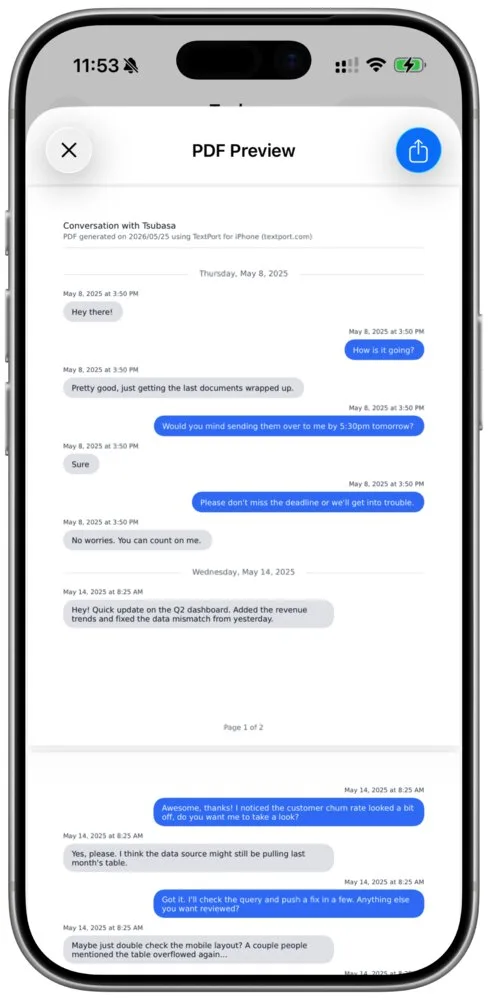
TextPort exports a conversation on an iPhone, with no computer.
- iMessage and SMS come in through the TextPort Shortcut (iOS 26.4 or later), word for word with each message's date and time, for the date range you pick.
- WhatsApp comes in from WhatsApp's own Export Chat file. Messenger, Instagram, Signal and other apps come in from screenshots or a screen recording, which TextPort reads, so check the result against your phone before you export.
- The export is a PDF with the sender, date and time above every message and numbered pages, a CSV spreadsheet, or plain text. Photos from iMessage and WhatsApp chats print in the PDF. You can send it as a link instead of an attachment.
Frequently asked questions
-
Yes. Adjusters decide claims from what you and the other people involved tell them plus supporting documents, and a text conversation is a dated, written record of what someone said. A text from the other driver admitting fault, a contractor confirming when a leak was reported, or a seller's messages proving you bought a stolen item can all support a claim. State regulators tell claimants to keep copies of all correspondence, and texts are correspondence. Send the whole conversation, with dates and times, not cropped screenshots of single messages.
-
For quick questions, texting is fine, but keep anything important in writing you can prove you sent: an email or a letter, with a copy. The Texas Department of Insurance tells claimants to follow up phone calls with an email or letter, and in several states the insurer's deadline to answer you starts when it receives your message. If your adjuster does text you, save the conversation: promises, requests for documents and dates all belong in your claim records.
-
It can ask for records relevant to the claim. Most policies require you to cooperate with the investigation and to produce documents, and property policies can require an examination under oath. In California, an insurer may examine you under oath only to get information "relevant and reasonably necessary" to the claim, and you may bring a lawyer and record it. If a request for your phone or messages seems broader than the claim, ask the adjuster in writing why they need it, and talk to a lawyer.
-
Yes, if every screenshot shows who sent each message and when, and nothing is cropped out. For more than a few dozen messages, a single PDF of the conversation is easier for an adjuster to read and harder to question. Don't edit, highlight or leave out messages that hurt your claim: insurance fraud laws cover false or misleading records, and Florida's covers incomplete ones too.
-
Check Recently Deleted in Messages first: Apple lets you recover deleted texts for up to 30 days. After that, look for the conversation on the other person's phone, since deleting a chat removes it only from your devices, or in an older computer or iCloud backup. Then set Keep Messages to Forever so nothing else disappears while the claim is open.

Start exporting your messages
Available for iPhone, Mac, and Windows. No computer required.