
How to File a Police Report Online (and When You Can't)
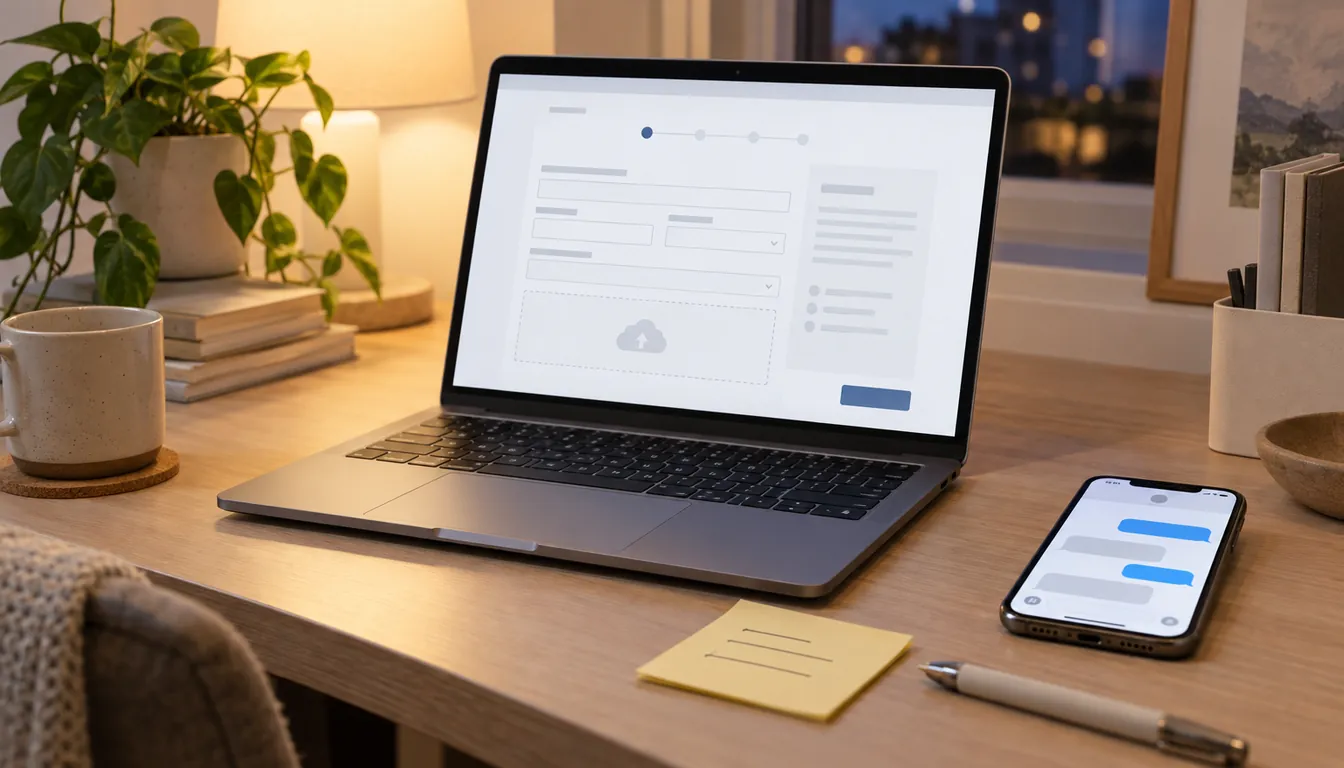
Yes, many US police departments let you file a report online for non-emergency crimes such as theft, lost property, vandalism, car break-ins, identity theft, card fraud, and harassing calls or texts from an unknown number. Go to the website of the department where it happened, check what it takes online, fill in the form and save the temporary number; after review, the official report number and usually a copy come by email. You can't file online for an emergency, violence or an injury, and in most of the big cities listed below, not if you know who did it. Philadelphia takes no reports online at all.
When the crime came by text, such as harassing messages, a scam, or a sale arranged by message, the conversation is your evidence, and the form has little room for it. Save the whole thread before you file, then summarize it in the report: the number, the dates, how many messages. San Diego's own sample narrative for harassing texts says: "I have taken screenshots of the saved text messages with the time and date stamps. I have uploaded those pictures to this crime report."
This is general information, not legal advice. What each department takes online changes, so read its page before you start, and call its non-emergency line if you're not sure your case fits. If it's an emergency or a crime in progress, call 911.
Can I file a police report online?
Only if your case passes the department's screening questions, which are much the same from city to city:
- It isn't an emergency. For an emergency or a crime in progress, call 911. Seattle's system "is not monitored live" and won't take incidents from the past 30 minutes.
- It happened in that department's area. USA.gov says to contact the local agency "where the crime occurred." Los Angeles won't take incidents on a state highway, and San Francisco sends freeway incidents to the California Highway Patrol.
- You don't know who did it. Chicago: "If you know who committed the crime, you should call 311 to file a report instead of submitting a police report online." Most of the big-city departments in the table below agree. Houston is the big exception, though threats involving weapons or a family or household member may not qualify there.
- No one was hurt and no weapon was involved. Los Angeles, Seattle, San Diego and Phoenix each exclude some mix of injuries, violent crimes, robbery, weapons, hate crimes, stolen cars and home burglaries.
- There's nothing for police to collect. Houston won't take a report online when there's physical evidence to collect. New York City requires that "The crime was not captured on video", and the LA County Sheriff's screening asks whether there are photos or videos of the incident.
- The loss is under the limit. Limits run from $250 for property damage in New York City to $50,000 in Houston.
- You're 18 or older and have an email address. Houston takes filers from 17 with a valid ID number. In San Francisco, you can call 311 instead if you have no email.
Filing online isn't anonymous: "a law enforcement officer may contact you for more information", the LA County Sheriff says.
How to file a police report online, step by step
- Find the department where it happened. Search for the city police or county sheriff's online reporting page. Identity theft is the exception: report where you live. LAPD tells filers to give their home address as the crime location "regardless of where the crime is believed to have occurred".
- Check the list and the screening questions. Each department lists what it takes online and asks yes-or-no questions before the form opens. Seattle: "If the crime you need to report is not listed, you cannot file it online."
- Gather the details. The date, time and address, what happened, a description and value of each item, and whether there's video or a witness. For card fraud, San Diego asks you to "List the store name, address, and dates and times of the fraudulent charges" and any case number from your card company. For harassing calls or texts, the sender's number and how many messages.
- Export the text messages. If the crime came by text, such as harassing messages from an unknown number, a scammer's messages or a seller who took your money, save the conversation for the dates involved as a PDF with the date and time on every message. TextPort does this on an iPhone, with no computer. Forms that take attachments ask for photos, so upload screenshots where the form takes images and keep the PDF for the detective, your insurer or a court.
- Write the narrative first, then fill in the form. Sacramento's form times out after 30 minutes on each section and caps the narrative at 2,000 characters, so draft it in a notes app and paste it in. San Diego publishes sample narratives by crime type. Houston and NYPD give you 30 days to finish a report you've started.
- Submit and save the temporary number. At LAPD, "You will immediately receive a temporary report number and be able to print a copy of the report you just made." Houston's comes with a note: "This is not an official HPD Incident Number."
- Watch your email. In Phoenix, each report "will either be accepted, rejected, or sent back to you for more information." If you're contacted, answer quickly: San Diego gives you seven days. Sacramento says to check your junk mail if the tracking number doesn't arrive within 15 minutes.
- Add new information under the official number. Seattle and San Francisco take supplemental reports online; in Phoenix, a supplement filed under the temporary number won't be added to your report. LAPD takes no supplements online: once you have the final number, call your station and ask for the detective on your case. Orlando takes updates at 407-246-2470. Don't file a second report for the same incident.
What big-city police take online
| Department | What you can file online | Rules that stand out |
|---|---|---|
| Los Angeles (LAPD) | Harassing calls and texts, lost property, vandalism, theft, theft from vehicles, minor collisions, hit and run, identity theft | No known suspects |
| New York (NYPD) | Only lost property, petit larceny ($1,000 or less), criminal mischief (up to $250) and graffiti | No harassment or identity theft. NYPD Online account required |
| Chicago | Crimes in city limits where you're the victim | Known offender: call 311 |
| Houston | Theft, vehicle burglary, property damage, fraud, identity theft, electronic harassment, some threats, minor assaults and protective-order violations | Known suspects allowed. Not threats or assaults involving weapons or a family or household member. Age 17 and up. Losses up to $50,000 |
| Phoenix | 14 types, including harassing calls, identity theft, card fraud and thefts | Thefts under $25,000. Known suspect only for business thefts, including shoplifting |
| Philadelphia | Nothing online or by phone | Go to a police district or call 911 |
| San Antonio | Theft, shoplifting, vehicle burglary, vandalism, lost property, custody violations | No harassment or identity theft listed. Over $2,500: call 210-207-7273 |
| San Diego | Harassing texts, email and social media; identity theft; card fraud; theft; vandalism; lost property | No known suspects. Photos can be attached |
| Dallas | Listed offenses, including harassment, card abuse, identity theft and theft under $2,500 (2023 list) | Known suspect: call. Harassment only after 10 or more calls or texts, not family violence |
| San Jose | 13 types, including harassing communications, fraud and identity theft | Reports labeled for insurance purposes. No burglaries |
| Seattle | Car break-ins, theft, property damage, harassing calls, card fraud, wage theft, identity theft, lost property | No known suspects. No home burglaries. Residents can report identity theft from anywhere |
| San Francisco | Harassing calls, phone and electronic scams, identity and crypto theft, package theft, car break-ins, card fraud | No residential burglaries, robberies or stolen cars |
Sources: LAPD, NYPD, Chicago, Houston, Phoenix, Philadelphia, San Antonio, San Diego, Dallas and its 2023 offense list, San Jose, Seattle, San Francisco.
The harassing-text categories above are mostly for unknown senders; Houston takes them even when you know who it is, except threats involving weapons or a family or household member. If you know who is harassing you, see how to file a police report for harassment.
The texts to save before you file
Save any conversation that shows what happened or what you lost:
- Harassing messages, every number they came from, and your reply asking them to stop.
- A scammer's messages: the first contact, links, payment requests and account details.
- The chat with a seller or buyer who scammed you.
- Messages or photos that show you owned what was stolen.
On your iPhone, go to Settings > Apps > Messages > Keep Messages and choose Forever. Save the whole conversation for the dates involved, with the sender's number and the date and time on every message, and keep the original on your phone, even after you block the number.
Upload screenshots where the form takes photos. San Diego says video "may be sent to a detective when you are contacted after your online report is approved", so offer the full PDF to the detective then. After an officer takes a report, San Francisco officers can text or email you an upload link. For more, see how to report harassing text messages.
What happens after you file a police report
If the review rejects your report, report by phone or in person. If it's approved, the official number comes by email, usually with a copy: LAPD emails the final report, Orlando sends a PDF, and the LA County Sheriff's copy is free.
Many online reports are recorded, not investigated. Seattle says "we won't be able to investigate most cases", and in Sacramento, a majority aren't assigned to detectives. The report still counts: Seattle says reviewed reports help it "track crime trends and patterns." If someone follows up, you'll hear by email or phone. And a prosecutor decides on charges: "When you make an initial police report, there is no guarantee that charges will be filed."
Insurance. Seattle, on the official number: "This is the number you need to file with your insurance company." After a car break-in in Texas, the Department of Insurance says damage to the car falls under comprehensive coverage, and items stolen from it probably under home or renter's insurance. See how to export text messages for an insurance claim.
Copies. New York law gives crime victims a free copy of the police report; NYPD's free verification, a short summary, takes up to 10 business days, and the full complaint report takes a Freedom of Information Law (FOIL) request. San Diego gives online filers a copy to keep; a copy from its records office costs $12.
Harassing calls or texts. San Jose tells you to give the report number to your phone company and keep track of when calls come and from what number.
Identity theft: IdentityTheft.gov first
Report identity theft to the FTC at IdentityTheft.gov. The FTC says: "In most cases, you can use your Identity Theft Report in place of a police report to clear your account and credit records of transactions that resulted from the identity theft."
Go to the police as well if you know the thief or have leads, if the thief used your name in a traffic stop or another encounter with police, or if a creditor or debt collector insists on a police report. Bring your FTC report, a photo ID, proof of address and any proof of the theft, and ask for a copy, the FTC's recovery plan says.
| State | What police must do |
|---|---|
| California | Police where you live or work must take the report, give you a copy and begin an investigation |
| Washington | Police where you live, work or where it happened must write a report and give you a copy, but don't have to investigate |
| New York | Police in your home county, or where part of the crime happened, must take the report and give you a free copy |
| Texas | An officer told of identity theft must write a report, and the agency gives it to you on request |
| Florida | The identity theft law doesn't say police must take a report, so ask your local department; the crime can be prosecuted in the county where you live |
Sources: Cal. Penal Code § 530.6, RCW 9.35.050, N.Y. Executive Law § 646, Tex. Code Crim. Proc. art. 2A.201, Fla. Stat. § 817.568.
Online scams and fraud
Call your bank, card company or payment app first. The FTC's scam guide says: "Report it to your bank or credit union immediately." Then report it:
- To your local police, if its form takes fraud. San Diego, Seattle and San Jose take card fraud online, and San Francisco takes phone and electronic scams.
- To the FBI's IC3, "the central hub for reporting cyber-enabled crime." It takes no attachments, so paste in the key text and keep the originals. Its FAQ says to contact local police directly if your case is time sensitive.
- To the FTC at ReportFraud.ftc.gov.
A false report is a crime
San Francisco says online reports are "read, screened and verified by a police officer to confirm information and reduce fraud." Filing a false one is a misdemeanor in California (LAPD warns of up to 6 months in county jail, a $1,000 fine, or both), a class A misdemeanor in New York, a Class B misdemeanor in Texas, a first-degree misdemeanor in Florida (a third-degree felony for a repeat offender whose false report was in writing), and a gross misdemeanor in Washington. Chicago's form cites a Class 4 felony under Illinois law.
Don't round up. San Francisco counts knowingly overstating the value of stolen items as a false report, and prosecutes one made for an insurance claim as felony insurance fraud.
Saving the texts as one dated PDF
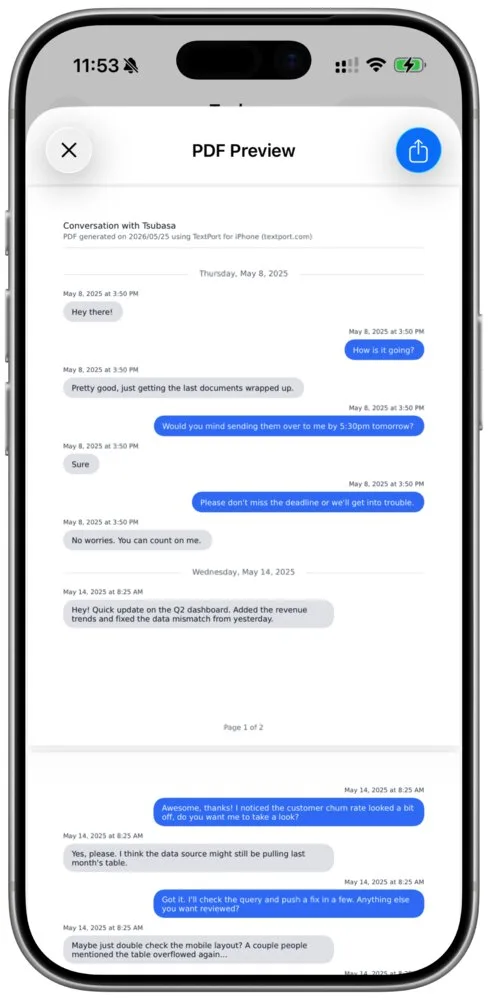
TextPort turns a harassing or scam conversation into one PDF on your iPhone, with no computer, ready for the detective who follows up on your report, your insurer or your bank.
- iMessage and SMS come in through the TextPort Shortcut (iOS 26.4 or later), word for word with each message's date and time, for the date range you pick.
- WhatsApp comes in from WhatsApp's own Export Chat file. Messenger, Instagram, Signal and other apps come in from screenshots or a screen recording, which TextPort reads, so check the result against your phone before you export.
- The export is a PDF with the sender, date and time above every message and numbered pages, a CSV spreadsheet, or plain text. Photos from iMessage and WhatsApp chats print in the PDF. You can send it as a link instead of an attachment.
Frequently asked questions
-
Usually not. Chicago tells you to call 311, and New York City, Los Angeles, San Diego, Dallas, San Antonio, Seattle, Orlando and King County, Washington, take online reports only when you don't know who did it. Phoenix allows a known suspect online only for shoplifting and other business thefts. Houston is the exception: its form asks for the suspect's name, phone number and address "whether the suspect is known or unknown." But threats involving weapons or a family or household member may not qualify there. If your department won't take it online, call the non-emergency line or go to a station.
-
You get a temporary number as soon as you submit, but it isn't the official report number. Los Angeles reviews online reports about once every 24 hours; Phoenix, Seattle and New York City say about five business days, and San Antonio emails the report in about five days. If the report is approved, the official number and usually a copy come by email. If nothing arrives, check your junk folder.
-
Often not. Seattle says "we won't be able to investigate most cases." Sacramento says a majority of reports are not assigned to detectives. The report still goes on record and gives you a number for your insurer, and you'll be contacted by email or phone if anyone follows up. Whether charges are filed is up to the prosecutor.
-
Usually not. The FTC says "In most cases, you can use your Identity Theft Report in place of a police report" when you report at IdentityTheft.gov. Go to the police as well if you know the thief or have leads, if the thief used your name with police, or if a creditor or debt collector insists on a police report. California, Washington and New York require police to take an identity theft report and give you a copy, and Texas requires officers to write one and give it to you on request.
-
On some forms. San Diego says "You may attach photos to your online report." Its sample narrative for harassing texts describes uploading screenshots with the time and date stamps. New York City asks for a picture when you report graffiti. Forms that take attachments ask for photos, so upload screenshots where the form takes them and keep a PDF of the conversation for the detective. The FBI's IC3 accepts no attachments.
-
Yes. It's a misdemeanor in California (up to 6 months in county jail, a $1,000 fine, or both, LAPD warns), New York, Texas, Florida and Washington, and Chicago's form cites a Class 4 felony under Illinois law. San Francisco counts knowingly overstating the value of stolen items as a false report, and prosecutes a false report made for an insurance claim as felony insurance fraud.

Start exporting your messages
Available for iPhone, Mac, and Windows. No computer required.