
What Can You Do Legally If Someone Owes You Money?
If someone owes you money, you can ask for it in writing, send a demand letter, agree a written payment plan, try free mediation, and then sue in small claims court, or in regular civil court for bigger amounts. If they paid you with a check that bounced, California, Florida and Washington let you claim a penalty on top. What you usually can't do is have them arrested: not paying back a loan is a civil matter unless there's evidence they never meant to repay or they knowingly wrote a bad check, and threatening criminal charges to get paid can itself be a crime.
Loans between friends, family and exes are often agreed by text and sent by Venmo, Zelle or Cash App. The payment record shows the money moved. The texts show why: that they asked to borrow it and promised to pay it back. Those messages go with you at every step, from the demand letter to the judge.
This is general information, not legal advice. Rules, limits and deadlines differ by state. For free help, try your local legal aid office or one of the community mediation programs below.
What to do, step by step
- Ask for the money in writing, with a date. Say how much, what it was for and when you need it back. In California, it's a step "you must take before filing a court case". You can ask in person, by letter or by email, and skip it if there's a restraining order between you or asking would be dangerous. An email or letter leaves a record you can show a judge.
- Export the text messages. If the borrower texted you, save the conversation for the dates involved as a PDF, with the date and time on every message: the texts where they asked for the money, promised to repay and made excuses. TextPort does this on an iPhone, with no computer. Download the matching Venmo, Zelle, Cash App or bank records too; the step-by-step guide shows where each app keeps them.
- Send a demand letter. Lay out the facts with dates, the amount, a deadline, how to pay you, and that you'll sue if they don't. TexasLawHelp says "giving the other side at least seven business days to respond would be reasonable." WashingtonLawHelp suggests certified mail with a return receipt. California's courts have a free demand letter program, and there's a sample in the step-by-step guide.
- Offer a written payment plan. If they can't pay it all at once, agree on amounts and dates. California's courts: "You should write up whatever you agree to." Get it signed by both of you, and decide what happens if a payment is missed.
- Suggest mediation. A neutral mediator helps you both agree on what gets paid and when. Many county programs and courts offer it free or at low cost (see the table below), and it's private: in California, "the other party can't use what you say in mediation against you in court later."
- File in small claims court before your deadline. Small claims is built for this: a Texas justice court guide lists "The defendant owes money to the plaintiff and will not pay" among the four most common reasons people file. Each state sets a deadline to sue, from 2 to 6 years in these five states depending on the state and whether the agreement was written, and New York may give only 3 years for a personal loan (CPLR 214-i). Check the deadlines table before you wait on a promise.
- Collect what you win. A judgment isn't the money. Ask them to pay first; if they don't, the step-by-step guide covers bank levies and wage garnishment by state.
A payment plan a court can enforce
For a plan agreed after you've won, California's courts say: "If you agree, put the agreement in writing and both sign the agreement." Once you've filed, a court can hold them to it:
- Florida has an official form, Form 7.345, a stipulation for installment settlement. They pay in installments; "If the total sum is paid timely and in full, plaintiff agrees that no judgment shall be entered against the defendant(s)". If they miss a payment, you're entitled to a judgment.
- Washington: "If a party agrees to pay at a later date, the other party may ask the court for a continuance." If the money hasn't come by the new date, go ahead with the hearing.
A plan agreed by text is in writing, but a signature on paper is safer, so get one. And don't let a plan carry you past your deadline to sue. California's guide: "Don't wait if you have a filing deadline that's coming up soon."
Free mediation, state by state
| State | Where to go |
|---|---|
| California | Many county programs, before or after you file, and many small claims courts, before or on the hearing day. Los Angeles County's community mediation is free if one of you lives there. |
| Texas | The Dispute Resolution Center of Harris County, free to county residents. Its request form lists informal loans. |
| Florida | No court mediation fee in small claims cases, and mediation can happen at the pretrial conference. Before you file, Orange County's Citizen Dispute Settlement mediates money disputes at no cost, and Hillsborough's Community Mediation Program takes balances owed. |
| New York | Community Dispute Resolution Centers in 62 counties, free or low-cost, including before you file. New York City Civil Court mediates small claims, and NYC311 connects you to a free mediator. |
| Washington | Dispute resolution centers must charge nothing or a fee based on ability to pay. King County District Court requires mediation before a small claims trial, at no cost. |
Sources: California courts, Los Angeles County DCBA, Harris County DRC and its request page, Fla. Stat. § 44.108, Florida Small Claims Rules, Orange County, Thirteenth Judicial Circuit, New York courts and ADR information, NYC311, RCW 7.75, King County District Court.
Mediation gives you time a hearing doesn't. California's guide: "In court you have only 5 - 10 minutes to give the judge your side of the story."
Can you sue someone for not paying you back?
Yes, in small claims court, up to your state's limit:
| State | Most a person can sue for | Filing fee |
|---|---|---|
| California | $12,500 | $30 to $75 by amount ($100 for frequent filers) |
| Texas | $20,000, in justice court | $54 plus a service fee set by the county |
| Florida | $8,000, not counting costs and interest | $50 to $295 by amount, plus a $4 clerk fee and a summons fee |
| New York | $10,000 in New York City; $5,000 in Nassau, western Suffolk and City Courts outside New York City; $3,000 in eastern Suffolk and in Town and Village Courts | $15 or $20 by amount; $10 or $15 in Town and Village Courts |
| Washington | $10,000 | $35 or $50 |
Sources: California courts and § 116.230, Texas State Law Library and plaintiff packet, Florida rules and fees, New York courts, New York City fees and guide, RCW 12.40.010 and the Washington courts.
You don't need a lawyer, and in California "You can't have a lawyer represent you." To prepare, see how to win in small claims court and text messages in small claims court.
Bigger amounts: regular civil court
Above the small claims limit, you sue in a regular civil court. California's guide calls that "much more challenging and expensive ... especially if you decide to file on your own without an attorney."
- California: a limited civil case has filing fees from $225, lawyers, and the full court rules. It "can take up to a year or longer to decide", where small claims is generally decided within 3 months.
- Florida: county court hears cases up to $50,000 filed on or after January 1, 2023 (§ 34.01).
- New York: the Civil Court of the City of New York "can only decide cases up to $50,000."
- Washington: district court hears contract claims for money up to $100,000, not counting interest, costs and attorneys' fees (RCW 3.66.020).
- Texas: justice court, where small claims are heard, goes up to $20,000 (Gov't Code § 27.031), so most personal loans fit. Above that, you sue in a county court at law or a district court (§ 25.0003); ask the clerk which one takes your case.
If they paid you with a bad check
| State | Civil penalty | Criminal side |
|---|---|---|
| California | A certified-mail demand that explains Civil Code § 1719 and states the check amount and the service charge; if unpaid after 30 days, the check plus three times its amount, at least $100 and at most $1,500 more | A crime if written with intent to defraud, knowing the money wasn't there |
| Texas | A processing fee of up to $30 | A Class C misdemeanor, but several prosecutors' hot-check units turn away loan repayments |
| Florida | A written demand in the statute's form, by certified mail with a return receipt or by first-class mail with an affidavit of service; if unpaid after 30 days, the amount owed plus three times that amount (at least $50), plus court costs and attorney fees | A separate 15-day notice, then the state attorney. A misdemeanor, or a felony from $150 when the payee got something of value for the check. Not for a postdated check, or one you knew or had reason to believe would bounce |
| New York | Up to twice the check, capped at $400 or $750, only for payees who post public notice of it | A class B misdemeanor |
| Washington | After a 15-day notice of dishonor, mailed in the statute's form: 12% interest, collection costs up to $40 (or the check amount, if less), and in court three times the check or $300, whichever is less, plus attorney fees. Not for a justifiable stop payment | With intent to defraud, a gross misdemeanor up to $750 and a class C felony above |
Sources: Cal. Civ. Code § 1719, Cal. Penal Code § 476a, Tex. Bus. & Com. Code § 3.506, Tex. Penal Code § 32.41, Fla. Stat. § 68.065, § 832.07 and § 832.05, N.Y. Gen. Oblig. Law § 11-104, N.Y. Penal Law § 190.05, RCW 62A.3-515, RCW 9A.56.060.
- California: a stopped payment counts too. "If someone stops payment on a check they wrote you without a reasonable (good faith) disagreement, you can sue for the amount of the check plus 3 times the amount of the check." The courts publish a sample bad check demand letter.
- Texas: Tarrant County's prosecutor lists "Checks that involve an extension of credit, payment on an account or repayment of a loan" as ineligible for a hot-check case and points to justice court instead. Kendall and Kerr counties say much the same.
- Florida: the two notices run on different clocks: 30 days for the civil demand, 15 days for the criminal one. A court can waive all or part of the triple damages for economic hardship.
Send each demand or notice with the wording and by the delivery method its statute sets, and keep proof: California allows the extra damages only if every requirement of § 1719 is met. Text them too, but don't count on a text as the notice.
Is it a crime not to pay someone back?
Usually not. California's Supreme Court, in Flatley v. Mauro: "The law does not contemplate the use of criminal process as a means of collecting a debt."
Texas and New York build the same idea into their theft laws. A promise the person never meant to keep can be theft by deception in Texas, but "failure to perform the promise in issue without other evidence of intent or knowledge is not sufficient proof" that they never meant to keep it. In New York, larceny by false promise requires a scheme to defraud, and the intent not to pay "may not be established by or inferred from the fact alone that such promise was not performed."
California prosecutors don't collect for individuals either. Santa Barbara County's district attorney says its consumer division "is prohibited from representing a private citizen who seeks the return of their money or any other personal remedy." The Riverside and San Diego offices say they can't sue for individuals.
So a plain unpaid loan belongs in small claims; a crime takes more, such as proof they never meant to repay or a check they knew would bounce.
What you can't do
Being owed money doesn't make pressure tactics legal. In California, "belief that the victim owes a debt is not a defense to the crime of extortion".
- Don't threaten criminal charges. Florida makes it a second-degree felony to maliciously threaten to accuse someone of a crime, or to hurt their reputation, to extort money (§ 836.05). Washington's extortion law counts a threat "To accuse any person of a crime or cause criminal charges to be instituted against any person".
- Don't threaten to expose or shame them. New York and Washington cover threats to publicize a fact "whether true or false" that would bring someone hatred, contempt or ridicule.
- Don't flood their phone. Texas and California make repeated messages sent to harass or annoy a crime (Tex. Penal Code § 42.07, Cal. Penal Code § 653m).
The safe line: tell them you'll sue, then do it. More in the step-by-step guide's What not to do.
The texts that prove the loan
Save every conversation where the money comes up:
- The ask: when they asked, how much, and what for.
- The promise: pay you back, a date, a monthly amount.
- After the due date: excuses, partial payments, any payment plan.
- Your requests, and their reply or silence.
On your iPhone, go to Settings > Apps > Messages > Keep Messages and choose Forever. Save the whole conversation for the dates involved, with their name or number and the date and time on every message, plus any photos or payment screenshots in the chat. Keep the original on your phone.
Attach a copy to your demand letter, bring one to mediation, and print copies for small claims. Some courts want both: King County District Court in Washington says "Digital evidence must be presented on your own device equipped with an HDMI port and copy for the Court." Your own texts end up in the same printout, so keep them calm. Whether the texts themselves form a contract is covered in are text messages legally binding.
Saving the texts as one dated PDF
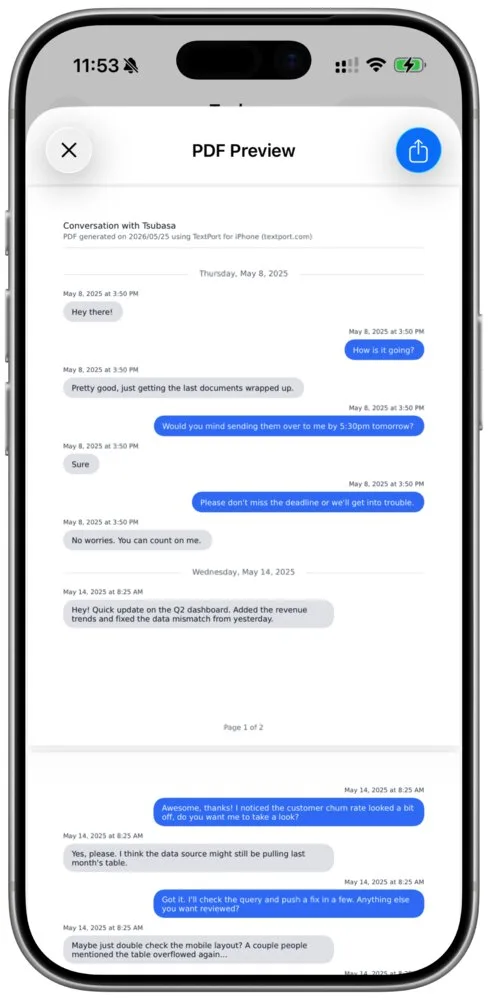
TextPort turns the conversation with the person who owes you into one PDF on your iPhone, with no computer, ready to attach to a demand letter, share with a mediator or print for small claims.
- iMessage and SMS come in through the TextPort Shortcut (iOS 26.4 or later), word for word with each message's date and time, for the date range you pick.
- WhatsApp comes in from WhatsApp's own Export Chat file. Messenger, Instagram, Signal and other apps come in from screenshots or a screen recording, which TextPort reads, so check the result against your phone before you export.
- The export is a PDF with the sender, date and time above every message and numbered pages, a CSV spreadsheet, or plain text. Photos from iMessage and WhatsApp chats print in the PDF. You can send it as a link instead of an attachment.
Frequently asked questions
-
Yes. It's one of the most common small claims cases: a Texas justice court guide lists "The defendant owes money to the plaintiff and will not pay" among the four most common reasons people file. You can sue for up to $12,500 in California, $20,000 in Texas, $8,000 in Florida, $10,000 in New York City and $10,000 in Washington. You'll need to show it was a loan, not a gift, and file before your state's deadline, which in New York may be only 3 years for a personal loan.
-
Ask in writing with a date, then send a demand letter that says how much they owe, by when, and that you'll sue if they don't pay. If they can't pay at once, agree a payment plan and write it down. If you're stuck, try mediation: Los Angeles County, Harris County in Texas, Orange County in Florida and New York's Community Dispute Resolution Centers offer it free or at low cost, and Washington's dispute resolution centers charge nothing or a fee based on what you can pay. California's courts put it simply: "If you ask for the money and the other side pays you, you won't need to go to court."
-
Usually not to collect a loan. California's Supreme Court said: "The law does not contemplate the use of criminal process as a means of collecting a debt." Texas and New York law both say a broken promise alone doesn't prove the borrower meant to cheat you. A bad check written knowingly can be a crime, but several Texas prosecutors' hot-check units turn away checks written to repay a loan. And threatening to report someone unless they pay can be extortion in California, Florida and Washington.
-
Yes, the same way you'd sue anyone else. You still have to show it was a loan, not a gift. If you want to keep the relationship, try mediation first. California's courts say: "Mediation can help neighbor or family disagreements because those relationships are important or will go on."
-
Your state may add a penalty. In California, send a certified-mail demand that explains Civil Code § 1719 and states the check amount and the service charge; if it goes unpaid for 30 days, you can sue for the check plus three times its amount, at least $100 and at most $1,500 more. Florida allows the amount owed plus three times that amount (at least $50) after an unpaid 30-day written demand, and Washington up to $300 extra after a 15-day notice of dishonor; both statutes give the wording to use. Texas lets you charge a $30 processing fee. New York's civil penalty applies only to payees who post a public notice of it.
-
Not to pressure them into paying. New York's and Washington's extortion laws cover threatening to publicize a fact, true or false, that would expose someone to hatred, contempt or ridicule. Florida's collection law bars anyone collecting a consumer debt from posting names on what it calls a deadbeat list. And in California, calling someone a thief online when they aren't one risks a libel claim. Tell them you'll sue, then do it.

Start exporting your messages
Available for iPhone, Mac, and Windows. No computer required.