
How to Document Neighbor Harassment (and What You Can Do About It)
To document neighbor harassment, keep a dated log of every incident, save the texts, notes and voicemails, photograph any damage, and write down who saw what. Then escalate in order: tell the neighbor once, in writing, to stop; try free community mediation; go to your HOA or landlord; call the police for threats, noise or damage; and if it continues, ask a court for a harassment order or sue in small claims. Which court order you can get against a neighbor depends heavily on your state.
A pattern is what turns a neighbor dispute into harassment: one argument over a fence is a dispute, weeks of threatening notes and late-night texts are harassment. Texts help you here. Texas's harassment law names them, and a saved text shows exactly what was said and when.
This is general information, not legal advice. Rules differ by state and often by city. For free help, contact your local legal aid office or your court's self-help center. If you're in danger, call 911.
Start documenting now
Maryland's People's Law Library, run by the state law library, gives this practical advice: "In your log, write down the date, what occurs and any other observations that may be helpful." Write each entry the same day:
| Date and time | What happened | Proof |
|---|---|---|
| Mar 5, 9:02 p.m. | Text saying he'll have my dog taken away | Text saved; my reply asking him to stop |
Also save:
- Photos and video. California's Civil Rights Department says: "If it is possible and safe to do so, the person being harassed should document the harassment by taking pictures or videos, or writing notes." Photograph damage, notes left on your door or car (keep the paper too), and where their camera points.
- Witnesses. Write down the name and contact details of anyone who saw or heard it.
- Messages. Texts, voicemails, emails and group chat posts (see below). TextPort can turn a text thread into one dated PDF on your iPhone.
- Report numbers. Note the date, officer and report number each time police come out.
For a full log template, see how to prove harassment or stalking.
Recording your neighbor, and their cameras
Recording audio is where you can break the law yourself.
| State | Recording a conversation you're part of |
|---|---|
| California | Everyone's consent, for confidential conversations |
| Florida | Everyone's consent, for phone calls and private conversations |
| Washington | Everyone's consent for private conversations, except threats and a few other cases |
| New York | Your own consent is enough |
| Texas | Your own consent is enough |
Sources: Cal. Penal Code § 632, Fla. Stat. § 934.03, RCW 9.73.030, N.Y. Penal Law § 250.00, Tex. Penal Code § 16.02.
California's rule leaves out conversations where people "may reasonably expect that the communication may be overheard or recorded", and a violation can mean a fine of up to $2,500 per violation, jail or prison time, or both. The person recorded can also sue for $5,000 per violation, and the recording generally can't be used as evidence. In Florida, an unlawful recording is a third-degree felony. Washington lets you record "threats of extortion, blackmail, bodily harm" with your own consent alone.
The table covers conversations you're part of. Recording one you're not part of, such as neighbors talking near your doorbell camera, can be illegal eavesdropping in all five states, New York and Texas included. If your camera records sound, think about turning the audio off.
As for the neighbor's camera, California's peeping law covers viewing "the interior of a bedroom, bathroom, changing room" or another place where people expect privacy, with intent to invade it. Texas, Florida and New York center on bathrooms, bedrooms and people undressing. California also lets you sue someone who uses a device to capture you "engaging in a private, personal, or familial activity" that they couldn't have captured without trespassing. In New York, an owner or tenant can sue for damages if a neighbor mounts a camera on the adjoining property to film activities in their backyard without written consent, with intent to harass, annoy, alarm or threaten (Civil Rights Law § 52-a).
If a camera looks into a bedroom or bathroom window, call the police. Otherwise, photograph where it points and log when it appeared. In Washington, repeated "monitoring, tracking, surveillance, keeping under observation" that would intimidate a reasonable person and serves no lawful purpose can count as stalking for a protection order.
Step 1: Ask them to stop, in writing
If it's safe, talk first. If that fails, the Maryland guide suggests "a clear written description of the problem and a proposed solution", with a copy of any law or ordinance they're breaking.
What about a cease and desist letter? A private letter has no legal force of its own; it isn't a court order. But a clear demand to stop counts in some laws:
- New York: fourth-degree stalking, a class B misdemeanor, can turn on whether "the actor was previously clearly informed to cease that conduct."
- Texas: unless the neighbor broke a restraining order, a civil stalking lawsuit requires that "the claimant at least once clearly demanded that the defendant stop the defendant's harassing behavior" and that it continued.
- Washington: judges weigh whether the respondent "has been given clear notice that all further contact with the petitioner is unwanted".
Keep it short and calm:
Please stop leaving notes on my car and texting me about my dog. I don't want any further contact. If it continues, I will contact the police.
Send it in a way you can prove: a text or email you keep, or a certified letter. Then stop arguing by text. If you're afraid of how they'll react, skip this step.
Step 2: Try free community mediation
Community mediation centers take neighbor disputes, and many charge nothing.
| State | Where to go | Cost |
|---|---|---|
| California | Los Angeles County community mediation; in San Diego, the National Conflict Resolution Center | LA: free. San Diego: may be free. State-funded programs are free for people who can't pay |
| Texas | County dispute resolution centers, such as Harris County's | Free to Harris County residents; others may charge a fee the county sets |
| Florida | Hillsborough County Community Mediation Program; Orange County Citizen Dispute Settlement | Free |
| New York | Community Dispute Resolution Centers; in New York City, mediation through 311 | Nominal or no cost; free in NYC |
| Washington | Dispute resolution centers, such as King County's | Free or based on ability to pay |
Sources: LA County, San Diego court, Bus. & Prof. Code § 467.2, Harris County, Texas ch. 152, Hillsborough, Orange County, N.Y. Jud. Law § 849-b, NYC 311, RCW 7.75, King County.
Hillsborough County's program reports: "In approximately 80% of the conferences held, the parties reach an agreement."
Skip it if you're afraid of the neighbor. San Diego's court warns that "mediation may not be a good choice if the parties have a history of abuse or victimization", and California's self-help site says: "You do not have to participate in mediation." If you go, bring your log and the texts, and get any agreement in writing.
Step 3: Make an HOA complaint or go to your landlord
If you're in an HOA
Put your HOA complaint in writing: the rule, the dates, your log and photos. In California, an HOA's internal dispute resolution covers disputes between the association and a member, so use it to press the board when it won't act, not against the neighbor. Once a member asks for it in writing, "the association shall participate in the procedure", at no fee to you. In California and Florida, you can also enforce HOA rules against the neighbor yourself (Step 6).
Neighbor harassment in apartments
If you rent, Illinois Legal Aid Online puts it bluntly: "The landlord is really the only one who can do something."
- California: for harassment based on a protected trait such as race, religion, disability or sexual orientation, the Civil Rights Department says "Housing providers must act quickly to correct and end harassment by another tenant when they knew or should have known about it, and where they have the power to correct it". The implied covenant of quiet enjoyment in every California lease also requires action when the harassment substantially interferes with your use and enjoyment of your home.
- Anywhere in the U.S.: threatening someone in their home because of race, color, religion, sex, disability, familial status or national origin violates the Fair Housing Act (24 CFR § 100.400), and a landlord who knew and could act can be liable for "Failing to take prompt action to correct and end a discriminatory housing practice by a third-party". File with HUD within one year of the last incident (42 U.S.C. § 3610).
Illinois Legal Aid's advice works anywhere: "Put your request in writing, date it, and keep photocopies. Then, keep a diary of incidents." A dated email or text to the property manager counts; save the thread as your copy.
Step 4: Call the police, or file a noise complaint
The Maryland guide says: "The police are most likely to be able to help if the other party has violated a local ordinance or state law with criminal penalties."
- Threats and harassing texts. In Texas, threatening bodily injury, or sending repeated electronic messages (texts included) meant to harass, is a Class B misdemeanor: up to 180 days in jail, a fine of up to $2,000, or both (§ 42.07, § 12.22). In New York, a threat sent "by computer or any other electronic means" is aggravated harassment. In California, threatening texts and repeated contact meant to harass are misdemeanors (§ 653m). Florida's cyberstalking law covers electronic messages.
- Noise. In New York City, call 311. NYPD responds within 8 hours when it isn't handling emergencies, and "They will be able to take action if the noise is still happening when they arrive." Texas treats unreasonable noise near someone's home as disorderly conduct (§ 42.01), and California punishes malicious loud noise (§ 415).
- Property damage. It's vandalism in California (§ 594) and criminal mischief in Texas (§ 28.03).
Get a report number every time and add it to your log. In Texas, a civil stalking lawsuit later requires a police report of stalking unless the neighbor broke a restraining order. See how to file a police report for harassment.
Step 5: A harassment order against a neighbor
A court order can tell your neighbor to stay away. Which one you can get varies a lot by state.
| State | Order against a neighbor | What to know |
|---|---|---|
| California | Civil harassment restraining order | Needs clear and convincing evidence; no filing fee if you allege violence, threats or stalking; up to 5 years |
| Texas | Protective order for victims of stalking and certain sex, trafficking and burglary offenses | Harassment alone isn't on the list |
| Florida | Injunction against stalking (including cyberstalking), or against repeat violence | Repeat violence means two incidents of violence or stalking, one within 6 months of filing; no filing fee for either |
| New York | Order of protection in a criminal case | Family Court needs a family or intimate relationship |
| Washington | Antiharassment protection order | May carry a filing fee, except for stalking, a hate crime or a single act or threat of violence; waived if you can't pay |
Sources: CCP § 527.6, CH-100-INFO, Texas ch. 7B, Fla. Stat. § 784.0485, Fla. Stat. § 784.046, NYPD, RCW 7.105.
- California names neighbors: "This includes a neighbor, a landlord, or a co-worker." But the court cannot "Order someone to stop creating a nuisance that doesn't involve harassment", and "The prevailing party in an action brought pursuant to this section may be awarded court costs and attorney's fees, if any." A weak petition can leave you paying your neighbor's lawyer.
- Texas lets anyone apply "without regard to the relationship between the applicant and the alleged offender", but only for listed offenses. Stalking is on the list; harassment isn't, so a neighbor's harassment alone won't get you a Texas protective order. Document the pattern as stalking, and report harassing texts as a crime.
- Florida has two orders that need no relationship. The repeat violence injunction is open to "Any person who is the victim of repeat violence", and violence there includes assault, battery and stalking.
- New York: "The police can charge the other person with a crime and during any of the court appearances in Criminal Court, the court can issue an Order of Protection", Legal Assistance of Western New York explains.
For the forms, the hearing and the evidence judges want, see can you get a restraining order for text messages.
Step 6: Sue your neighbor
For money, use small claims: up to $12,500 in California, $20,000 in Texas justice court, $8,000 in Florida, and $10,000 in Washington and New York City ($5,000 in Nassau, western Suffolk and City Courts outside New York City; $3,000 in eastern Suffolk and in Town and Village Courts). California small claims can order someone to stop "only when a statute expressly authorizes a small claims court to award that relief." See how to win in small claims court.
To make it stop, file a nuisance lawsuit. In California, "An action may be brought by any person whose property is injuriously affected, or whose personal enjoyment is lessened by a nuisance", and the court can order the nuisance stopped and award damages. Washington also lets you sue over a nuisance.
Over HOA rules, any California owner can enforce the CC&Rs. Before suing in superior court, you must first try alternative dispute resolution, a step that "does not apply to a small claims action." In Florida, a member can sue another member who breaks the governing documents (§ 720.305). In both states the winner of a suit over HOA rules gets reasonable attorney's fees and costs (§ 5975), so losing can mean paying your neighbor's lawyer.
For stalking in Texas, a civil lawsuit needs harassment on more than one occasion that made you reasonably fear for your or your family's safety. Then either the neighbor broke a restraining order against harassing you, or all of these: they threatened to hurt you or commit a crime against you, your family or your property; they seemed able to carry it out, which made you afraid; you clearly demanded they stop (Step 1); they kept going; and you reported it to police as stalking. To prove the repeated harassment, you need "evidence other than evidence based on the claimant's own perceptions and beliefs": texts, photos, witnesses.
If your neighbor makes false reports about you
Knowingly false police reports are crimes in all five states: a misdemeanor in California (up to 6 months in jail) and Florida (up to 1 year), a class A misdemeanor in New York, a Class B misdemeanor in Texas, and a gross misdemeanor in Washington.
Can you sue your neighbor for false accusations? In California, the privilege that protects reports to police "does not make privileged any communication between a person and a law enforcement agency in which the person makes a false report" knowing it's false or with reckless disregard for the truth. California (Civil Code § 51.7) and New York (Civil Rights Law § 79-n) give you a claim when someone falsely calls the police on you because of your race, religion, disability or another protected trait.
Washington cuts the other way. A person who complains to a government agency "is immune from civil liability for claims based upon the communication to the agency or organization regarding any matter reasonably of concern to that agency or organization", and a neighbor who wins on that defense recovers attorney's fees plus $10,000 (the $10,000 can be denied for bad faith). We didn't find comparable civil rules for Texas or Florida. Talk to a lawyer before you sue.
Which texts to save, and how to hand them over
Save these conversations:
- All texts, iMessages and WhatsApp messages from the neighbor, and your replies.
- Your written demand to stop, and everything after it.
- Your complaints to the HOA, property manager or landlord, and their answers.
- Neighborhood group chats where the neighbor posted about you.
- Messages with other neighbors who saw incidents, and photos or videos sent in any of these chats.
To stop your iPhone from deleting old texts, go to Settings > Apps > Messages > Keep Messages and choose Forever. Save the whole conversation for the dates involved, with the date and time on every message and the neighbor's phone number visible, not just the name you saved them under. Keep the original conversation on your phone.
Then hand them over:
- Police: printed copies, or a PDF by email if the department takes it.
- HOA or landlord: attach the conversation as a PDF to your written complaint, and keep a copy.
- Court: California's self-help site lists text messages as evidence and says "Make 3 copies of any document you want the judge to see." Washington's petition has a checkbox for "Text/email/social media messages" and warns: "The Restrained Person will see this Petition and any other evidence you file with the court."
If the neighbor says the messages aren't theirs, see how to authenticate text messages for court. For more on saving harassing texts, see documenting harassment text messages.
Saving the texts as one dated PDF
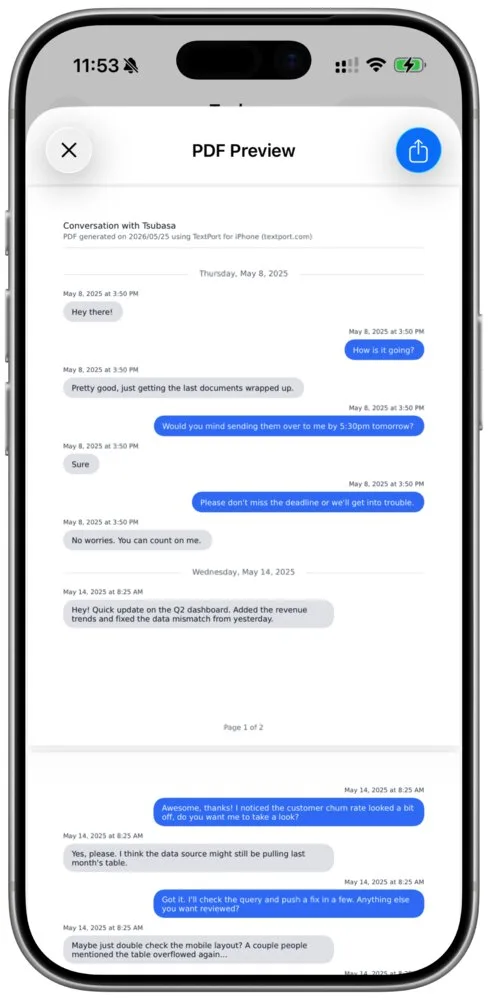
TextPort turns the conversation with your neighbor into one PDF on your iPhone, with no computer, ready to attach to an HOA or landlord complaint or print three times for court.
- iMessage and SMS come in through the TextPort Shortcut (iOS 26.4 or later), word for word with each message's date and time, for the date range you pick.
- WhatsApp comes in from WhatsApp's own Export Chat file. Messenger, Instagram, Signal and other apps come in from screenshots or a screen recording, which TextPort reads, so check the result against your phone before you export.
- The export is a PDF with the sender, date and time above every message and numbered pages, a CSV spreadsheet, or plain text. Photos from iMessage and WhatsApp chats print in the PDF. You can send it as a link instead of an attachment.
Frequently asked questions
-
Sometimes. In California, anyone whose personal enjoyment of their home is lessened by a nuisance can sue to stop it and for damages, and Washington also lets you sue over a nuisance. Texas has a civil stalking lawsuit, but only for repeated harassment that made you reasonably fear for your or your family's safety; unless the neighbor broke a restraining order, you also need a threat they could carry out, a clear demand to stop that they ignored, and a police report of stalking. For money alone, small claims is the simplest route: up to $12,500 in California, $20,000 in Texas justice court, $8,000 in Florida, and $10,000 in Washington and New York City ($5,000 or $3,000 elsewhere in New York).
-
It depends on your state and on who they told. In California, a police report made knowing it's false isn't covered by the privilege that protects honest reports, and California and New York let you sue over a false police call aimed at you because of your race, religion, disability or another protected trait. Washington cuts the other way: a person who complains to a government agency is immune from civil claims over it, and a neighbor who wins on that defense can recover attorney's fees plus $10,000. Talk to a lawyer before you file.
-
Not on its own. A private cease and desist letter isn't a court order and has no legal force of its own. But a clear, dated demand to stop counts in some laws: New York's fourth-degree stalking crime requires that the person was clearly told to stop, Texas's civil stalking lawsuit requires a clear demand to stop unless the neighbor broke a restraining order, and Washington judges consider whether the person got clear notice that further contact is unwanted. A short text or letter does that job. Keep a copy.
-
The camera laws we checked cover less than people often assume. California's covers viewing the inside of a bedroom, bathroom or other place where you expect privacy, with intent to invade it, and Texas, Florida and New York center on bathrooms, bedrooms or someone undressing. New York also lets you sue for damages if a neighbor mounts a camera on their property to film activities in your backyard, without your written consent, to harass, annoy, alarm or threaten you. If a camera looks into a bedroom or bathroom window, call the police. In Washington, repeated surveillance with no lawful purpose can count as stalking for a protection order.
-
You can ask for a civil harassment restraining order against a neighbor for violence, a credible threat of violence, or a knowing and willful course of conduct that seriously alarms, annoys or harasses you, serves no legitimate purpose, and would cause a reasonable person substantial emotional distress. The judge must find it by clear and convincing evidence, and the winner can be awarded attorney's fees. The order can't stop a nuisance that doesn't involve harassment; for that you file a civil action. Threats by text and repeated contact meant to harass are also misdemeanors.
-
Tell your landlord in writing, ask them to act, and keep a copy. In California, the Civil Rights Department says landlords must act quickly to end harassment by another tenant based on a protected trait such as race, religion or disability once they knew or should have known about it, and every lease requires them to stop tenant-on-tenant harassment that substantially interferes with your use of your home. Under federal fair housing rules, a landlord who fails to act promptly on harassment by another tenant based on race, religion, disability or another protected trait can be liable. Keep a diary of incidents to back up each complaint.

Start exporting your messages
Available for iPhone, Mac, and Windows. No computer required.