
How to File a Small Claims Case, Step by Step
To file a small claims case, check that your claim is under your state's limit, ask the other side to pay, and find their exact legal name and address. Then fill out your state's claim form, file it with the small claims clerk in the right county (or online, where allowed), pay a filing fee of $10 to $300, and have someone other than you serve the defendant. In California the clerk gives you a case number and a court date when you file, usually 1 to 2 months away.
Many small claims cases start with a deal made by text: a loan, a repair price, a promise to pay you back by Friday. That thread is often the only written record of the agreement, the amount and the promises. In Florida, a claim based on a written document must have a copy of it attached.
This is general information, not legal advice. Small claims rules differ by state and often by county, so check your court's website or ask the clerk before you file. For free help, ask your court's self-help center or local legal aid.
How to file a small claims case, step by step
- Check the limit and whether small claims fits. The limit is $8,000 in Florida, $10,000 in New York City and Washington, $12,500 in California and $20,000 in Texas, and lower for businesses and in some New York courts.
- Ask for the money first. California requires it: "You must ask the defendant (in person, in writing, or by phone) to pay you before you sue." Elsewhere, it's still the cheapest way to get paid; see how to get money back from someone who owes you.
- Get the defendant's exact legal name and address. Use the person's full legal name, or the business's registered name. California warns: "If the name isn’t right, you may not be able to collect any money if you win."
- Pick the right court. Usually that's the county where the defendant lives or does business (in Texas, also the justice court precinct), or another place your state allows, such as where an agreement was made. The wrong place can get your case dismissed or moved.
- Fill out your state's claim form. That's SC-100 in California, a small claims petition in Texas, a statement of claim in Florida and New York, and a Notice of Small Claim in Washington. Say who you're suing, how much and why, with dates.
- Export the text messages. If the defendant texted you about the loan, the job or the deposit, save the conversation for the dates involved as a PDF with the date and time on every message. TextPort does this on an iPhone, with no computer. Attach the pages showing the agreement, the amount and their promises where your court wants documents with the claim, as Florida does, and keep the rest for the hearing.
- File the claim. Hand the original and copies to the clerk, mail them, or file online where allowed: some California courts, many Texas justice courts, Florida's statewide E-Filing Portal, and King County, Washington. In New York City, ask the clerk.
- Pay the filing fee. It's $30 to $75 in California, $54 in Texas, $50 to $295 plus small add-ons in Florida, $10 to $20 in New York and $35 or $50 in Washington. If you can't afford it, ask the clerk about a fee waiver.
- Have the defendant served. You can't serve the papers yourself in any of these five states; who can depends on the state (table below), and in New York the clerk mails them. Serve at least 15 days before the court date in California (20 if the defendant is in another county), 10 in Washington, and before the pretrial conference in Florida.
After that, get your evidence ready. How to win in small claims court covers preparing your case, the hearing, appeals and collecting.
Does your claim fit in small claims?
| State | Limit | Good to know |
|---|---|---|
| California | $12,500 for a person; $6,250 for a business | No more than two claims over $2,500 per calendar year, statewide |
| Texas | $20,000, including any attorney fees | Heard in justice court |
| Florida | $8,000, not counting costs, interest and attorneys' fees | |
| New York | $10,000 in NYC; $5,000 in City Courts, Nassau and western Suffolk; $3,000 in eastern Suffolk and in Town and Village Courts | Only individuals can sue (businesses use Commercial Claims); businesses can be sued |
| Washington | $10,000 for a person; $5,000 for others | King County: only the person owed can file |
Sources: California § 116.221 and § 116.231; Texas § 27.031; Florida rules; New York NYC, elsewhere and the Attorney General; RCW 12.40.010 and King County.
Owed more than the limit? In California you can sue in the civil division instead, or stay in small claims and "give up your right to the amount over the limit." Not in Texas: "You cannot agree to accept less money just so you can file in a small claims court." New York doesn't let you split a claim to get under the limit. For other routes, see what you can do legally if someone owes you money.
Finding the defendant's legal name and address
- A person: their full name, plus other names they use with AKA. Name a married couple as two people; after a car accident in Washington, list the driver and the registered owner.
- A sole proprietor: the owner and the business name together. California's example: "On your forms, you will write Chris Cole, individually, and DBA Ace Copy & Shipping."
- A corporation or LLC: the registered company and its registered agent.
| State | Where to look up a business |
|---|---|
| California | Secretary of State website |
| Texas | County clerk's assumed name (DBA) records; Secretary of State's SOSDirect (charges a fee); Comptroller at 1-800-252-1386 |
| Florida | Division of Corporations at sunbiz.org or 850-245-6052, for corporations and fictitious names |
| New York | County Clerk's certificate of doing business; Department of State's business entity database |
| Washington | Secretary of State's corporation search |
Sources: California, Texas State Law Library, Miami-Dade Clerk, New York, WashingtonLawHelp.
New York's guide for courts outside NYC says: "You can still start your case. You can use any name that the business or person operating the business uses." Give the clerk the correct name later, or collecting will be very hard.
Use a street address, not just a P.O. box. If the person moved, California says the Postal Service may give you their forwarding address for serving a lawsuit, and it lists "Reverse phone directories (if you know their phone number)" among search tools.
Which court: where to file in each state
- California: usually the county where the other side lives or does business. For a broken agreement, also where you made it, where it was broken or was to happen, or where they lived or worked when you made it. The court checks this itself, even if the defendant doesn't object (§ 116.370), and "If you file in the wrong county, the court may cancel (dismiss) your case."
- Texas: the county and precinct where the defendant lives, where the incident happened, where the contract was to be performed, or where the property is. If they live out of state: "If the defendant is a non-resident of Texas, or if defendant’s residence is unknown, the plaintiff may file the suit in the county and precinct where the plaintiff resides." Many counties post precinct maps online.
- Florida: the summons lists seven proper places (Rule 7.060): where the contract was entered into; where an unsecured promissory note was signed or the maker lives; where the property is; where the event happened; where any defendant lives; any place a contract names; and, for money due with no agreement on where to sue, where payment was to be made.
- New York City: "In general, a claimant can sue in the county where either party resides." If neither of you does, sue where either works or has a business address; if the defendant has none of those in the city, you can't sue there.
- New York outside NYC: the Town or Village Court where the defendant lives, works or does business (up to $3,000), or any City Court in that county (up to $5,000). Nassau and Suffolk counties have their own rules and limits; ask the clerk there. Someone who doesn't live, work, do business or own property you rent or rented in New York State can't be sued in small claims.
- Washington: the district court in the county where the defendant lives, or where they work if you can't find their home (WashingtonLawHelp). Sue a business where it's located.
The claim form, the fee and online filing
| State | Claim form | Filing fee | Online filing |
|---|---|---|---|
| California | Plaintiff's Claim and ORDER to Go to Small Claims Court (SC-100) | $30 to $75 by amount ($100 for frequent filers) | Some courts |
| Texas | Small claims petition | $54, plus a service fee set by county | Many justice courts, through eFileTexas |
| Florida | Statement of claim (forms 7.330 to 7.337) | $50 to $295 by amount, plus a $4 clerk fee and a summons fee | Florida Courts E-Filing Portal |
| New York | Statement of claim, filled out with the clerk | $15 or $20 ($10 or $15 in Town and Village Courts) | Ask the clerk |
| Washington | Notice of Small Claim (MISC 05.0100) | $35 or $50, by county | King County |
Sources: California forms and filing; Texas Justice Court Training Center and State Law Library; Florida § 34.041 and Orange County Clerk; New York; Washington courts.
- California: fill out SC-100 on paper, as a fillable PDF, or with the courts' free Guide & File app, which "asks you questions and fills out the forms for you." File the original and at least 2 copies.
- Texas: "The court will likely have petition forms for you to use," and eFileTexas's guided interview (Texas Small Claims Petition) builds one. No personal checks. Service costs extra, $105 per defendant at one Grayson County court; if you can't pay, file a Statement of Inability to Afford Payment of Court Costs.
- Florida: use the form that fits, such as 7.333 for money lent (7.331 is for goods sold); the clerk must help if you ask. With add-ons, Miami-Dade's fees run $55 to $300, plus $10 per summons.
- New York City: file at the small claims clerk's office in the right county, or by mail if you live outside the city; no personal checks. "The clerk will give you a date for the hearing." On e-filing, the page says an outside service can do it, and also "The court system does not provide electronic filing for Small Claims matters at this time."
- Washington: sign the Notice in front of the clerk unless your court says otherwise, and use your court's own form if it has one. King County charges $50, and its online form creates the case for you; if you ask for a fee waiver, file by mail or in person instead.
Serving the papers and getting a court date
| State | Who serves | Deadline | When the hearing is |
|---|---|---|---|
| California | An adult not in the case, a sheriff, marshal or registered process server, or the clerk by certified mail ($15) | At least 15 days before the court date (20 if the defendant is in another county); 10 days earlier for substituted service | Usually 1 to 2 months after filing |
| Texas | A sheriff or constable, a certified process server, the clerk by restricted-delivery mail, or an adult the court authorizes | No fixed deadline; the defendant's 14 days to answer start at service | Trial notice at least 45 days ahead |
| Florida | The sheriff or a process server; the clerk by certified mail for Florida residents | Before the pretrial conference, or it's canceled for that defendant; the case can be dismissed if they aren't served within 120 days of filing | Pretrial conference within 50 days of filing; trial within 60 days after it |
| New York | The clerk, by certified and first-class mail; if the mail fails, an adult not in the case or a process server delivers it | Dismissed if not served within 4 months of filing | The clerk gives you the date when you file |
| Washington | An adult not in the case, the sheriff, or registered or certified mail with a signed return receipt | At least 10 days before the first hearing | The clerk writes it on the Notice |
Sources: California service and timing; Texas Rules, Part V; Florida rules; New York City and elsewhere; RCW 12.40.040.
- California: the clerk's certified mail often works for a business's agent, but "For others, it often doesn't work." Your server fills out a Proof of Service (form SC-104); file it at least 5 days before the hearing.
- Not by email or text. Santa Clara County's court: "Phoning, faxing, e-mailing, or leaving papers on a doorstep or windshield is not proper service." Don't serve by text either; use the methods above and ask the clerk if they fail.
- Texas: if the defendant doesn't answer within 14 days, you can ask for a default judgment. If service fails, the court can allow alternative service.
- Washington: legal aid says to mail the Notice at least 13 days before trial and file a signed Certificate of Service. King County requires mediation before an in-person trial.
The texts to file with your claim
Pick out the messages that show the deal, the amount and that they haven't paid.
- The deal and the amount: the loan, the price of the job or the deposit, and any partial payments.
- Their promises and admissions: I'll pay you back Friday, I know I owe you.
- Your demand and their reply, or their silence, plus photos sent in the chat.
To save them, stop deletion first: on your iPhone, go to Settings > Apps > Messages > Keep Messages and choose Forever. Save the whole conversation for the dates involved, not just the messages that help you, with the date and time on every message and the other person's name or number visible. Keep the original on your phone.
Hand them over as your court asks:
- With the claim, in Florida: the Orange County clerk says "Copies of any contracts, notes, leases, receipts or other evidence you have in support of your claim must be furnished to each person you are suing as well as to the court."
- On paper: Kitsap County District Court in Washington says to print texts because "A judge will not look at a device such as a phone or computer to look at your exhibits."
See also text messages in small claims court, security deposits and contractor disputes.
Saving the texts as one dated PDF
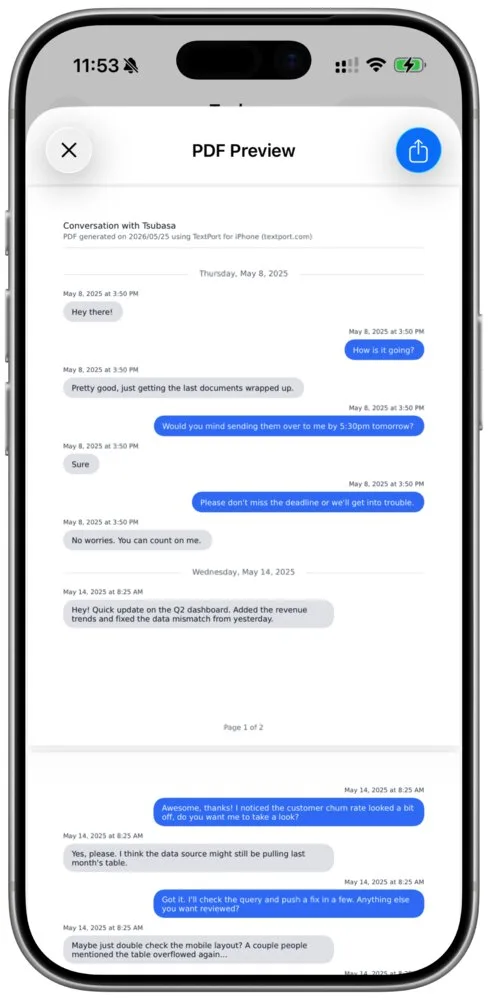
TextPort turns the conversation with the person you're suing into one PDF on your iPhone, with no computer, ready to attach where your court wants documents with the claim, and to print in as many copies as it asks for.
- iMessage and SMS come in through the TextPort Shortcut (iOS 26.4 or later), word for word with each message's date and time, for the date range you pick.
- WhatsApp comes in from WhatsApp's own Export Chat file. Instagram and Messenger chats import from the export Meta sends you, word for word. Signal and other apps come in from screenshots or a screen recording, which TextPort reads, so check the result against your phone before you export.
- The export is a PDF with the sender, date and time above every message and numbered pages, a CSV spreadsheet, or plain text. Photos from iMessage and WhatsApp chats print in the PDF. You can send it as a link instead of an attachment.
Frequently asked questions
-
In some places. California's courts say "Some courts allow e-filing (online filing)." Many Texas justice courts accept filings through eFileTexas, but not all. The Orange County clerk says Florida small claims can be filed through the statewide Florida Courts E-Filing Portal by registered users, and King County District Court in Washington has an online form that builds the Notice of Small Claim for you. New York City's court page says both that an outside service can e-file your claim and that the court doesn't offer e-filing for small claims, so ask the clerk.
-
Usually in the county where the defendant lives or does business. California, Texas and Florida also let you file where a contract was made or was to be performed, or where an accident or other event happened. In Texas you also pick the justice court precinct, and if the defendant lives outside Texas you can file in your own. In New York City, you can sue in the county where either of you lives. Filing in the wrong place can get a California case dismissed or a Texas case moved, sometimes with a second filing fee.
-
Sometimes. Texas lets you file in your own county and precinct if the defendant doesn't live in Texas. New York doesn't allow a small claims case against someone who doesn't live, work, do business or own property you rent or rented in the state. California's instructions say that with very limited exceptions the defendant must be served within California. Washington's district court statute lets you sue a nonresident where they can be served, where the claim arose, or where you live.
-
No, not in any of these five states. In California an adult who isn't in the case, a sheriff, marshal or registered process server, or the clerk by certified mail serves the papers. Texas bars anyone who is a party to the case or interested in its outcome. In Florida the sheriff, a process server or, for Florida residents, the clerk's certified mail does it. In New York the clerk mails the notice; if the mail fails, an adult who isn't in the case delivers it. In Washington an adult who isn't in the case or the sheriff delivers it, or it goes by registered or certified mail with a return receipt the defendant signs. Emailing doesn't count: Santa Clara County's court says "Phoning, faxing, e-mailing, or leaving papers on a doorstep or windshield is not proper service." Don't serve by text either; use your state's methods and ask the clerk if they fail.
-
In California, usually 1 to 2 months; Los Angeles County says 20 to 70 days. In Texas, the defendant has 14 days after service to answer, and the court sends a trial notice at least 45 days before trial. In Florida, the pretrial conference comes within 50 days of filing and the trial within 60 days after that. In New York City the clerk gives you the date when you file, and hearings are usually at 6:30 p.m. In Washington the clerk writes the date on the Notice of Small Claim.
-
No. The small claims rules in California, Texas, Florida, New York and Washington set only a maximum. Fees scale with the claim instead: Florida's lowest fee covers claims under $100, and California charges $30 for claims up to $1,500.

Start exporting your messages
Available for iPhone, Mac, and Windows. No computer required.