
How to Get a Restraining Order: Step by Step
To get a restraining order, pick the order that fits your relationship with the person, fill out your state's petition describing what they did, and file it with the court clerk, in person or online where allowed. A judge can grant a temporary order, often the same day, without the other person there. They're then served, and at a hearing, usually two to three weeks later, the judge decides on a longer order. Filing for a domestic violence order is free in California, Texas, Florida, New York and Washington, whatever the state calls it: a restraining order, protective order, injunction for protection, order of protection or protection order.
If you're in immediate danger, call 911. The National Domestic Violence Hotline is at 1-800-799-7233, or text START to 88788. This is general information, not legal advice. Rules differ by state, and court self-help centers, clerks and domestic violence advocates help with the forms for free.
If the person has been texting you, those messages are often your clearest proof: their exact words, dated, showing how often it happened. California's, Washington's and Florida's petition forms ask about texts by name. Whether texts alone are enough is covered in can you get a restraining order for text messages.
How to get a restraining order, step by step
- Pick the order that fits your relationship. In all five states below, a partner, ex or close family member falls under a domestic or family violence order; a neighbor, coworker or stranger, under a stalking, harassment or similar order.
- Get your state's petition from the court's website or the clerk's office.
- Describe what happened, most recent incident first, with dates, places and the exact words used. The other person will read it.
- Export the text messages. If they texted you, save the conversation for the dates involved as a PDF with the date and time on every message and their number visible. TextPort does this on an iPhone, with no computer. Print copies for the court.
- File and ask for a temporary order. A judge reads your petition without the other person there and decides whether to protect you until the hearing.
- Have the other person served. A sheriff or police officer usually does it. You can't serve the papers yourself.
- Go to the hearing with printed evidence: your texts, photos, police reports and witnesses. If you miss it, you can lose the temporary order.
- Carry the order, and renew it before it expires. If they break it, including by text, call 911.
Which order to ask for: restraining order, protective order or injunction
| State | Partner, ex or family member | Anyone else |
|---|---|---|
| California | Domestic violence restraining order (DV-100): spouse, ex, dating partner, co-parent, or close family (not an aunt, uncle or cousin) | Civil harassment restraining order (CH-100): neighbor, coworker, distant relative |
| Texas | Family violence protective order: family member, someone you live or lived with, spouse or dating partner | Stalking, sexual assault or human trafficking protective order, with no relationship required |
| Florida | Domestic violence injunction (12.980(a)): a relative or household member you live or lived with, or a co-parent. Dating violence injunction (12.980(n)): dated within the past 6 months | Repeat violence (12.980(f)), sexual violence (12.980(q)) or stalking (12.980(t)) injunction, open to any victim, partners and relatives included |
| New York | Family Court order of protection (Family Offense Petition): relatives by blood or marriage, current or former spouses, co-parents, intimate partners | Criminal court order of protection, starting with a police report |
| Washington | Domestic violence protection order | Antiharassment, stalking or sexual assault protection order, all on the same form, PO 001 |
Sources: California courts, TexasLawHelp, Fla. Stat. 741.28, NYC Family Court, RCW 7.105.100.
California is strict about the choice: "If you file the wrong type, the judge won't be able to make a decision in your case and you'll have to start the process over." Washington is the opposite: a petition "must not be dismissed or denied" because the facts fit a different type.
In Florida, repeat violence means two incidents of violence or stalking, one within 6 months of filing. A sexual violence petitioner must have reported it to law enforcement and be cooperating in any criminal case, unless the offender's prison term for it has ended or ends within 90 days (§ 784.046). A stalking injunction, which covers cyberstalking, "may be sought by any affected person".
In New York, "A casual friend or co-worker is not an intimate relationship." If Family Court can't take your case, the order comes through criminal court, starting with a police report; see how to file a police report for harassment.
Where to get the forms: California's self-help guide, which adds CLETS-001, a form for the police the other person never gets; TexasLawHelp's free Protective Order Kit; Florida's approved forms and court clerk, who "shall assist petitioners" in domestic violence cases; New York's Family Court, where staff can help you complete the petition; and Washington's forms page, for PO 001 and the confidential PO 003.
Writing the petition
At the temporary-order stage, the petition may be all the judge reads.
- Most recent first. California: "Write about the most recent abuse first, even if it is not the worst abuse." New York City's Family Court suggests the first and worst incidents too, and "the exact words the respondent used."
- Dates, names, places. Washington: "Be as specific and descriptive as possible. Put the date, names, what happened, and where." If you don't know the exact day, California says to "give an estimate and write down that it is an estimate."
- How they contacted you. California's DV-100 asks for what was "sent to you (examples: text messages, emails, or pictures)." Washington's PO 001 asks "How were any statements made? (in person, mail, text, phone, email, social media)". Florida's stalking petition asks about contacts in "voice messages, texts, emails, or other electronic communication."
- They'll read it. Washington warns: "The Restrained Person will see this Petition and any other evidence you file with the court." If you've moved, California lets you list "a friend's address or P.O. box", and Texas, New York and Washington also let you keep your address off the papers.
A log kept as things happened makes this easy; how to prove harassment and stalking has a template.
Getting your texts ready before you file
Do this before you file, while the messages are still on your phone.
- Save the whole conversation for every date in your petition, not just the worst messages. Include photos they sent, texts from new numbers or other apps, messages passed on through friends, and your own message asking them to stop.
- Stop your iPhone from deleting old texts: Settings > Apps > Messages > Keep Messages > Forever. Keep the originals on your phone and bring it to court.
- Show the sender's number and the date and time on every message, not just the name you saved them under. It answers a judge's first questions: who sent it, and when.
- Transcribe voicemails. Washington's evidence checklist asks for "Voice messages (written transcript)".
- Print them. Placer County Superior Court in California says electronic evidence must come "in a form (for example: printed out) that can be marked as an exhibit and left with the court. The court will not be able to look at the item on your phone or computer."
- File them with the petition where you can. California says "If you have proof (like an email or a text message), you can include it with your request." Washington says the same. In Florida, a temporary injunction rests on your sworn petition alone, so quote the key texts in it.
If the other person says the messages are fake, how to authenticate text messages for court covers what to say. For keeping a record over time, see documenting harassment text messages.
Filing, fees and the temporary order
- California: file at the courthouse, online, or by drop box, which may be slower. Every court must accept domestic violence petitions electronically; for civil harassment, that starts January 1, 2027. Domestic violence filings are free. A civil harassment petition costs $435 to $450 unless the person was violent, stalked you or threatened violence (item 13a on CH-100), or you get a fee waiver. The judge decides on a temporary order "the same day or by the next business day."
- Texas: for family violence, file where you live, where the other person lives or where it happened, in person or online through eFile Texas Self Help, or ask the county or district attorney to file for you. Filing, service and copies are free (§ 81.002). "You may be able to get a temporary protective order the same day you apply." It lasts up to 20 days and can be extended.
- Florida: file with the clerk of the circuit court; for domestic violence, where you live (even temporarily), where they live or where it happened. None of the five injunctions has a filing fee, and e-filing is optional. A temporary injunction lasts up to 15 days.
- New York: file in Family Court where either of you lives or where an incident happened. "It is free to file." CourtHelp says to file in person unless you're working with a domestic violence advocate group. A judge or referee hears you that day and decides on a temporary order.
- Washington: file in your county (or where it happened), in person or online at any hour. Only antiharassment petitions can cost money, and not when they involve stalking, violence or threats, sexual misconduct or domestic violence, or you can't pay (RCW 7.105.105). A judge reviews it "the same day you file, or the next working court day" if you file late or when the court is closed.
At night or on a weekend
- California: call the police. In domestic violence and stalking cases, an officer can get an emergency protective order from an on-call judge at any hour (Fam. Code § 6241). It lasts 5 court days or 7 calendar days, whichever ends first (§ 6256), so file for a temporary order right away.
- Florida: a judge must be available nights, weekends and holidays for temporary injunctions in domestic violence cases (§ 26.20).
- New York: "If you need a Temporary Order of Protection and Family Court is closed, you can go to your local Criminal Court to file." Sent back to Family Court, it lasts at most 4 calendar days, so file there by its return date (§ 154-d).
- Texas: an emergency protective order comes from a magistrate after an arrest, and "there is no separate application process required of the victim." It lasts 61 to 91 days (91 to 121 if a deadly weapon was used).
Serving the other person
- California: "A sheriff or marshal can do it for free" in domestic violence cases, though it can take a couple of weeks, so contact them right away. For civil harassment, service by a peace officer is free when they're serving a temporary or final order or you have a fee waiver; otherwise the sheriff may charge $50.
- Texas: the clerk arranges free service by law enforcement.
- Florida: the sheriff serves "on any day of the week and at any time of the day or night", and the temporary injunction takes effect once served.
- New York: "The Temporary Order of Protection is not in effect until it is handed to the respondent." A friend, process server, sheriff or police officer can serve it.
- Washington: law enforcement serves for free, and temporary orders go out by email, text message or social media first, unless weapons, custody, a move-out or a jailed respondent requires personal service (RCW 7.105.150). It must happen at least 5 court days before the hearing.
The hearing
| State | Full hearing | A final order can last |
|---|---|---|
| California | Within 21 days of the temporary order decision, or 25 for good cause | Up to 5 years, renewable (domestic violence orders even permanently) |
| Texas | No later than 14 days after filing (20 at the prosecutor's request in counties over 2.5 million people or multi-county districts) | Family violence: up to 2 years, longer in some cases. Stalking and sexual assault: up to life |
| Florida | Before the temporary injunction ends | Until the court changes or ends it |
| New York | Set by the judge when you file; the temporary order can be extended at each court date | Up to 2 years, or 5 with aggravating circumstances |
| Washington | Within 14 days of filing | Usually at least 1 year, or permanent |
Sources: Cal. Fam. Code § 242 and § 6345, Tex. Fam. Code ch. 84 and ch. 85, Tex. Code Crim. Proc. art. 7B.007, Fla. Stat. 741.30, N.Y. Family Court Act § 842, RCW 7.105.305 and 7.105.315.
Your word can be enough. California's hearing guide says: "Bringing evidence or witnesses is optional and not required. Your statements alone can be proof for your case." Still, bring printed copies of each exhibit (three in California; four in Placer County, which also wants copies given to the other side beforehand), police reports, photos and your phone. California says to bring witnesses; in Washington, witnesses usually file a written declaration instead of testifying.
Keep it short: Washington warns "You may have no more than 5 minutes to speak." And don't miss it: "If you do not appear at your full hearing, the judge will dismiss your temporary order."
After the order: renewals, guns and violations
Renew in time. In California, you can ask up to 3 months before the end date (free for a domestic violence order); once it has expired, you have to ask for a new order. In Texas, ask before it expires. In Washington, file within the 90 days before it ends; you don't have to prove you're still afraid. A New York court can extend an order for good cause, even if there's been no new abuse (§ 842).
Guns. In California, "all restraining orders include a firearms and ammunition restriction", and someone under a domestic violence order must give up their guns within 24 hours of being served. Texas makes it a crime to have a gun under a final protective order or a magistrate's emergency order (Penal Code § 46.04), and Florida bars guns under final domestic violence and stalking injunctions (§ 790.233). New York and Washington courts can order guns surrendered; in Washington, ask on the petition (form WS 001). Federal law bars guns for anyone under an order protecting an intimate partner or their child, issued after a hearing they had notice of, that finds them a credible threat or forbids physical force (18 U.S.C. § 922).
Violations. Call 911. Breaking the order is a crime in all five states. A text counts: "If they are not allowed to contact you, then even a text or a message through a family member or friend can be considered a violation." Don't reply. Save it, report it and "be sure to get an offense report number". In Florida, if no one was arrested for breaking a domestic violence injunction, the clerk helps you file an affidavit; in New York, you can also file a violation petition in Family Court. See how to report harassing text messages.
Keep a photo of every page of the order on your phone, as California suggests. Federal law gives protection orders "full faith and credit" in every state.
Saving the texts as one dated PDF
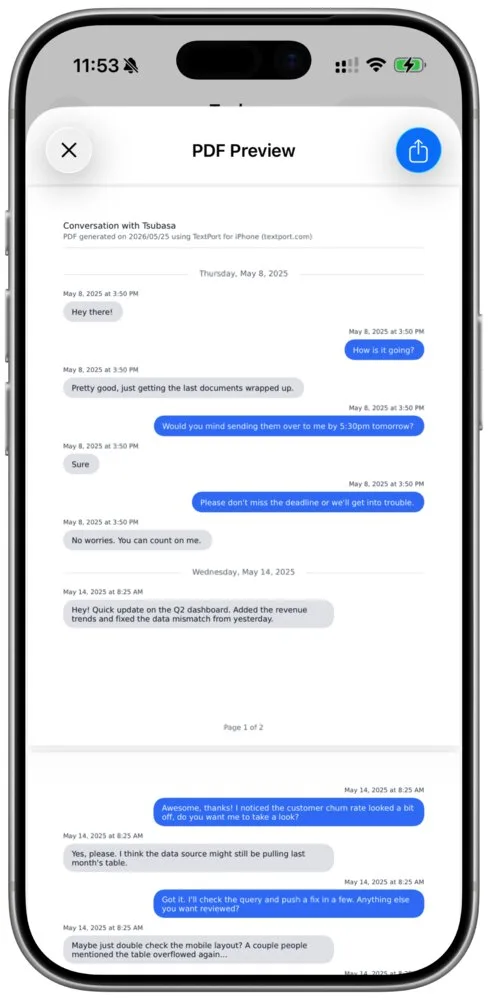
TextPort turns the conversation into one PDF on your iPhone, with no computer, ready to file with your petition or print for the hearing.
- iMessage and SMS come in through the TextPort Shortcut (iOS 26.4 or later), word for word with each message's date and time, for the date range you pick.
- WhatsApp comes in from WhatsApp's own Export Chat file. Messenger, Instagram, Signal and other apps come in from screenshots or a screen recording, which TextPort reads, so check the result against your phone before you export.
- The export is a PDF with the sender, date and time above every message and numbered pages, a CSV spreadsheet, or plain text. Photos from iMessage and WhatsApp chats print in the PDF. You can send it as a link instead of an attachment.
Frequently asked questions
-
A temporary order can come quickly. In California and Washington, a judge decides the same day you file or by the next court day. In New York, you see a judge the day you file, and in Texas you may get one the same day you apply. The longer order comes after a hearing: within 21 days of the temporary order decision in California (25 for good cause), within 14 days of filing in Texas and Washington, and in Florida before the temporary injunction runs out, which is at most 15 days. California's courts say the whole process can last a few weeks or months.
-
Nothing for a domestic violence order in California, Texas, Florida, New York or Washington, and Texas charges nothing to file or serve a protective order. The exceptions: a California civil harassment petition costs $435 to $450 unless you allege violence, stalking or threats of violence or get a fee waiver, and Washington can charge a filing fee for some antiharassment petitions.
-
In some states. Every California court that takes domestic violence petitions must accept them electronically; for civil harassment petitions, that becomes required on January 1, 2027. Washington courts must accept petitions online at any time of day. In Florida, you may e-file but don't have to. In Texas, the state's free eFile Texas Self Help site walks you through a protective order application and lets you file it electronically. New York's CourtHelp says you must file in person unless you're working with a domestic violence advocate group.
-
Often, yes. In California, in domestic violence and stalking cases, a police officer can get an emergency protective order from an on-call judge at any hour; it lasts 5 court days or 7 calendar days, whichever ends first, so you then ask the court for a regular order. Florida must have a judge available nights, weekends and holidays for domestic violence cases. In New York, a local criminal court can issue a temporary order when Family Court is closed and send the case back there; that order lasts at most 4 calendar days, so file your Family Court petition by its return date. Washington takes petitions online at any hour, and a judge reviews them by the next court day. In Texas, an emergency order comes from a magistrate after an arrest; you don't apply for it.
-
In California, up to 5 years, and it can be renewed without new abuse. In Texas, a family violence order usually lasts up to 2 years, and stalking and sexual assault orders can last for life. In Florida, an injunction lasts until the court changes or ends it, unless the judge sets an end date. In New York, up to 2 years, or 5 with aggravating circumstances. In Washington, at least a year (antiharassment orders can be shorter) or permanently.
-
Mostly, it's the name each state uses for the same kind of court order. California calls it a restraining order, Texas a protective order, Florida an injunction for protection, New York an order of protection and Washington a protection order. In New York, a restraining order is technically something else, so ask for an order of protection there.

Start exporting your messages
Available for iPhone, Mac, and Windows. No computer required.