
Landlord Harassment: What Counts, How to Document It, and Where to Report It
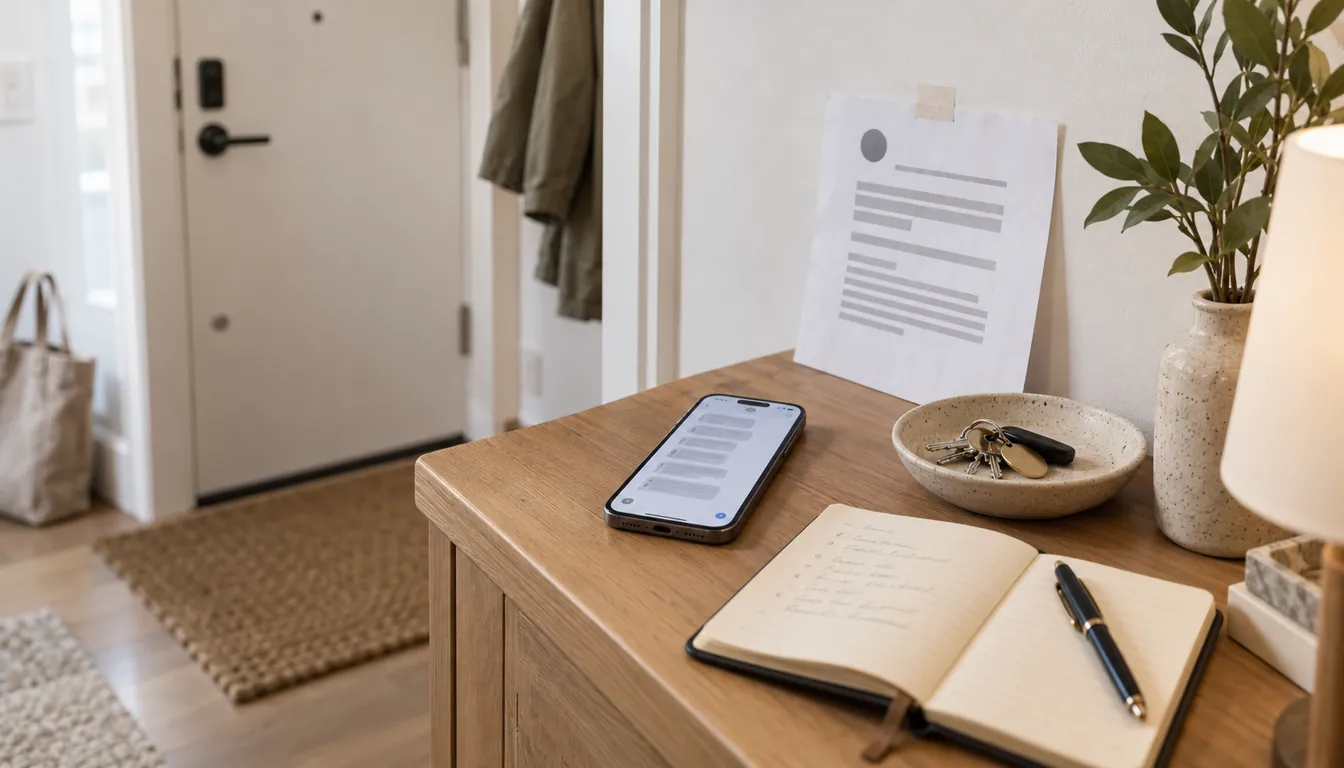
Landlord harassment is what a landlord, manager or maintenance worker does to push you out or make your home unlivable: entering without notice, threats, late-night calls and texts, cutting off utilities, changing the locks, buyout pressure, retaliation after a repair complaint, or sexual demands. Keep a dated log, save the texts, photos and videos in their original form, and report it: to your city housing agency (311 in New York City), to HUD within one year if it's sexual or based on a protected trait such as race or disability, and to the police if you're threatened or locked out. You can also sue: up to $2,000 per violation under California Civil Code 1940.2, one month's rent plus $1,000 for a Texas lockout, at least three months' rent for a Florida one.
Much of it happens by text: entry notices, late-night messages about moving out, cash offers to leave. An archived HUD fact sheet's example of illegal harassment is a maintenance worker who repeatedly sends unwelcome "sexually explicit text messages and photos to a tenant." In a 2026 Queens Housing Court case, the tenant's evidence included a text in which the landlord said a dispute over the electric bill could only be resolved by the tenant moving out, and a video the landlord texted him of himself firing a gun, which the court found was meant to threaten him into leaving. The court found harassment and awarded him $5,000, though he had already been evicted in a separate case.
This is general information, not legal advice, and tenant laws differ by state and city. For free help, contact your local legal aid office or tenant union. If you're threatened or in danger, call 911.
Examples of landlord harassment
- Entering without proper notice, or using entry to harass. California's law says: "The landlord may not abuse the right of access or use it to harass the tenant."
- Threats of physical harm, by word or gesture.
- Late-night calls and texts. New York City lists "Threats and intimidation, such as late-night phone calls including phone calls to encourage or ask you to move out of your home or give up your rights." It also lists repeated off-hours contact you haven't agreed to.
- Cutting off heat, water or electricity.
- Lockouts: changing the locks, removing doors, putting your things out.
- Buyout pressure: repeated or threatening offers of money to leave.
- Retaliation: an eviction notice, rent increase or cut in services soon after you complain about repairs.
- Refusing your rent.
- Immigration threats. California bans threatening to disclose a tenant's immigration status to make them leave.
- Sexual harassment: demanding sex or nude photos for housing or repairs, explicit messages. An example from the Justice Department: "When I fell behind on rent, he said there was another way I could pay. I said no and he evicted me."
What usually isn't harassment
- A good-faith warning about a lease violation. California's harassment law says it isn't a violation.
- Ordinary business contact. California's crime of repeated calls and texts excludes contacts "made in good faith or during the ordinary course and scope of business." A rent reminder is business. Ten messages a night is not.
- A Texas lock change for unpaid rent, but only if the lease allows it; you got written notice at least 5 days ahead by mail, or 3 days ahead by hand or posted inside your main door; no one is home; the office is open that day and the next for you to pay; it's the only lock change this rental period; and the landlord gives you a new key at any hour, paid or not (§ 92.0081).
If you're locked out, threatened or the power is off
Threats or violence: call 911. The Los Angeles Housing Department: "If a tenant feels they are in physical danger, they should call the LAPD or dial 911."
Locked out: call the police and ask for a report. In 2022, California's Attorney General told police chiefs and sheriffs that lockouts are crimes, not just civil disputes, even when the tenant owes rent, and that officers should "Write a report about the incident even if no arrest is made." In New York, illegally evicting an occupant of 30 days or more, including by changing the locks or cutting essential services, is a class A misdemeanor (RPAPL § 768). In New York City, call the NYPD or your local precinct. In Florida, Jacksonville Area Legal Aid says to call the police and "Ask the police to write a report."
Have proof you live there: ID, mail, a utility bill, the lease. The Los Angeles Housing Department says to "save digital copies (images) in an email, or a secured personal device."
In Texas, go to the justice court. A sworn complaint to the justice of the peace in your precinct can get you a writ of re-entry, which the judge can issue without hearing from the landlord first (§ 92.009). For a utility cutoff, ask for a writ of restoration. The filing fee was $54 in most counties as of 2022, and fees can be waived (Texas Justice Court Training Center).
See how to file a police report for harassment.
When the texts themselves are a crime
Harassing messages can break criminal law on their own: repeated calls or electronic contact meant to annoy or harass in California (Penal Code § 653m), repeated electronic communications, text messages included, in Texas (Penal Code § 42.07), threats of harm by phone or electronic means in New York (Penal Law § 240.30), and cyberstalking in Florida (§ 784.048). See how to report harassing text messages, and if they won't stop, restraining orders for text messages.
What the law says by state
| State | What the law bans | Retaliation protection |
|---|---|---|
| California | Threats, force, menacing conduct, significant intentional illegal entry or immigration threats to make you move; lockouts and utility shutoffs meant to end your tenancy | 180 days after a habitability complaint if you're current on rent, once in 12 months; retaliation for using any legal right is also banned |
| New York | In NYC, any act or omission meant to make you leave or give up your rights; statewide, lockouts and willfully cutting heat or water | Presumed for one year after a good-faith complaint, except in owner-occupied buildings with fewer than four units |
| Texas | Lockouts, with the narrow unpaid-rent exception, and utility cutoffs | Six months, including a bad-faith course of conduct |
| Florida | Abusing the right of entry to harass; cutting utilities or blocking access | A defense to eviction |
| Massachusetts | Interfering with quiet enjoyment, failing to provide utilities, lockouts | Presumed for six months |
Sources: California § 1940.2, § 789.3, § 1942.5; New York RPAPL § 768, RPL § 235, RPL § 223-b; Texas § 92.0081, § 92.008, § 92.331; Florida § 83.53, § 83.67, § 83.64; Massachusetts § 14, § 15F, § 18.
- California's 1940.2 applies only to acts done "for the purpose of influencing a tenant to vacate a dwelling". In Los Angeles, where the Tenant Anti-Harassment Ordinance covers all residential tenants, harassment is "a landlord’s bad faith conduct directed at a specific tenant or tenants that causes the latter detriment or harm." San Francisco's Rent Ordinance § 37.10B bars bad-faith threats of physical harm, coercive buyout offers that come with threats, and refusing rent.
- Florida has preempted local landlord-tenant rules since 2023 (§ 83.425), so a city ordinance may not protect you.
- Federal law covers harassment because of race, color, religion, sex, familial status, national origin or disability. "Harassment can be written, verbal, or other conduct, and does not require physical contact." One severe incident can be enough, and you don't have to show psychological or physical harm (24 CFR § 100.600).
Can your landlord enter without notice?
In California, outside emergencies and a few other cases, the landlord must give written notice and come during normal business hours. "The notice shall include the date, approximate time, and purpose of the entry." Twenty-four hours is presumed reasonable, or six days if mailed. The statute lists delivery in person, to someone of suitable age at your home, on, near or under the door, or by mail. It names no electronic method, and the Los Angeles Housing Department's 24-hour notice flyer lists the same four methods.
California's statute doesn't say how often a landlord may inspect, but Los Angeles treats as abuse of access "entering or photographing portions of a rental unit that are beyond the scope of a lawful entry or inspection", vague notices, unreasonably long time windows, and excessive entry requests the stated reason doesn't justify.
- Florida sets 24 hours' notice, between 7:30 a.m. and 8:00 p.m., only for repairs, and lets the landlord enter any time to protect or preserve the premises (§ 83.53).
- Texas: the State Bar's Tenants' Rights Handbook says to "Study your lease carefully to determine the circumstances under which the landlord may enter" your home.
- Massachusetts: MassLegalHelp lists an entry "without your permission or notice" as grounds to sue under the quiet enjoyment law.
How to document landlord harassment
The Los Angeles Housing Department's advice: "Tenants should keep a log with dates and times, get statements from neighbors, and take pictures."
- Keep a log. The Legal Aid Foundation of Los Angeles (LAFLA) gives this sample entry: "July 15, 2022 – electricity went out at 4 AM. Was off until 10 PM on Sunday. Called DWP and emailed property manager. Wife and neighbor Marty in unit 4C witnessed."
- Put it in writing. LAFLA says: "Email or text messages can be a good way to send these communications." After a call or a visit, text a short summary of what was said.
- Keep the originals. In Wall v Chauca, the Queens case (an unpublished trial-level decision), the tenant said his copy of the gun video showed the wrong date stamp because he had shrunk the file to email it to the court, and he couldn't find the original file or the text it came with. It was still admitted, but keep the thread on your phone and send unedited copies.
- Photograph and film notices on your door, the broken lock, the cold radiator.
- Line up witnesses. San Francisco's Rent Board holds a harassment hearing only if your account is backed by documents or a witness other than you.
- Keep receipts for what it cost you, like a hotel night or spoiled food.
Be careful recording calls and visits. Recording a confidential conversation without everyone's consent is a crime in California (Penal Code § 632), Florida requires everyone's consent for phone calls and private conversations (§ 934.03), and Massachusetts bars secret recording without everyone's permission (Chapter 272, § 99). In those states, write down what was said right away, or text a summary as in step 2.
Which texts to save, and how
Save your conversations with the landlord, manager, super and maintenance worker, especially:
- Entry notices, and messages about when someone came in.
- Threats, insults, sexual messages and photos.
- Late-night or repeated messages. The timestamps are the proof.
- Buyout offers, and your written answer.
- Your repair requests and complaints, which start the retaliation clock.
- Your message asking them to stop, or to write instead of calling.
- Call history screenshots and voicemails.
To stop your iPhone from deleting old texts, go to Settings > Apps > Messages > Keep Messages and choose Forever. Save the whole conversation for the dates involved, not just the worst messages, with the date and time on each message, the photos and videos in it, and the landlord's name or number visible. Keep the original on your phone. TextPort can turn the thread with your landlord into one dated PDF on your iPhone for a complaint or a court date.
For a New York City harassment case, the Attorney General says to "bring all evidence of the harassment, including witnesses, with you when you go to court." Bring printed copies to court, attach a PDF to an agency complaint, and email it to your lawyer. See text messages in landlord disputes.
Sending a landlord harassment letter
LAFLA tells Los Angeles tenants to send the landlord a letter to stop. The city's ordinance requires written notice before a lawsuit only for claims over failed repairs or maintenance: the landlord gets a reasonable time to fix the problem, and since December 2024, there's no wait if the neglect is intentional and shows willful disregard for your comfort, safety or well-being (Los Angeles Housing Department, Ordinance 188416). In New York City, a written note refusing buyout offers stops them for 180 days.
Put in the letter the dates and incidents from your log, what must stop, that entry needs proper notice, that you want contact in writing, and the law, such as Civil Code 1940.2 in California or Chapter 186, § 14 in Massachusetts. Send it in a way you can prove, keep a copy, and text or email it too.
Where to report landlord harassment
| Where | Report to | Contact or deadline |
|---|---|---|
| New York City | 311, or an HP proceeding in Housing Court | 311 |
| New York, rent-stabilized or rent-controlled | NYS Homes and Community Renewal | 1-866-275-3427 |
| Los Angeles | Los Angeles Housing Department | 1-866-557-7368, or online |
| San Francisco | Rent Board harassment report | Within 12 months, for harassment since Feb. 8, 2026 |
| California, discrimination or sexual harassment | Civil Rights Department | Within one year |
| Massachusetts | Attorney General's Civil Rights Division | (617) 963-2917 |
| Texas, lockout or utility cutoff | Justice court in your precinct | Writ of re-entry or restoration |
| Florida, lockout | Police, then small claims | Ask for a written report |
| Anywhere, sexual or discriminatory harassment | HUD | (800) 669-9777, within one year |
| Anywhere, sexual harassment | Justice Department | 1-844-380-6178 |
- New York City. HPD says: "File all complaints with 311 and make sure to say that you believe you are being harassed." To go to court, file an HP proceeding at your borough's Housing Court and list every act of harassment on the form; a fee waiver is available (NY Attorney General).
- San Francisco. The Rent Board asks the landlord to respond within seven days. It holds a hearing only for harassment since February 8, 2026 and in the past 12 months that made the unit uninhabitable, is still going on, or is part of a pattern in the building, backed by documents or a witness other than you. The hearing decides whether harassment happened but awards no money (Rent Ordinance § 37.9(l)).
- California. The Civil Rights Department handles harassment because of a protected trait.
- Massachusetts. Complaints go to the Attorney General's Civil Rights Division (advisory).
- HUD. You don't have to complain to your landlord first. File within one year after the harassment happened or ended (42 U.S.C. § 3610), or sue in court within two years (§ 3613).
- Justice Department. For sexual harassment, it says: "To preserve your rights, you should also consider filing a fair housing complaint" with HUD.
Compensation for landlord harassment
| Place | Law | What you can recover |
|---|---|---|
| California | Civil Code 1940.2 | Up to $2,000 per violation, in small claims too |
| California | Civil Code 789.3 (lockouts, shutoffs meant to end your tenancy) | Actual damages plus up to $100 a day, at least $250 per cause of action |
| California | Civil Code 1942.5 (retaliation) | Actual damages, plus $100 to $2,000 in punitive damages per act for fraud, oppression or malice |
| Los Angeles | Tenant Anti-Harassment Ordinance | Three times your damages, including emotional distress, plus $2,000 to $10,000 per violation; up to $5,000 more per violation if you're over 65 or disabled |
| San Francisco | Rent Ordinance § 37.10B | Three times actual damages or $1,000, whichever is greater |
| New York City | Housing Maintenance Code | Actual damages or $1,000, your choice, plus punitive damages if the court awards them |
| Texas | Property Code 92.0081, 92.008 | One month's rent plus $1,000 plus actual damages, minus any rent you owe; one more month's rent if the landlord changed the locks and won't give you a key |
| Texas | Property Code 92.333 (retaliation) | One month's rent plus $500 plus actual damages |
| Florida | § 83.67 | Actual and consequential damages or three months' rent, whichever is greater |
| Massachusetts | Chapter 186, § 14 | Actual and consequential damages or three months' rent, whichever is greater |
| Massachusetts | Chapter 186, § 15F (lockouts) | Three months' rent or three times your damages |
| Massachusetts | Chapter 186, § 18 (retaliation) | One to three months' rent, or actual damages if greater |
Most of these also cover attorney's fees, but some, including California's 789.3 and 1942.5 (when fees are requested at the start), award them to whichever side wins, so a tenant who loses can owe the landlord's fees. Sources beyond the statutes linked above: LAHD, San Francisco, NYC Local Law 148 of 2017, Texas § 92.333.
Not every penalty goes to you. In New York City, a harassment finding carries a civil penalty, $2,000 to $10,000 per unit under the 2017 local law, but it's paid to the city's housing agency, HPD. New York's lockout law doesn't say its $1,000 to $10,000 civil penalty goes to the tenant, and Massachusetts's $25 to $300 fine under § 14 is a criminal penalty.
In two 2026 New York City cases, a tenant got $1,000 plus $4,000 in punitive damages (Wall v Chauca), and in a case the landlord didn't show up to defend, two tenants got $1,000 plus $4,000 and $6,500 plus $10,000 in punitive damages (Nicholson v 80 Clarkson Partners). Each landlord also owed HPD $2,000 per finding.
Small claims court takes cases up to $12,500 in California, $8,000 in Florida, and $7,000 in Massachusetts. See how to win in small claims court, and if you're moving out, how to get your security deposit back.
Saving the texts as one dated PDF
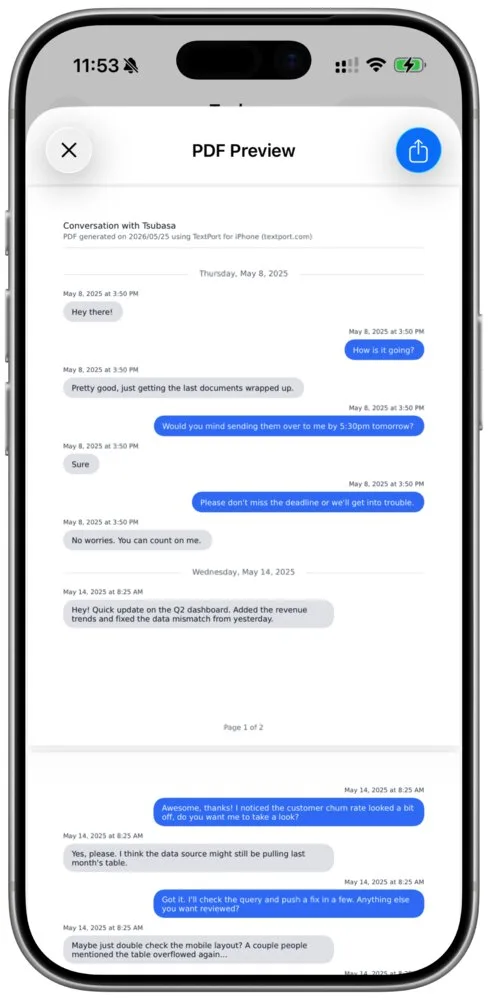
TextPort turns the conversation with your landlord into one PDF on your iPhone, with no computer, ready to attach to a housing complaint or print for a court date.
- iMessage and SMS come in through the TextPort Shortcut (iOS 26.4 or later), word for word with each message's date and time, for the date range you pick.
- WhatsApp comes in from WhatsApp's own Export Chat file. Messenger, Instagram, Signal and other apps come in from screenshots or a screen recording, which TextPort reads, so check the result against your phone before you export.
- The export is a PDF with the sender, date and time above every message and numbered pages, a CSV spreadsheet, or plain text. Photos from iMessage and WhatsApp chats print in the PDF. You can send it as a link instead of an attachment.
Frequently asked questions
-
It depends on where you live. In California, Civil Code 1940.2 covers force, threats, menacing conduct, a significant and intentional illegal entry, or threats about immigration status, when done to make you move out. New York City counts any act or omission by or for an owner that is meant to make you leave or give up your rights, including late-night calls pressuring you to move. Los Angeles covers bad-faith conduct such as abusing the right of entry or pushing a buyout. Under federal law, sexual demands, or severe or pervasive conduct because of your race, sex, disability or another protected trait, are harassment, and one severe incident can be enough.
-
It depends on the law you sue under. In California, up to $2,000 per violation under Civil Code 1940.2, plus up to $100 a day for a lockout or utility shutoff. Los Angeles tenants who win get three times their damages plus $2,000 to $10,000 per violation. In New York City, a tenant gets actual damages or $1,000, plus any punitive damages; in 2026 decisions, tenants were awarded $5,000 to $16,500, the top award in a case the landlord didn't defend. A Texas lockout costs one month's rent plus $1,000, a Florida one at least three months' rent, and a Massachusetts one three months' rent or three times your damages.
-
The law doesn't say. Civil Code 1954 requires written notice and lists personal delivery, leaving it with someone of suitable age at your home, leaving it on, near or under the door, or mail. It names no electronic method, and the Los Angeles Housing Department's flyer lists the same four methods. Save any notice you get by text: it shows the date, time and purpose the landlord gave, and in Los Angeles, vague notices and excessive entry requests count as abuse of the right of access.
-
Yes, for threats, violence and lockouts. Call 911 if you're in danger. California's Attorney General has told police that lockouts are crimes, not just civil disputes, and that officers should write a report even if no one is arrested. In New York, forcing out an occupant of 30 days or more without a court order is a class A misdemeanor. Harassing calls or texts can be a crime in their own right in California, Texas, New York and Florida.
-
Not in California or Florida. California's Attorney General says a landlord can't force a tenant out even if the tenant owes rent, and Florida bars cutting utilities or changing the locks. Texas is different: a landlord may change the locks of a tenant who is behind on rent only if the lease allows it, written notice was given in advance (5 days by mail, or 3 by hand or posted inside your door), no one is home, it's the only lock change that rental period, and the landlord hands over a new key at any hour, whether or not you pay. A Texas landlord may not cut your utilities for unpaid rent, whether you pay the utility company or the landlord provides them; only real repairs, construction or an emergency allow a shutoff, apart from a narrow procedure for unpaid electric bills the landlord issues.
-
Usually not on its own. California's crime of repeated calls and electronic contact excludes contacts made in good faith or in the ordinary course of business, and a good-faith warning about a lease violation isn't harassment under Civil Code 1940.2. It changes when the messages threaten you, push you to move out, or keep coming late at night or outside business hours when you haven't agreed to that, which New York City lists as harassment. Save the whole conversation either way.

Start exporting your messages
Available for iPhone, Mac, and Windows. No computer required.