
How to Write a Demand Letter (With a Free Sample)
To write a demand letter, list what happened in date order, state the exact amount owed and how you worked it out, mention your proof, give a date to pay and say how, and end by saying you'll file in small claims court if they don't. Keep it calm, sign it, send it by certified mail with a return receipt, and keep a copy. First check whether a law requires a specific notice for your claim: in California, asking for the money is a required step before small claims. A free sample letter for money owed is below.
Many debts start in a text thread: a friend borrowing rent money, a contractor's quote, a client approving your work. Those messages show what they agreed to and when they promised to pay. TexasLawHelp says: "If you know any evidence (like a contract), you should mention it." Without a signed contract, the texts are often your best proof, so attach them as an exhibit.
This is general information, not legal advice. Rules differ by state. For free help, contact your local legal aid office.
How to write a demand letter, step by step
Work out what you're owed and gather your proof. Settle on one number you can explain: the loan minus what they've repaid, the unpaid invoice, the repair bill. Washington legal aid says: "Ask for only what you believe you're owed." Put the agreement, receipts, payment records and photos in one folder.
Check whether a law requires a specific notice first. California requires you to ask for the money before small claims, and some claims, such as one under Texas's Deceptive Trade Practices Act, need written notice a set time before you sue (see the table below).
Export the text messages. If the borrower, client, landlord or contractor texted you, save the conversation for the dates involved as a PDF with the date and time on every message. TextPort does this on an iPhone, with no computer. Label it as an exhibit, such as Exhibit A: our text messages from March 3 to June 1, 2026, and highlight the messages where they agreed to the amount or promised to pay. Keep an unmarked copy for court.
List the facts in date order. Washington legal aid: "Make a short, numbered list of important facts." Include when you made the deal, what changed hands and how, what they promised, any partial payments, and each time you asked.
Turn the list into a short, formal letter. Address it to the person you made the agreement with, or to the company by name. Stick to facts; Washington legal aid warns: "The more you attack, the more you invite the other side to respond in a similar tone." Type it, sign it and date it.
Set a deadline and say how to pay. TexasLawHelp: "giving the other side at least seven business days to respond would be reasonable." Washington legal aid suggests 7 to 10 days, and a Los Angeles legal aid guide for deposits 7 to 14. Name the payment method (check, Zelle, cash) and whether you'll accept a payment plan in writing.
Send it so you can prove it arrived. Use certified mail with a return receipt requested. If they might refuse to sign, Washington legal aid says to use "regular mail with tracking and delivery confirmation". Email a PDF copy too.
Keep copies and follow up once. Keep the letter, exhibits, post office receipts and printed tracking. Wait the full time you gave them, then contact them once more.
If they don't pay, file in small claims, or first try a second letter or mediation (below). The return receipt helps you counter any claim that they never got your letter.
Free sample demand letter for money owed
Copy this and fill in the brackets. It has each part the Texas and Washington legal aid guides ask for.
[Your name], [your address], [your phone and email]
[Date]
[Their name], [their address]
Re: Demand for payment of $[amount]
Dear [their name],
On [date], you asked to borrow $[amount] for [what it was for] and agreed to pay me back by [date]. I sent you the money that day by [Zelle, Venmo, check number or cash].
You repaid $[amount] on [date]. The remaining $[amount] is unpaid. I asked you for it on [dates], and [you said you would pay by (date) / you have not replied since (date)].
I have enclosed our text messages from [first date] to [last date] as Exhibit A, with the messages where you agreed to repay me highlighted, and my payment record as Exhibit B.
Please pay $[amount], which is the $[amount lent] minus the $[amount repaid], by [a date at least 7 to 10 days after this letter should reach them], by [check to the address above, or Zelle to (phone or email)]. If you can't pay it all at once, contact me by that date with a payment plan, and we will put it in writing.
If I do not receive payment or a written plan by [date], I will file a claim against you in small claims court for $[amount].
Sincerely, [signature], [printed name]
Adapt it
- Unpaid invoice: give the invoice number, what you delivered and when, the due date and any partial payment, and attach the invoice and the messages where the client approved the work. New York's courts post a sample letter for businesses' commercial claims.
- Security deposit: cite your state's deposit law and ask for receipts for each deduction. How to get your security deposit back has a deposit letter with each state's law.
- Contractor: say what was agreed and what's missing or wrong, and ask for it fixed by a date or your money back. Washington's Department of Labor & Industries says to give the contractor "a written list of your complaints and needs, including a deadline for them to respond to you." See contractor disputes.
- Damaged property: list each cost with its receipt or estimate, like the repair bill and rental car in Washington legal aid's car-repair sample.
Do you have to send a demand letter first?
| State | Before small claims | Laws with their own notice |
|---|---|---|
| California | Required: ask for the money first, by letter, email, in person or by phone | Consumers Legal Remedies Act (damages): 30 days, certified or registered mail, return receipt requested. Bounced check: 30 days, certified mail |
| Texas | Recommended | Deceptive Trade Practices Act: 60 days. Construction defect: 60 days, certified mail, return receipt requested, with your evidence. Attorney's fees (if you have a lawyer): 30 days |
| Florida | Recommended by the Miami-Dade Clerk | Bounced check: 30 days, in the statute's form |
| New York | Required only for a business's commercial claim over a consumer transaction, 10 to 180 days before filing | Bounced-check damages: two demands, only for payees who post a public notice |
| Washington | Recommended | Bounced check: notice of dishonor, 15 days |
- California: the courts' demand letter page says: "This is a step you must take before filing a small claims court case," unless there's a restraining order between you or asking would be dangerous. It also offers a free program that writes the letter for you. The claim form, SC-100, accepts asking by phone too. Consumer notice: Civil Code § 1782.
- Texas: the Texas State Law Library says: "It is always recommended you try and resolve your problems with the other party on your own." Notice rules: § 17.505, § 27.004 and, for attorney's fees when you have a lawyer, § 38.002.
- Florida: the Miami-Dade Clerk says: "It is a good idea to send a letter, which clearly states your complaint." Florida's small claims rules don't require one for an ordinary money claim.
- New York: the courts' small claims guide requires a demand letter only for a business's commercial claim over a consumer transaction. An individual suing in small claims has no such step.
- Washington: Washington legal aid's small claims guide says: "A good demand letter can show the person you're serious and sometimes cause the person to reconsider and settle with you out of court."
Bounced checks have their own demand rules, with damages if the demand goes unpaid. Use the notice wording and mailing method the statute sets, not the sample letter above. In California, the damages are three times the check (at least $100, at most $1,500) on top of the check itself, after a certified-mail demand and 30 days (Civil Code § 1719, with a court sample letter); in Florida, three times the amount (at least $50) on top of the amount owed, after 30 days (§ 68.065); in Washington, three times the check or $300, whichever is less, after a notice of dishonor in the form of RCW 62A.3-520 and 15 days (RCW 62A.3-515). If they stopped payment because of a genuine dispute with you, these damages may not apply.
What not to put in a demand letter
Name one consequence: a lawsuit. Anything beyond that can turn a demand into a crime.
- No police or criminal charges. California's Supreme Court in Flatley v. Mauro: "The law does not contemplate the use of criminal process as a means of collecting a debt." It added that "belief that the victim owes a debt is not a defense to the crime of extortion," though tough pre-lawsuit demands, including threats to sue, aren't necessarily extortion. In Florida, maliciously threatening "to accuse another of any crime or offense" to get money is a second-degree felony. Texas's debt collection law bars threatening criminal charges against someone who hasn't broken a criminal law, and says it doesn't prevent "threatening to institute civil lawsuits".
- No threats to expose them. California, Florida, New York and Washington all count a threat to expose a secret, or something that would disgrace the person, as an extortion threat (Cal. Penal Code § 519, Fla. Stat. § 836.05, N.Y. Penal Law § 155.05, RCW 9A.04.110). In New York and Washington, that includes a threat to "publicize an asserted fact, whether true or false" that would bring someone hatred, contempt or ridicule. Don't threaten to tell their boss, family or followers.
- No harm of any kind. TexasLawHelp: "Never threaten the other party with illegal activity or physical, mental, or other harm. You will be in danger of prosecution if you make threats."
- No name-calling. Calling someone a thief in a letter you copy to others or post online risks a libel claim (California Civil Code § 45).
- No flood of texts afterward. Texas and California make repeated messages sent to harass or annoy a crime (Texas Penal Code § 42.07, California Penal Code § 653m).
A demand letter doesn't pause your deadline to sue
Don't count on a demand letter to pause the statute of limitations, your deadline to sue. Florida's statute says: "A disability or other reason does not toll the running of any statute of limitations except those specified in this section", and a demand letter isn't on its list. California's courts: "Don't wait if you have a filing deadline that's coming up soon."
The exceptions are specific laws with their own rule, such as Florida's construction-defect notice (§ 558.004), which pauses the deadline to sue but not the outer limit (the statute of repose). In Texas, you can skip the 60-day notice for a Deceptive Trade Practices Act or construction-defect claim when you must sue sooner to beat the deadline (§ 17.505, § 27.004). A written promise to pay that they sign can sometimes give you more time, but don't count on it. If your deadline is close, file. Loan deadlines for each state are in how to get money back from someone who owes you.
If they ignore the letter
- Send a second letter. Washington legal aid says "this might be your best option," and suggests writing to someone else at the company, or to its head.
- Try mediation. The Texas State Law Library points to mediators at dispute resolution centers.
- If they agree to pay, put it in writing. California's courts: "You should write up whatever you agree to."
- File in small claims. You don't need a lawyer. Limits for an individual are $12,500 in California, $20,000 in Texas justice court, $8,000 in Florida (not counting costs, interest and attorney's fees), $10,000 in New York City ($5,000 in Nassau, western Suffolk and City Courts outside New York City; $3,000 in eastern Suffolk and in Town and Village Courts) and $10,000 in Washington.
See how to file a small claims case and how to win in small claims court. For other options, see what you can do legally if someone owes you money.
Which texts to attach, and how
Washington legal aid says: "Print any emails or electronic communication you get about this issue." Save the text messages that show:
- The agreement: the amount, what it was for, the price or quote.
- Their promises to pay or to finish the work, with dates.
- Partial payments, excuses and admissions, like I know I owe you, I'll have it Friday.
- Your earlier requests and their replies or silence: proof you tried to resolve it informally first, as TexasLawHelp advises.
- Photos sent in the chat: the damage, the unfinished job, a receipt.
To stop your iPhone from deleting old texts, go to Settings > Apps > Messages > Keep Messages and choose Forever. Export the conversation for the dates involved, not just the best messages, with their name or number visible and the date and time on every message. Keep the original on your phone. Put a printed copy in the certified envelope, attach the PDF to the email copy, and keep a set for court.
Don't rely on a text alone as your written demand: send the letter, and text them that it's coming. Whether a deal made by text binds the other side is covered in are text messages legally binding.
Saving the texts as one dated PDF
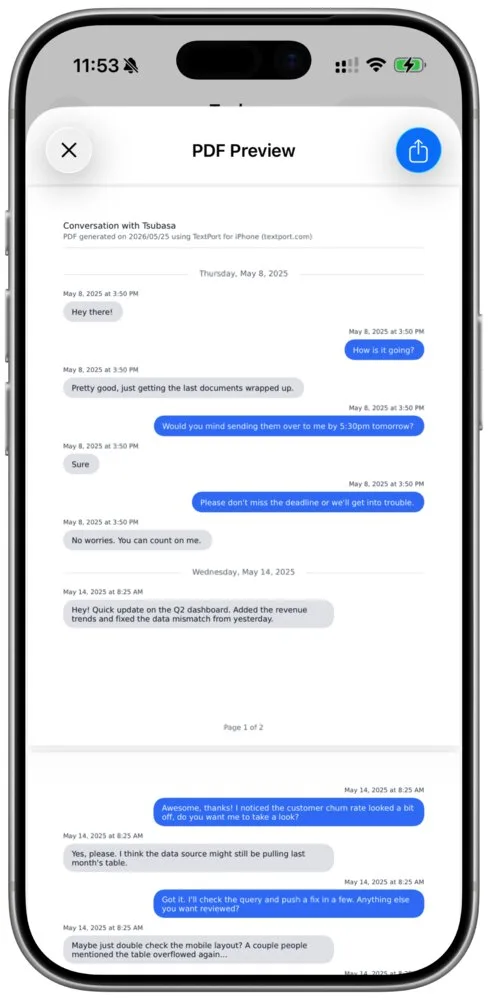
TextPort turns the conversation with the person who owes you into one PDF on your iPhone, with no computer, ready to attach to your demand letter as an exhibit and print for small claims court.
- iMessage and SMS come in through the TextPort Shortcut (iOS 26.4 or later), word for word with each message's date and time, for the date range you pick.
- WhatsApp comes in from WhatsApp's own Export Chat file. Instagram and Messenger chats import from the export Meta sends you, word for word. Signal and other apps come in from screenshots or a screen recording, which TextPort reads, so check the result against your phone before you export.
- The export is a PDF with the sender, date and time above every message and numbered pages, a CSV spreadsheet, or plain text. Photos from iMessage and WhatsApp chats print in the PDF. You can send it as a link instead of an attachment.
Frequently asked questions
-
No. TexasLawHelp says: "You do not need an attorney to write a letter." It adds that a letter signed by an attorney "may also make it more likely that the recipient takes it seriously." In California, the courts' free online program asks you questions about your situation and writes the letter for you.
-
In California, yes. The claim form says: "You must ask the defendant (in person, in writing, or by phone) to pay you before you sue," unless there's a restraining order between you or asking would be dangerous. In New York, only a business filing a commercial claim over a consumer transaction must send one, 10 to 180 days before filing. Court and legal-aid guides in Texas, Florida and Washington recommend one. Some laws, such as Texas's Deceptive Trade Practices Act (60 days) and California's Consumers Legal Remedies Act (30 days), require their own written notice before you sue.
-
TexasLawHelp says at least seven business days would be reasonable, and Washington legal aid says: "A typical deadline for responding to a demand letter is 7 to 10 days." A Los Angeles legal aid guide for security deposits says to wait 7 to 14 days. Bounced-check laws set their own periods: 30 days in California and Florida, 15 days in Washington. Don't let the letter's deadline push you past your deadline to sue.
-
Email works for California small claims: the courts say "You can ask in person, by writing a letter, or emailing the other side." Don't rely on a text alone as your written demand. Send the letter by certified mail with a return receipt (or tracked mail if they might refuse to sign), email a PDF copy, and text them that it's on the way. Some laws, such as California's Consumers Legal Remedies Act, require certified or registered mail.
-
Don't count on it. Florida's statute lists the only reasons the clock pauses, and a demand letter isn't one of them. California's courts warn: "Don't wait if you have a filing deadline that's coming up soon." A few laws set their own rule for their own notice, such as Florida's construction-defect notice, which does pause the clock (though not the outer statute of repose). For an ordinary money claim, file before your deadline even if the letter's deadline hasn't passed.
-
It can if it threatens criminal charges or public exposure to get paid. California's Supreme Court said "The law does not contemplate the use of criminal process as a means of collecting a debt," and that believing the person owes you is no defense to extortion. Florida's law also covers threats to accuse someone of a crime, and California's, Florida's, New York's and Washington's cover threats to expose a secret or something that would disgrace them. Threatening to sue is fine: Texas's debt collection law says it doesn't prevent threatening a civil lawsuit, and California's Supreme Court said pre-lawsuit demands that include threats to sue aren't necessarily extortion.

Start exporting your messages
Available for iPhone, Mac, and Windows. No computer required.